
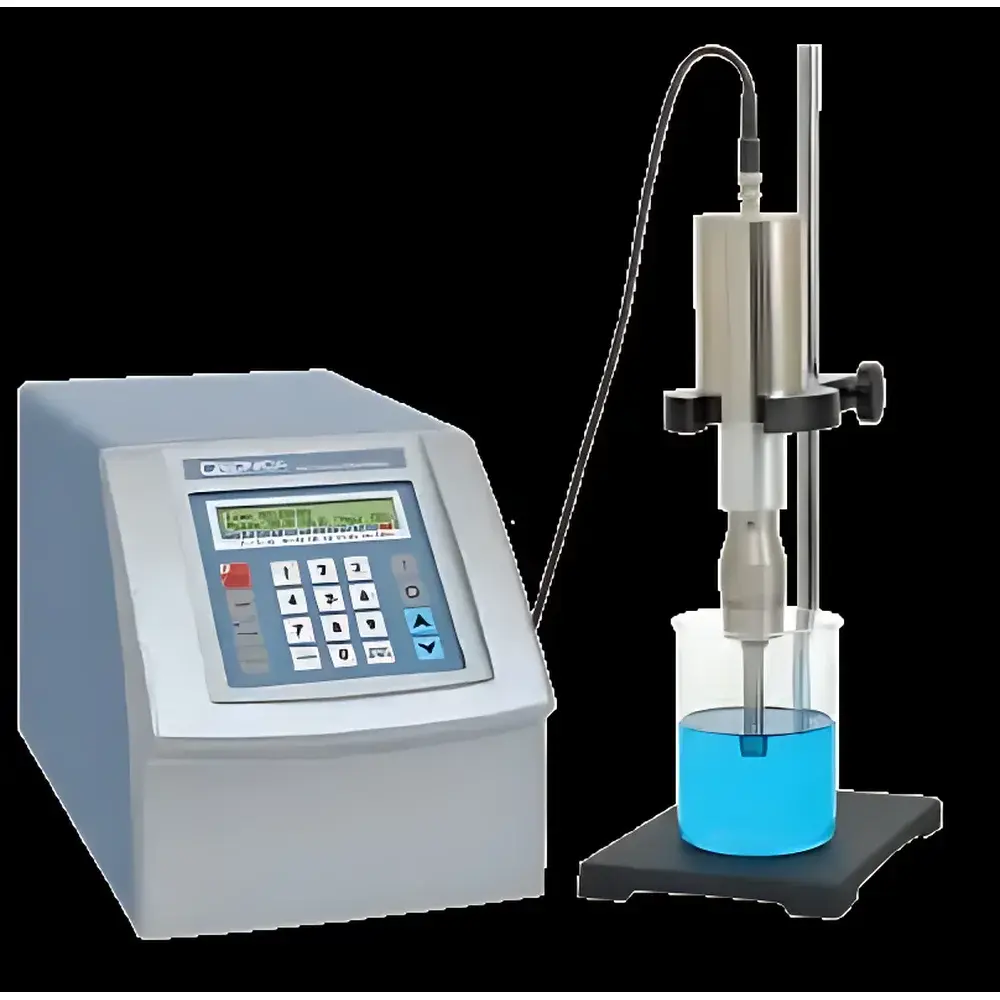
Qsonica Q500 Benchtop Ultrasonic Sonicator
| Brand | Qsonica LLC |
|---|---|
| Origin | USA |
| Manufacturer Type | Authorized Distributor |
| Product Category | Imported Instrument |
| Model | Q500 |
| Instrument Type | Ultrasonic Cell Disruptor |
| Maximum Output Power | 500 W |
| Operating Frequency | 20 kHz |
| Sample Volume Range | 0.1–1000 mL (up to 0.5 L/min with flow cell) |
| Dimensions (W × D × H) | 20.3 × 38.7 × 22 cm |
| Continuous Operation Time | Up to 10 hr |
| Adjustable Pulse Duration | 1 s – 1 min |
| Amplitude Range | 20–100% (120 µm nominal at 1/2″ probe) |
| Display | Digital real-time readout of time, power, and energy |
| Safety | Integrated overload protection |
| Remote Control | Footswitch-compatible |
| Standard Kit | Host unit, transducer, 1/2″ tapered probe (part #4220), wrench set |
Overview
The Qsonica Q500 Benchtop Ultrasonic Sonicator is an engineered solution for reproducible, scalable cell lysis, DNA shearing, nanoparticle dispersion, and emulsification in academic, pharmaceutical, and biomanufacturing laboratories. Based on piezoelectric transduction at a fixed resonant frequency of 20 kHz, the system converts electrical energy into high-intensity mechanical vibrations transmitted through interchangeable titanium alloy probes. These vibrations generate controlled cavitation—formation, growth, and implosive collapse of microbubbles—in liquid media, resulting in localized shear forces sufficient to disrupt membranes, solubilize inclusion bodies, or fragment chromatin without chemical additives. Designed for routine benchtop use, the Q500 delivers up to 500 W of acoustic output power with precise amplitude modulation (20–100%), enabling method transfer from small-volume optimization (e.g., 0.2 mL in microplates) to preparative-scale processing (up to 1 L with flow cell integration). Its compact footprint (20.3 × 38.7 × 22 cm) and 10-hour continuous duty cycle support unattended operation under validated protocols.
Key Features
- Digital amplitude control (20–100%) with real-time feedback—ensures consistent energy delivery across replicates and operators
- Programmable pulse mode (1 s ON / 1 s OFF up to 1 min intervals)—minimizes thermal accumulation in temperature-sensitive samples such as primary cells, enzymes, or RNA complexes
- Integrated digital display showing elapsed time, instantaneous power (W), and cumulative energy (J)—critical for SOP documentation and audit readiness
- Overload protection circuitry automatically halts operation upon impedance mismatch or transducer overheating—preserves probe integrity and ensures user safety
- Footswitch compatibility enables hands-free activation during sterile workflows or multi-step protocols requiring simultaneous manual manipulation
- Modular probe architecture: all standard probes feature tapped (threaded) tips for rapid, tool-free replacement—reducing cross-contamination risk and downtime
Sample Compatibility & Compliance
The Q500 accommodates diverse biological matrices—including bacterial cultures (E. coli, Bacillus), yeast, mammalian suspension cells, tissue homogenates, and viscous lysates—across volumes from 0.1 mL (microcentrifuge tubes) to 1000 mL (beaker or jacketed vessel). Optional accessories extend compliance with regulated environments: the 432MP sound enclosure meets OSHA-recommended noise exposure limits (<85 dBA at 1 m); the 4900 recirculating chiller enables temperature-controlled sonication per USP particulate matter testing or ISO 13485-compliant device cleaning validation. When paired with GLP/GMP-aligned software (e.g., Qsonica’s optional Q-Link™ interface), the instrument supports 21 CFR Part 11-compliant electronic records, including operator ID, timestamped parameter logs, and tamper-evident audit trails.
Software & Data Management
While the Q500 operates autonomously via front-panel controls, it is compatible with Qsonica’s Q-Link™ PC-based software (sold separately) for advanced protocol management and data export. Q-Link™ enables creation and storage of multi-step programs—including ramped amplitude profiles, nested pulse sequences, and interlocked temperature monitoring (when used with external sensors). All session data—including start/stop timestamps, average power, total energy delivered, and fault codes—are exported in CSV format for integration into LIMS or ELN platforms. The system adheres to IEEE 11073-10201 standards for medical device interoperability, facilitating future integration with automated lab infrastructure.
Applications
- Cell disruption for recombinant protein purification (e.g., His-tagged proteins from E. coli inclusion bodies)
- Chromatin immunoprecipitation (ChIP) sample prep—controlled DNA fragmentation to 200–500 bp fragments
- Nanoparticle synthesis and deagglomeration (liposomes, polymeric micelles, metal oxides)
- Preparation of subcellular fractions (mitochondria, nuclei) without detergent-induced artifacts
- PMCA (Protein Misfolding Cyclic Amplification) using the 431MPXH96 microplate horn for prion detection assays
- Homogenization of fibrous tissues (muscle, plant roots) when coupled with cryo-cooled flow cells
FAQ
What is the recommended maintenance schedule for the Q500 transducer and probe?
Inspect probe threads and tip surface before each use; clean with isopropanol and lint-free cloth. Replace titanium probes after ~200 hr of cumulative operation or upon visible pitting or cracking. Transducers require no routine servicing but must be operated within ambient temperatures of 15–30°C and relative humidity <80% non-condensing.
Can the Q500 be validated for GMP manufacturing processes?
Yes—when configured with Q-Link™ software, calibrated probes, and documented IQ/OQ protocols (available from Qsonica Technical Services), the Q500 meets requirements for equipment qualification under Annex 11 and ICH Q5A.
Is the 1/2″ probe (part #4220) suitable for lysing Gram-positive bacteria?
Yes—optimized amplitude settings (70–90%) and pulse ratios (3 s ON / 5 s OFF) achieve >95% lysis efficiency for Staphylococcus aureus and Bacillus subtilis in standard buffers, as verified by colony-forming unit (CFU) reduction assays.
Does the Q500 support external temperature monitoring during sonication?
The base unit lacks built-in temperature sensing, but its analog output port (0–10 V) accepts signals from third-party PT100 or thermistor probes—enabling closed-loop temperature regulation when integrated with programmable chillers.
How does amplitude calibration correlate to actual tip displacement?
Amplitude is linearly mapped to peak-to-peak displacement: 100% = 120 µm for the 1/2″ probe, 60 µm for the 3/4″ probe, and 30 µm for the 1″ probe—values traceable to NIST-traceable laser vibrometer measurements per ASTM E2957-21.



