
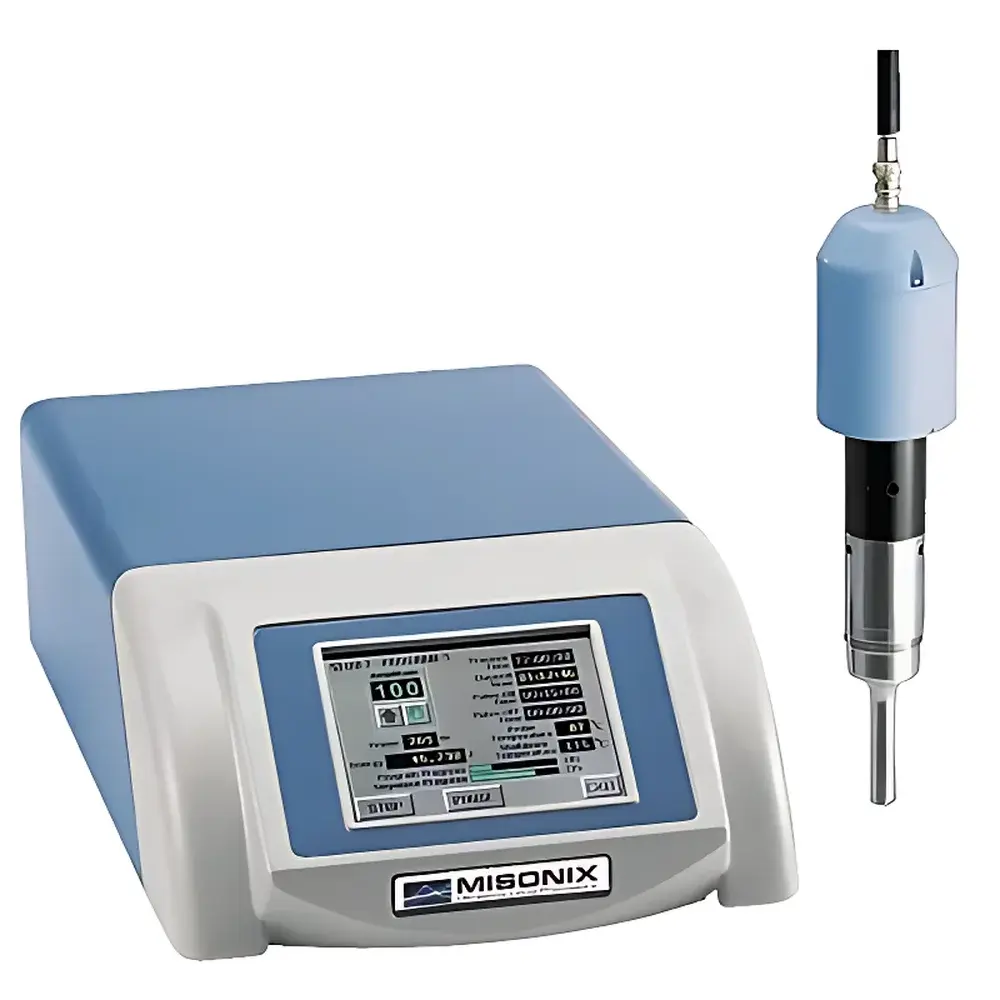
Misonix Sonicator 4000 Ultrasonic Cell Disruptor
| Brand | Misonix |
|---|---|
| Origin | USA |
| Model | Sonicator 4000 |
| Output Power | 600 W |
| Operating Frequency | 20 kHz |
| Sample Volume Range | 0.1–4000 mL |
| Pulse Duration Adjustable | 1 s–24 hr |
| Continuous Operation Capability | 72 hr |
| Dimensions (W × D × H) | 27.9 × 50.8 × 13.9 cm |
| Weight | 12.0 kg |
| Probe Types | Tapped & Stepped, Diameter Range: 1.6–25.4 mm |
| Control Interface | Full Digital Touchscreen |
| Compliance | Designed for GLP/GMP-adjacent workflows, supports audit-ready operation with optional temperature probe (TP4000) |
Overview
The Misonix Sonicator 4000 is a high-performance ultrasonic cell disruptor engineered for precise, reproducible lysis of biological samples across research, biopharmaceutical development, and diagnostic laboratories. Utilizing piezoelectric transduction at a fixed resonant frequency of 20 kHz, the system generates intense cavitation in liquid media—producing localized pressure differentials that mechanically shear cellular membranes, organelles, and inclusion bodies without significant thermal denaturation when operated under controlled pulse conditions. Its digitally regulated amplitude control (0–100% in 0.1% increments) ensures consistent energy delivery regardless of probe geometry or real-time sample thermal load, making it suitable for sensitive applications such as protein extraction, chromatin shearing (ChIP-seq), nanoparticle dispersion, and bacterial endotoxin release studies.
Key Features
- Digital amplitude modulation with closed-loop feedback—maintains setpoint accuracy within ±1% across variable probe configurations and ambient temperatures.
- Full-color capacitive touchscreen interface (7-inch diagonal) with intuitive icon-driven navigation and multilingual UI support (English, Spanish, French, German, Chinese).
- Integrated self-diagnostic suite: real-time monitoring of transducer impedance, duty cycle stability, and thermal load on power electronics; alerts trigger automatic shutdown if thresholds are exceeded.
- Programmable multi-step protocols: up to 99 independent methods stored onboard, each supporting timed amplitude ramps, dual-pulse modes (on/off burst sequencing), and inter-sample cooling intervals.
- Energy output display in real time (Joules delivered) and cumulative energy tracking per run—critical for method transfer and SOP documentation.
- Extended continuous runtime capability (up to 72 hours) with active thermal management: low-noise centrifugal cooling fan + heat-dissipating aluminum chassis design minimizes internal temperature rise during prolonged operation.
- Modular probe architecture: all tapped probes feature standardized 1/2″-27 UNF threading; stepped probes use proprietary acoustic impedance matching for high-intensity micro-volume processing.
Sample Compatibility & Compliance
The Sonicator 4000 accommodates sample volumes from 0.1 mL (using 1.6 mm microtip) to 4 L (with 25.4 mm industrial horn), supporting aqueous buffers, viscous lysates, glycerol-containing formulations, and low-conductivity solvents. Probe compatibility includes standard tapered horns (models 200, 207, 210), microtipped variants (418–420), and optional accessories such as cup horns (non-contact mode) and acoustic enclosures (reducing airborne noise to <65 dBA at 1 m). The system is designed to operate within ISO/IEC 17025-accredited environments and meets electrical safety requirements per UL 61010-1 and IEC 61010-1. While not FDA-cleared as a medical device, its operational parameters align with USP Analytical Instrument Qualification guidelines and support 21 CFR Part 11-compliant data integrity when paired with validated third-party LIMS integration.
Software & Data Management
Onboard firmware enables method export/import via USB flash drive in CSV and XML formats. Optional PC-based Misonix ControlSuite v3.2 provides remote monitoring, automated report generation (PDF/Excel), and electronic signature capture for GxP workflows. Audit trail functionality logs all parameter changes, user logins, and instrument events with timestamp and operator ID—retained for ≥18 months unless manually purged. Firmware updates are distributed through Misonix’s secure customer portal and require cryptographic signature verification prior to installation.
Applications
- Genomic DNA and chromatin fragmentation for next-generation sequencing library preparation.
- Extraction of membrane-bound receptors and insoluble protein aggregates from E. coli, yeast, and mammalian cell lines.
- Homogenization of tissue biopsies and FFPE-derived samples prior to proteomic analysis.
- Dispersion of carbon nanotubes, liposomes, and polymeric nanoparticles in formulation development.
- Endotoxin release quantification from Gram-negative bacteria in vaccine potency testing.
- Preparation of subcellular fractions (mitochondria, nuclei) under chilled conditions using pulsed operation (e.g., 5 s on / 15 s off).
FAQ
Is the Sonicator 4000 compatible with temperature-controlled sample chambers?
Yes—when used with the optional TP4000 temperature probe and external recirculating chiller (e.g., Thermo Fisher Polyscience 4500 series), the system can maintain sample temperature between 0–40°C during sonication.
Can multiple probes be calibrated independently within one instrument?
Each probe type has a unique acoustic loading profile; calibration is performed at the factory and stored in non-volatile memory per probe serial number—no field recalibration is required.
Does the system support validation documentation packages?
Misonix provides IQ/OQ protocol templates compliant with ASTM E2500 and ISO 13485; PQ execution must be conducted by the end user under site-specific conditions.
What is the expected lifetime of the converter under normal usage?
Rated for ≥10,000 hours of cumulative operation when maintained per manufacturer guidelines (including periodic torque verification of probe-to-converter coupling).
Are consumables such as probe tips covered under warranty?
Tapered probe tips are considered wear items and excluded from standard warranty coverage; stepped probes carry a separate 12-month limited warranty against material defects.




