
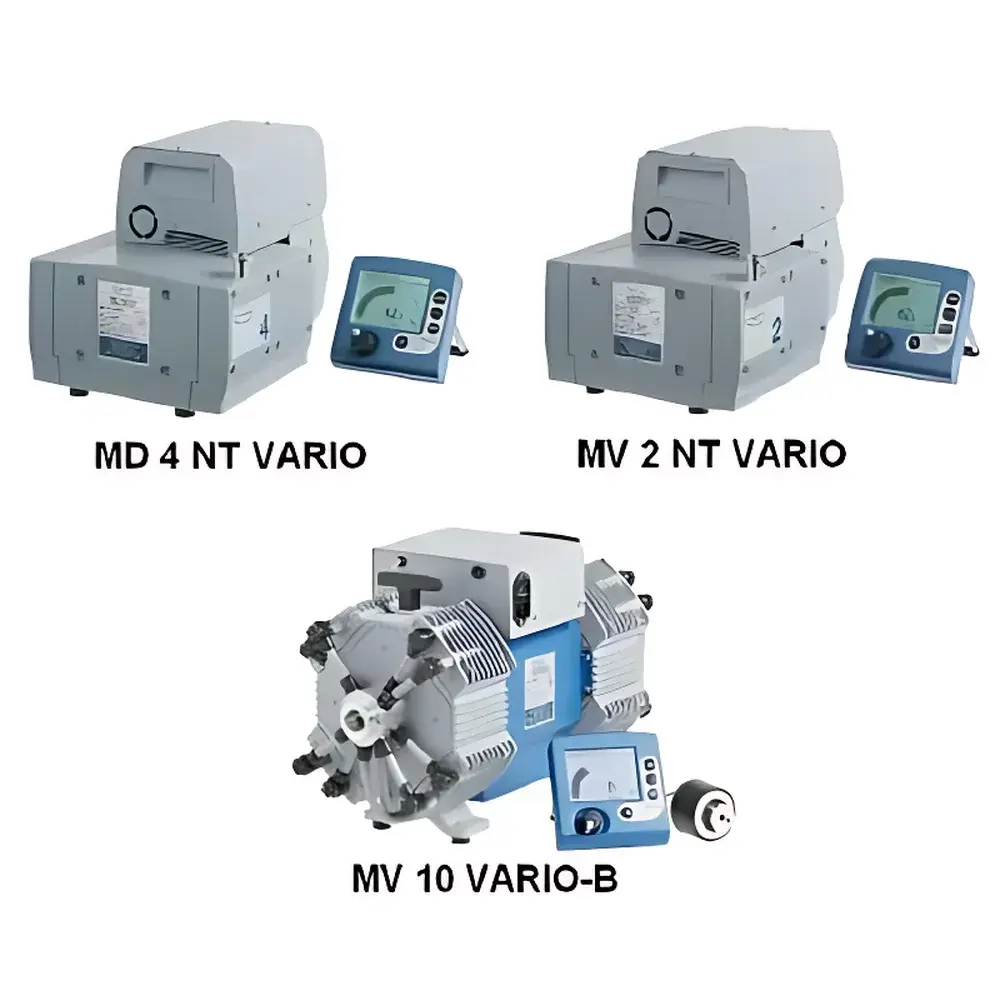
Vacuubrand MD 4 NT VARIO, MV 2 NT VARIO & MV 10 VARIO-B Variable-Speed Diaphragm Vacuum Pumps with Integrated CVC 3000 Electronic Vacuum Controller
| Brand | VACUUBRAND® |
|---|---|
| Origin | Germany |
| Pump Stages | 3 (MD 4 NT VARIO) / 4 (MV 2 NT VARIO, MV 10 VARIO-B) |
| Max. Flow Rate (50/60 Hz) | 5.7 m³/h (MD 4 NT VARIO) / 3.3 m³/h (MV 2 NT VARIO) / 10.4 m³/h (MV 10 VARIO-B) |
| Ultimate Vacuum (abs.) | 13 mbar (MD 4 NT VARIO) / 0.3 mbar (MV 2 NT VARIO) / 0.3 mbar (MV 10 VARIO-B) |
| Dimensions (L×W×H) | 325×235×245 mm (MD 4 NT VARIO, MV 2 NT VARIO) / 486×222×303 mm (MV 10 VARIO-B) |
| Weight | 18.6 kg (MD 4 NT VARIO) / 18.9 kg (MV 2 NT VARIO) / 25.0 kg (MV 10 VARIO-B) |
Overview
The Vacuubrand MD 4 NT VARIO, MV 2 NT VARIO, and MV 10 VARIO-B are high-performance, oil-free variable-speed diaphragm vacuum pumps engineered for precision vacuum control in demanding laboratory environments. Each model integrates the CVC 3000 electronic vacuum controller as a fully embedded system—enabling real-time, closed-loop regulation of vacuum level across a wide operational range. These pumps operate on the principle of positive displacement via PTFE-coated, multi-layer elastomeric diaphragms driven by brushless DC motors. The variable-frequency drive allows continuous speed modulation from 0–100% of nominal RPM, delivering stable vacuum setpoints without mechanical throttling or bypass valves. Designed and manufactured in Germany to ISO 9001-certified production standards, the series meets stringent requirements for chemical resistance, low vibration, and long-term reliability in applications where hydrocarbon contamination or oil backstreaming must be eliminated—including analytical sample preparation, rotary evaporation, vacuum filtration, freeze drying, and inert atmosphere glove box purging.
Key Features
- Integrated CVC 3000 electronic controller with digital vacuum sensor (capacitance manometer), programmable setpoint memory (up to 10 presets), and RS-485 interface for remote monitoring and automation
- Oil-free, chemically resistant construction: stainless steel pump heads, PTFE/NBR diaphragms, and EPDM seals ensure compatibility with aggressive solvents (e.g., acetone, chloroform, ethyl acetate) and acidic vapors
- Three-stage (MD 4 NT VARIO) and four-stage (MV 2 NT VARIO, MV 10 VARIO-B) configurations optimized for differential vacuum requirements—higher stage count enables lower ultimate pressure and improved pumping efficiency at low absolute pressures
- Brushless DC motor with intelligent thermal management: automatic speed reduction under elevated ambient temperature or prolonged duty cycles to maintain diaphragm integrity and service life
- Low noise emission (≤48 dB(A) at 1 m) and minimal mechanical vibration (<0.5 µm RMS), critical for sensitive instrumentation such as mass spectrometers or surface analysis tools located in proximity
- Compliance with CE, UL/CSA 61010-1, and RoHS directives; all models rated for continuous operation at 40 °C ambient per IEC 60034-1
Sample Compatibility & Compliance
These pumps are validated for use with aqueous, organic, and mildly corrosive vapor streams encountered in routine laboratory workflows. The CVC 3000 controller supports pressure control accuracy of ±1% of reading (full scale) within its calibrated range (1–1000 mbar abs.), enabling reproducible process conditions required for GLP-compliant evaporation protocols or USP sterile compounding vacuum steps. While not intrinsically safe for Class I, Division 1 hazardous locations, optional ATEX-certified versions (MD 4 NT VARIO-EX, etc.) are available for solvent-rich environments. All units ship with documentation traceable to DIN EN ISO/IEC 17025-accredited calibration labs and include factory verification reports conforming to ASTM D2873 (vacuum pump performance testing).
Software & Data Management
The CVC 3000 controller provides native Modbus RTU and ASCII protocol support over RS-485, allowing seamless integration into LabVantage, Thermo Fisher SampleManager, or custom SCADA architectures. Optional Vacuubrand PC software (VC-Control Suite v3.2) enables logging of vacuum profiles, event-triggered alarms (e.g., pressure deviation >±5 mbar for >30 s), and export of timestamped CSV datasets compliant with FDA 21 CFR Part 11 requirements—including electronic signatures, audit trails, and user access levels (Operator, Supervisor, Administrator). Raw sensor data is stored onboard for ≥72 hours during network interruption, ensuring data continuity for QA/QC audits.
Applications
- Routine vacuum distillation and rotary evaporation with programmable ramp-hold sequences to prevent bumping or foaming
- High-throughput solid-phase extraction (SPE) manifold control, maintaining consistent flow rates across 24+ channels
- Pre-concentration of environmental water samples prior to GC-MS analysis, minimizing analyte loss via controlled vacuum decay
- Vacuum-assisted degassing of polymer resins and composite precursors in materials science labs
- Backing pumps for turbomolecular or diffusion vacuum systems requiring clean, pulse-free foreline pressure
- Glove box regeneration cycles with automated pressure stabilization between atmospheric and ≤1 mbar
FAQ
What vacuum level accuracy does the CVC 3000 controller provide?
The CVC 3000 delivers pressure control stability of ±1% of reading (full scale) between 1–1000 mbar abs., verified annually per ISO 6344-2.
Can these pumps handle condensable vapors from solvent evaporation?
Yes—integrated gas ballast and optional cold trap compatibility mitigate condensate ingress; however, continuous exposure to >10% saturated vapor load requires periodic diaphragm inspection per maintenance schedule.
Is firmware update capability supported remotely?
Firmware updates are performed via USB-to-RS485 adapter using VC-Control Suite; no internet connectivity or cloud dependency is required, preserving air-gapped lab security policies.
Do the pumps meet GMP documentation requirements for pharmaceutical labs?
Each unit ships with a Certificate of Conformance, Factory Calibration Report, and IQ/OQ templates aligned with Annex 15 and EU GMP guidelines—validated for use in Category B cleanroom support utilities.
What is the expected service interval for diaphragms under typical lab usage?
Under standard operating conditions (≤6 h/day, ambient ≤30 °C, non-corrosive loads), diaphragm replacement is recommended every 12–18 months, with wear tracking enabled via CVC 3000’s internal runtime counter and motor current diagnostics.



