
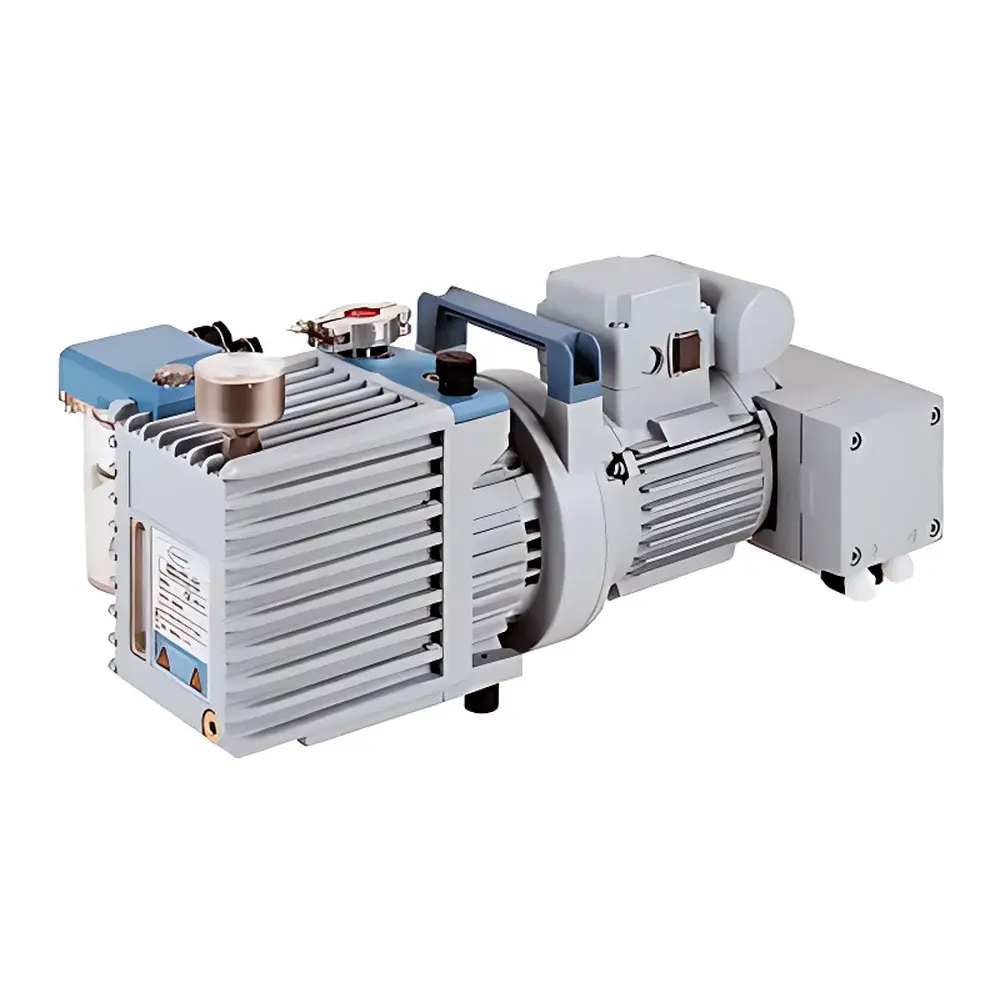
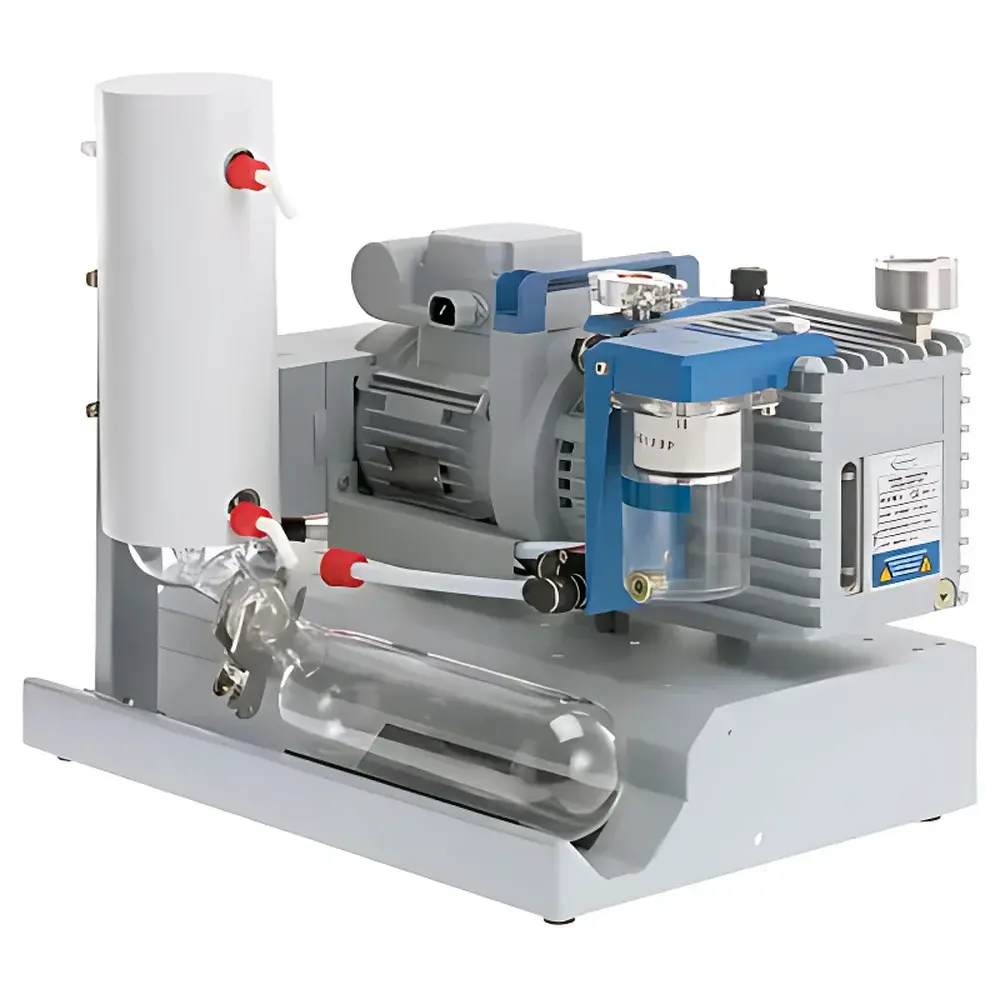
VACUUBRAND RC 6 Hybrid Chemical Vacuum Pump
| Brand | VACUUBRAND® |
|---|---|
| Origin | Germany |
| Pump Type | Two-Stage Rotary Vane + Two-Stage Chemical-Resistant Diaphragm Hybrid Pump |
| Model | RC 6 |
| Max. Pumping Speed (50/60 Hz) | 5.9 / 6.9 m³/h |
| Ultimate Pressure (Absolute) | 4 × 10⁻⁴ mbar (partial pressure), 2 × 10⁻³ mbar (base vacuum), 1 × 10⁻² mbar (with gas ballast) |
| Water Vapor Tolerance | >40 mbar |
| Oil Capacity (Type B) | 0.34–0.53 L |
| Inlet Port | KF DN 16 |
| Outlet Port | DN 10 mm hose barb |
| Motor Power | 0.375 kW |
| Rated Speed (50/60 Hz) | 1500 / 1800 rpm |
| IP Rating | IP 40 |
| Dimensions (L×W×H) | 510 × 305 × 230 mm |
| Weight | 24.2 kg |
Overview
The VACUUBRAND RC 6 Hybrid Chemical Vacuum Pump is an engineered solution for laboratories handling aggressive, condensable, or oxidizing vapors—particularly in organic synthesis, solvent distillation, rotary evaporation, and chemical reaction monitoring. Unlike conventional oil-sealed rotary vane pumps, the RC 6 integrates two independent pumping stages in a single compact chassis: a two-stage rotary vane pump for high-speed rough vacuum generation and a two-stage chemically resistant diaphragm pump dedicated to maintaining ultra-low partial pressure within the oil sump. This hybrid architecture prevents solvent vapors from reaching the rotary vane oil chamber, thereby suppressing condensation, minimizing oil degradation, and extending service intervals. The system operates on the principle of staged pressure reduction—where the diaphragm stage continuously evacuates the oil reservoir to keep its internal vapor pressure below the dew point of common solvents (e.g., acetone, THF, dichloromethane, ethanol), effectively decoupling vapor load from the lubricated stage. As a result, the RC 6 delivers stable base vacuum performance while significantly reducing operational risk in corrosive environments.
Key Features
- Hybrid dual-pump architecture: Independent two-stage rotary vane + two-stage PTFE-diaphragm configuration for simultaneous high-throughput evacuation and vapor management
- Chemical resistance engineered at critical interfaces: Diaphragm pump housing, valves, and seals constructed from fluoropolymer-composite materials compliant with DIN ISO 2859-1 sampling standards for chemical exposure
- Gas ballast functionality integrated into the rotary vane stage for controlled admission of dry air, enabling continuous operation under high water vapor loads (>40 mbar)
- “Telescope-style” modular design facilitates rapid field maintenance—oil changes, diaphragm replacement, and filter servicing require no specialized tools or alignment procedures
- Reduced oil consumption: Up to 90% lower than standalone rotary vane pumps operating under identical solvent-laden conditions, verified per ASTM D2889-18 lubricant stability testing protocols
- Low acoustic emission: <52 dB(A) at 1 m distance, suitable for shared laboratory environments requiring compliance with ISO 7779 noise assessment criteria
Sample Compatibility & Compliance
The RC 6 is validated for continuous duty with halogenated hydrocarbons (e.g., CH₂Cl₂, CHCl₃), ketones, esters, alcohols, and low-molecular-weight organic acids. It is not recommended for use with strong oxidizers (e.g., nitric acid fumes, chlorine gas) or unsaturated monomers prone to polymerization in vacuum lines. All wetted components meet USP Class VI biocompatibility requirements for non-implantable devices. The pump conforms to IEC 61000-6-3 (EMC emissions) and IEC 61000-6-2 (immunity), and its electrical safety design complies with EN 61010-1:2019 for laboratory equipment. When operated with optional PC 8 cold trap assembly, the combined RC 6/PC 8 system satisfies EPA Method 25A requirements for solvent recovery efficiency in emission-controlled labs.
Software & Data Management
While the RC 6 operates as a stand-alone analog device, it supports digital integration via optional VACUUBRAND VACUU·VIEW™ interface module (sold separately). This module enables real-time monitoring of motor current draw, inlet pressure (via external Pirani gauge), and runtime hours—data logged in CSV format with timestamped entries traceable to GLP/GMP audit trails. The system supports 21 CFR Part 11–compliant user access control when deployed with VACUU·VIEW™ Server Edition and networked authentication infrastructure. No proprietary drivers are required; communication uses standard Modbus RTU over RS-485.
Applications
- Routine rotary evaporation of acid-sensitive or moisture-reactive compounds
- Vacuum drying of hygroscopic pharmaceutical intermediates under inert atmosphere
- Short-path distillation of thermally labile natural product extracts
- In-line vacuum degassing prior to HPLC mobile phase preparation
- Controlled vacuum aspiration in glovebox antechambers handling air-sensitive catalysts
- Process-scale solvent recovery in pilot plant chemistry workflows
FAQ
Can the RC 6 be used without the diaphragm pump stage?
No—the diaphragm stage is mechanically and functionally integrated; disabling it compromises vapor protection and voids warranty.
Is oil change frequency reduced only for solvent-laden applications?
Yes. Under dry-air or nitrogen purge conditions, oil life aligns with standard rotary vane pump recommendations (per VACUUBRAND Technical Bulletin TB-RC6-03).
What vacuum level is achievable when using the PC 8 cold trap?
With PC 8 installed at the exhaust, base pressure improves to ≤5 × 10⁻⁴ mbar (absolute) due to enhanced condensate removal and reduced backstreaming.
Does the RC 6 require external cooling water?
No—it is air-cooled only; ambient temperature must remain between 15–35 °C for rated performance.
Can the RC 6 be mounted vertically?
No. It must be operated horizontally on a stable, vibration-damped surface to ensure proper oil distribution and diaphragm actuation geometry.



