
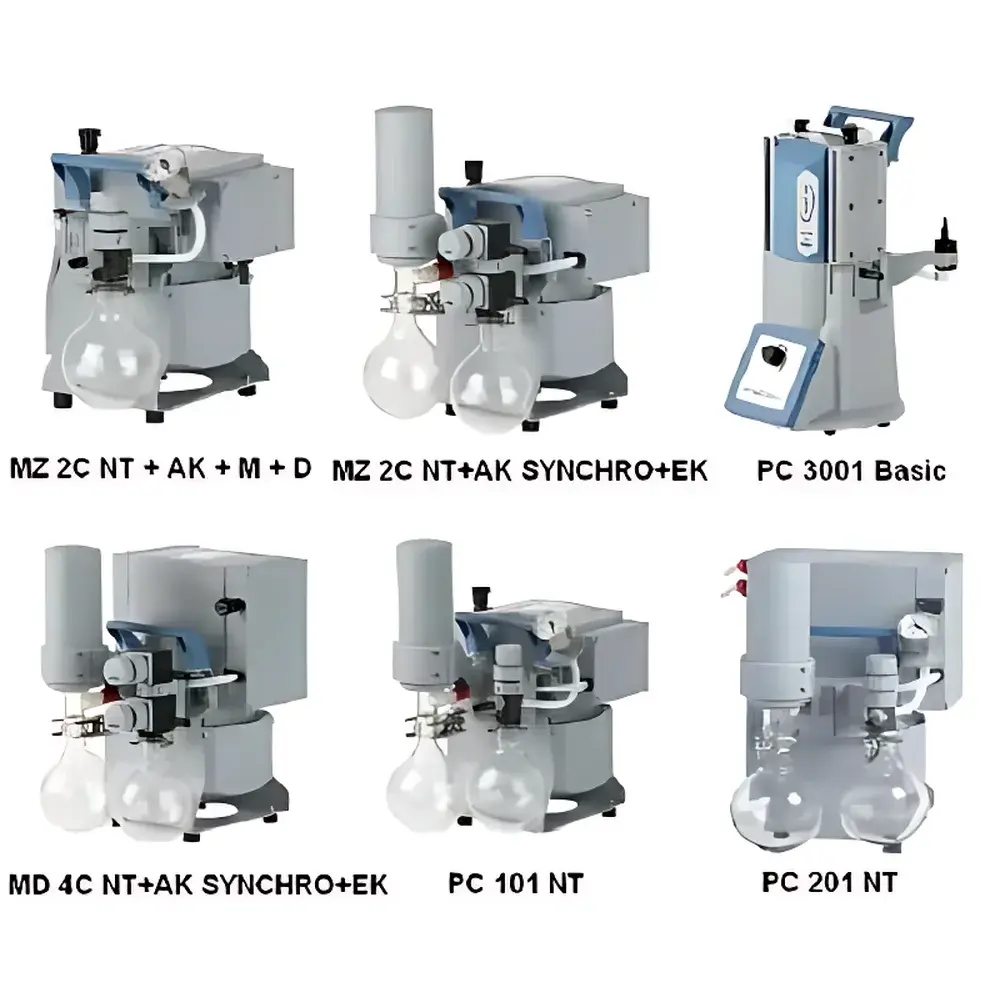
Vacuubrand Chemical Vacuum System with Manual Flow Control
| Brand | VACUUBRAND® |
|---|---|
| Origin | Germany |
| Pump Type | Chemically Resistant Diaphragm Vacuum Pump |
| Models | MZ2CNT+AK+M+D |
| Max. Pumping Speed (50/60 Hz) | 1.3–3.8 m³/h |
| Ultimate Vacuum (abs.) | 1.5–7 mbar |
| Ultimate Vacuum (abs., with gas ballast) | 2–12 mbar |
| Dimensions (L×W×H) | 251×256×400 mm to 326×248×402 mm |
| Weight | 6.4–17.6 kg |
| Gas Ballast Valve | Standard on all models |
| Inlet Protection | AK gas separation bottle (standard or optional) |
| Exhaust Protection | EK solvent trap (standard or optional) |
| Flow Control | Manual rotary valve (D-type) or synchro dual-inlet valve (SYNCHRO) |
| Pressure Monitoring | Integrated Bourdon tube gauge (M-type) |
| Compliance | CE, RoHS, ISO 9001 certified manufacturing |
Overview
The Vacuubrand Chemical Vacuum System with Manual Flow Control is a modular, chemically inert vacuum solution engineered for reproducible, low-maintenance operation in demanding laboratory environments. Built around Vacuubrand’s proprietary oil-free diaphragm pump technology—specifically the MZ2C NT, MD4C NT, and MD1C VARIO-SP series—this system eliminates hydrocarbon contamination while maintaining high chemical resistance across aggressive vapors including halogenated solvents, acids, and bases. The core principle relies on positive displacement via PTFE-coated diaphragms and chemically stable elastomers (e.g., EPDM or FKM), ensuring long-term integrity under continuous exposure. Unlike rotary vane pumps requiring oil changes and frequent maintenance, these systems operate without lubricants, reducing downtime and eliminating risk of backstreaming. Each configuration integrates passive protection components—including inlet AK gas separation bottles and exhaust EK solvent recovery traps—to prevent condensate ingress and extend pump service life. Designed for use in fume hoods or benchtop installations, the system supports stable vacuum generation from atmospheric pressure down to ≤1.5 mbar (abs.), with gas ballast functionality enabling safe handling of condensable vapors.
Key Features
- Chemically resistant construction: All wetted parts—including diaphragms, valves, and housings—are fabricated from PTFE, FKM, EPDM, and stainless steel to withstand corrosive vapors and solvents.
- Modular architecture: Systems are pre-assembled and tested as integrated units (e.g., MZ2CNT+AK+M+D), minimizing field commissioning time and ensuring leak-tight performance.
- Manual flow regulation: Precision rotary flow control valves (D-type) enable fine-tuned adjustment of suction rate without altering pump speed—critical for gentle evaporation, fractional distillation, or vacuum filtration where process stability is paramount.
- Dual-inlet capability (SYNCHRO models): MZ2CNT+AK SYNCHRO+EK and MD4CNT+AK SYNCHRO+EK support two independent vacuum applications simultaneously, each with dedicated manual flow control and shared AK/EK protection.
- Integrated pressure monitoring: Bourdon tube gauges (M-type) provide direct, analog readout of absolute pressure at the inlet—no external transducers or calibration required.
- Passive vapor management: Standard AK gas separation bottles separate entrained liquid droplets and aerosols upstream; EK solvent traps condense and retain volatile organics downstream, protecting both pump internals and laboratory air quality.
Sample Compatibility & Compliance
These systems are validated for continuous duty with common laboratory solvents (acetone, methanol, dichloromethane, ethyl acetate), acidic gases (HCl, HNO₃ vapors), and basic vapors (ammonia). They comply with IEC 61000-6-3 (EMC), EN 61000-6-2 (immunity), and carry CE marking per EU Machinery Directive 2006/42/EC. All models meet RoHS 2011/65/EU restrictions on hazardous substances. While not intrinsically safe for Zone 1/2 explosive atmospheres, they are routinely deployed in GLP-compliant QC labs and GMP-aligned pharmaceutical R&D settings where traceability and operational consistency are documented per internal SOPs. No FDA 21 CFR Part 11 requirements apply to standalone vacuum systems, though data logging (via optional CVC 3000 controller) supports audit-ready pressure/time records when integrated into controlled processes.
Software & Data Management
The base configurations operate without software—relying entirely on mechanical controls and analog instrumentation for robustness and fail-safe operation. However, the PC3001 Basic model offers upgrade paths: the CVC 3000 vacuum controller (option 1) provides digital pressure setpoint control, real-time logging (CSV export), and programmable ramp profiles—enabling integration into automated workflows. All logged data include timestamps, pressure values, and operational status flags, supporting 21 CFR Part 11-compliant electronic records when deployed with validated IT infrastructure. Firmware updates for the CVC 3000 are distributed via Vacuubrand’s secure customer portal and require authenticated access.
Applications
- Routine solvent removal in rotary evaporation and cold trap setups
- Vacuum filtration of acid- or base-sensitive precipitates
- Distillation under reduced pressure for heat-labile compounds
- Lyophilization pre-vacuum stages and chamber evacuation
- Gas sampling and headspace analysis preparation
- Thin-film deposition and vacuum drying of polymer films
- Controlled atmosphere glovebox purging and maintenance
FAQ
What materials are used in the diaphragm and valve assemblies?
All diaphragms are multi-layer PTFE-reinforced composites; check valves utilize FKM or EPDM elastomers depending on model and chemical exposure profile.
Can these systems handle water vapor continuously?
Yes—gas ballast operation allows sustained pumping of saturated air or aqueous vapor streams; however, prolonged exposure to >80% RH may reduce service interval between membrane replacements.
Is the AK gas separation bottle sufficient for highly volatile solvents like diethyl ether?
The AK bottle provides primary aerosol separation; for full protection with low-boiling solvents, pairing with an EK solvent trap (standard on SYNCHRO and PC-series models) is strongly recommended.
What is the typical service life of the diaphragm under normal lab use?
Under continuous operation with non-aggressive media, diaphragms typically last 6,000–8,000 hours; service intervals are extended by consistent use of AK/EK protection and gas ballast.
Are spare parts and technical documentation available globally?
Yes—Vacuubrand maintains authorized distributor networks in over 80 countries; OEM replacement kits, exploded diagrams, and CE declarations are accessible via the Vacuubrand Technical Portal using registered account credentials.



