
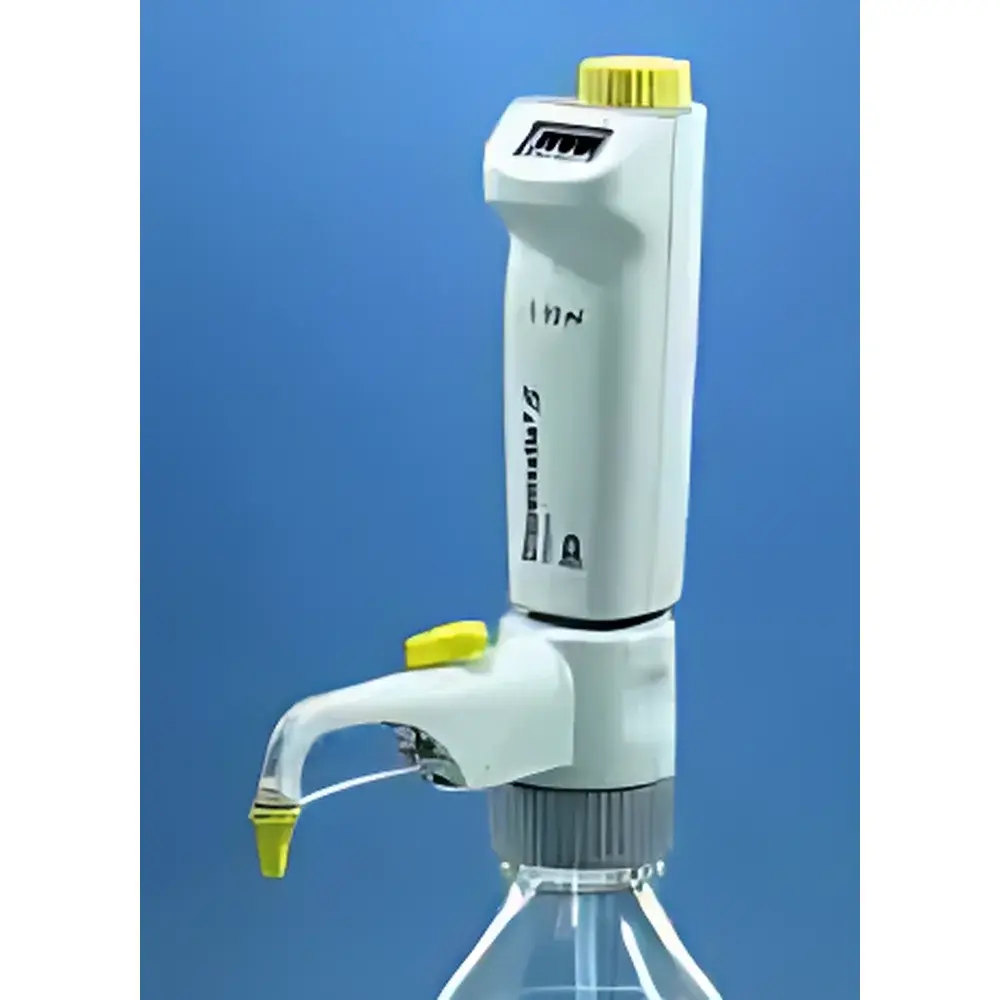
Dispensette® S Organic Bottle Top Dispenser
| Brand | BRAND |
|---|---|
| Origin | Germany |
| Distributor Type | General Distributor |
| Import Status | Imported |
| Model Type | Digital Adjustable |
| Instrument Category | Manual Bottle Top Dispenser |
| Operating Limits | Max. vapor pressure 500 mbar |
| Wetted Materials | Borosilicate glass, aluminum oxide ceramic, tantalum, ETFE, FEP, PFA, PTFE, PP |
Overview
The Dispensette® S Organic is a precision-engineered manual bottle top dispenser designed specifically for the safe, accurate, and repeatable dispensing of aggressive organic solvents, strong mineral acids (excluding hydrofluoric acid), and highly reactive reagents including trifluoroacetic acid (TFA), tetrahydrofuran (THF), peroxides, chlorinated hydrocarbons (e.g., dichloromethane, trichlorotrifluoroethane), and fluorinated compounds. Its measurement principle relies on positive displacement via a chemically inert piston-cylinder system, ensuring volumetric accuracy independent of liquid density, vapor pressure, or surface tension—critical for non-aqueous and volatile media where air-displacement pipettes fail. Engineered to meet stringent laboratory safety and traceability requirements, the Dispensette® S Organic complies with ISO 8655-3 for piston-operated dispensers and supports GLP/GMP workflows through consistent volume delivery and mechanical stability across repeated cycles.
Key Features
- Chemically resistant wetted materials: borosilicate glass barrel, aluminum oxide ceramic piston seal, tantalum spring, and fluoropolymer components (ETFE, FEP, PFA, PTFE) — validated for compatibility with concentrated HCl, HNO₃, TFA, THF, and peroxide solutions
- Digital adjustable volume setting with tactile feedback and lockable mechanism; resolution down to 0.01 mL across the full range (1–100 mL, depending on model)
- Integrated safety reflux valve (optional) prevents backflow contamination and over-pressurization during dispensing of volatile solvents
- Redesigned fluid path geometry reduces flow resistance, enabling faster aspiration and smoother, lower-effort dispensing—even at maximum volume settings
- Patented toothed rail volume adjustment system ensures high reproducibility (< ±0.5% CV) between users and over time, eliminating drift associated with traditional vernier scales
- Operating envelope certified for liquids up to 2.2 g/cm³ density, 500 mm²/s kinematic viscosity, 40 °C temperature, and 500 mbar vapor pressure — exceeding standard organic solvent handling thresholds
Sample Compatibility & Compliance
The Dispensette® S Organic is validated for use with Class I–III organic solvents per GHS hazard classification, including halogenated hydrocarbons, ethers, carboxylic acids, and oxidizers. It conforms to DIN EN ISO 8655-3:2022 for calibration and performance testing of piston-type dispensers. All wetted parts are extractables-free per USP , and device construction meets RoHS Directive 2011/65/EU and REACH Annex XIV restrictions. For regulated environments, its mechanical design supports audit-ready documentation: no software or electronic components eliminate 21 CFR Part 11 validation burden, while consistent mechanical repeatability facilitates IQ/OQ protocols under ISO/IEC 17025-accredited quality systems.
Software & Data Management
This is a fully mechanical, non-electronic instrument; therefore, it requires no firmware, drivers, or data logging software. Volume settings are manually indexed and physically locked—eliminating configuration drift, cybersecurity vulnerabilities, or dependency on proprietary platforms. Calibration certificates (traceable to PTB or NIST standards) are provided with each unit and may be archived alongside lab notebooks or LIMS entries as static QC records. Users maintain full control over calibration frequency and verification intervals in accordance with internal SOPs or ISO/IEC 17025 clause 6.4.10.
Applications
- Precise preparation of HPLC and GC mobile phases containing acetonitrile, methanol, THF, or chloroform
- Reagent addition in synthetic organic chemistry workflows involving anhydrous conditions or moisture-sensitive reagents
- Standardized acid digestion protocols requiring reproducible delivery of concentrated HCl or HNO₃
- Formulation of peroxide-based cleaning solutions under controlled ventilation
- Quality control sampling in pharmaceutical excipient manufacturing where solvent residue limits apply
- Calibration solution preparation for ICP-MS and AAS where trace metal contamination must be minimized (leveraging tantalum and glass wetted path)
FAQ
Is the Dispensette® S Organic compatible with hydrofluoric acid (HF)?
No. HF attacks both borosilicate glass and aluminum oxide ceramic components. Use only HF-compatible dispensers with sapphire or fused silica wetted parts.
Can this dispenser be autoclaved?
No. Maximum operating temperature is 40 °C; thermal sterilization will degrade fluoropolymer seals and compromise dimensional stability.
What is the recommended recalibration interval?
Annual calibration is advised for routine QC use; however, laboratories operating under ISO/IEC 17025 or GMP should establish interval based on usage frequency, risk assessment, and historical performance data.
Does the digital adjustment require batteries or electronics?
No. The digital scale is purely mechanical—volume is set via physical rotation of a calibrated drum with engraved numeric readout and locking collar.
How does it differ from the Dispensette® S Trace?
The S Trace uses quartz glass and sapphire components for ultra-trace metal analysis; the S Organic prioritizes broad chemical resistance over sub-ppt metal purity, using tantalum and optimized fluoropolymers instead.
Related Products



