
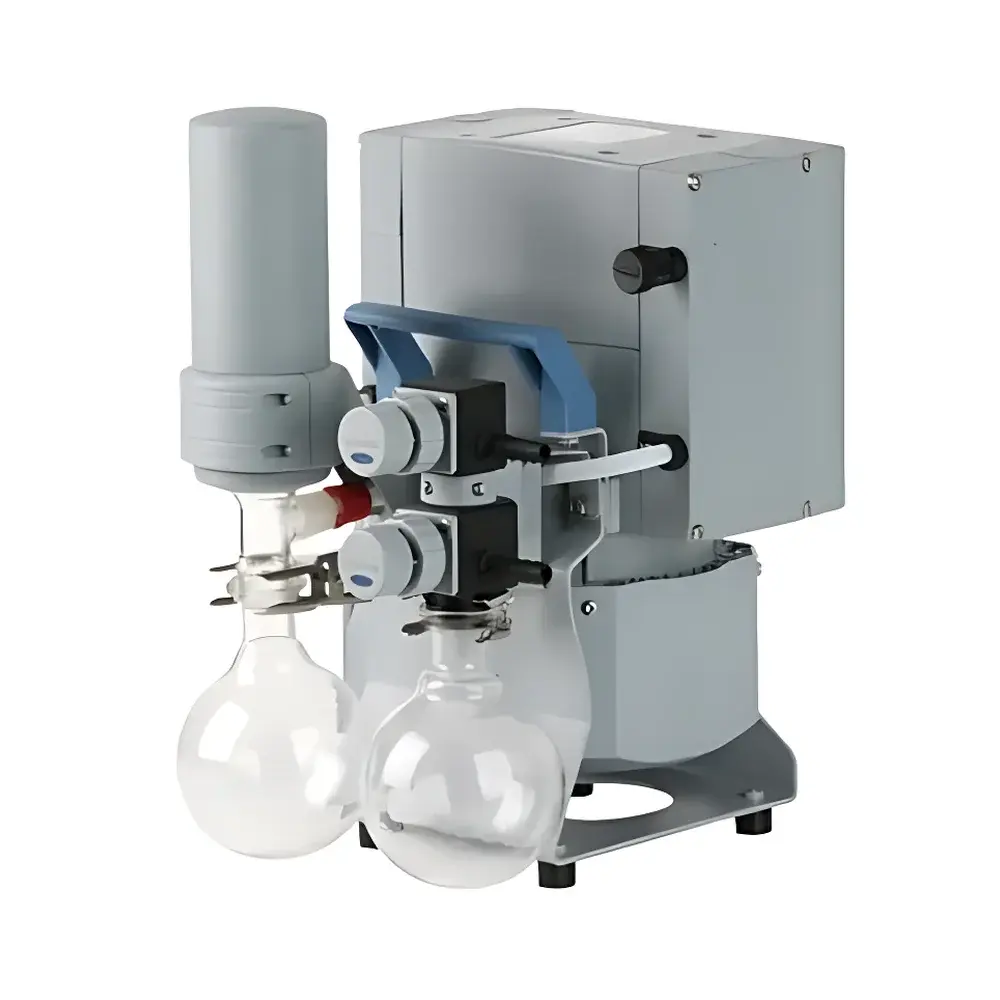
VACUUBRAND MD 4C NT + AK SYNCHRO + EK Chemical Vacuum System
| Brand | VACUUBRAND® |
|---|---|
| Origin | Germany |
| Model | MD 4C NT + AK SYNCHRO + EK |
| Pump Stages | 4 / 3 |
| Max. Pumping Speed (50/60 Hz) | 3.4 / 3.8 m³/h |
| Max. Pumping Speed (50/60 Hz) | 2.0 / 2.2 cfm |
| Ultimate Vacuum (abs.) | 1.5 / 1.1 mbar |
| Ultimate Vacuum with Gas Ballast | 3 / 2.2 mbar |
| Operating Temp. Range | 10–40 °C |
| Storage Temp. Range | −10–60 °C |
| Max. Exhaust Pressure (abs.) | 1.1 bar |
| Inlet Ports | 2 × DN 10 mm hose nozzle |
| Exhaust Port | DN 10 mm hose nozzle |
| Cooling Water Connections | 2 × DN 6–8 mm |
| Rated Motor Power | 0.25 kW |
| Rated Speed (50/60 Hz) | 1500 / 1800 min⁻¹ |
| IP Rating | IP 40 |
| Dimensions (L×W×H) | 326 × 248 × 402 mm |
| Weight | 17.6 kg |
| Sound Pressure Level (50 Hz, typical) | 45 dBA |
| Certifications | NRTL (US/Canada), ATEX II 3G IIC T3 X (230 V only) |
Overview
The VACUUBRAND MD 4C NT + AK SYNCHRO + EK is a fully integrated, chemically resistant oil-sealed rotary vane vacuum system engineered for demanding laboratory applications requiring simultaneous dual-vacuum control and high solvent recovery efficiency. Based on the proven 4-stage, 3-stage compression architecture of the MD 4C NT pump, this system incorporates two critical accessories: the AK glass inlet separator with protective polymer coating and the EK compact exhaust condenser — both designed to maximize process safety, chemical compatibility, and environmental compliance. The system operates on the principle of positive displacement via rotating vanes within an oil-lubricated chamber, enabling stable vacuum generation across a wide operating range (1.5 mbar ultimate vacuum without gas ballast; 3 mbar with gas ballast). Its dual-inlet configuration—each equipped with independent manual flow control valves—allows concurrent, isolated operation of two vacuum-dependent instruments (e.g., a rotary evaporator and a vacuum concentrator) without cross-contamination or pressure coupling. This architecture eliminates the need for external solenoid manifolds or secondary vacuum controllers, reducing footprint, maintenance points, and failure modes.
Key Features
- Chemical resistance optimized via fluorocarbon-treated internal surfaces and FKM elastomers throughout the vacuum path, ensuring long-term stability when handling aggressive vapors (e.g., chlorinated solvents, acetic acid, THF)
- Dual independent inlet ports with calibrated manual needle valves for precise, repeatable flow regulation—critical for method transfer and GLP-compliant workflows
- AK inlet separator: borosilicate glass vessel with shatter-resistant polymer sleeve, rated for particulate and aerosol capture upstream of the pump head; prevents oil contamination and extends service intervals
- EK exhaust condenser: compact, vertically oriented, water-cooled unit achieving >95% solvent condensation efficiency under standard lab conditions (20 °C coolant, 25 °C ambient); enables near-quantitative recovery of low-boiling solvents such as acetone, ethyl acetate, and dichloromethane
- Integrated gas ballast valve for continuous operation during high-vapor-load processes without compromising ultimate vacuum performance
- Low-noise design (45 dBA at 50 Hz) and IP 40-rated motor housing suitable for general laboratory environments including fume hoods and shared instrumentation rooms
Sample Compatibility & Compliance
The MD 4C NT + AK SYNCHRO + EK is validated for use with common organic solvents, aqueous acidic/basic solutions, and moderately corrosive vapors encountered in synthesis, purification, and analytical sample preparation. It complies with NRTL requirements for electrical safety in the United States and Canada (UL 61010-1, CSA C22.2 No. 61010-1). For installations in potentially explosive atmospheres, the 230 V version carries ATEX certification (II 3G IIC T3 X), permitting safe deployment in Zone 2 environments where flammable vapors may be present intermittently. While not intrinsically rated for Zone 1, its sealed construction and absence of ignition sources make it suitable for controlled-use scenarios under documented risk assessment. The system supports Good Laboratory Practice (GLP) and current Good Manufacturing Practice (cGMP) environments through traceable calibration documentation, stable vacuum output, and mechanical simplicity—no software-based interlocks or firmware updates required.
Software & Data Management
This is a hardware-integrated, analog-controlled vacuum system with no embedded microprocessor or digital interface. All operational parameters—including inlet flow rate, condenser cooling water temperature, and pump oil level—are monitored manually using factory-calibrated mechanical gauges and visual indicators. The SYNCHRO series pressure indicator kit (optional accessory, part no. 699907) provides analog vacuum readout via Bourdon-tube gauge compatible with ISO-KF 10 connections. Because no electronic data logging or remote control capability is included, the system inherently satisfies regulatory requirements for systems exempt from FDA 21 CFR Part 11 compliance—ideal for labs maintaining paper-based SOPs or integrating vacuum control into larger PLC-managed platforms via external analog I/O signals.
Applications
- Simultaneous operation of rotary evaporation and vacuum centrifugal concentration under identical or independently tuned vacuum setpoints
- Solvent removal from heat-sensitive biomolecules (e.g., peptides, oligonucleotides) where condensate recovery minimizes waste disposal costs and improves sustainability metrics
- Drying of hygroscopic or air-sensitive compounds in vacuum ovens with real-time vapor load management
- Distillation and fractional extraction workflows involving mixed-solvent systems where differential boiling points necessitate staged vacuum control
- Preparative chromatography fraction collection under reduced pressure to prevent oxidation or decomposition
FAQ
Can the MD 4C NT + AK SYNCHRO + EK operate continuously for extended periods?
Yes—designed for unattended 24/7 operation under nominal load conditions; recommended oil change interval is every 6 months or 3,000 operating hours, whichever occurs first.
Is the EK condenser compatible with chilled water recirculation systems?
Yes—its dual DN 6–8 mm cooling ports accept standard laboratory chillers (flow rate: 0.5–2 L/min; ΔT ≤ 10 K). Performance degrades above 30 °C coolant inlet temperature.
Does the system require special venting or exhaust ducting?
No—when used with the EK condenser and properly maintained AK separator, exhaust emissions meet OSHA PEL and EU Directive 2004/108/EC limits for non-hazardous solvent vapors; local ventilation is still recommended per institutional EH&S policy.
What maintenance is required beyond oil changes?
Annual inspection of inlet valve seals, AK glass integrity, and EK condenser coil cleanliness; no routine bearing replacement is specified under normal operating conditions.
Can this system replace a diaphragm pump in acid digestion applications?
No—it is not suitable for highly oxidizing or strongly alkaline vapors (e.g., concentrated HNO₃, HF, NaOH fumes); for such applications, a chemically inert dry pump or specialized corrosion-resistant diaphragm system is required.
Related Products



