
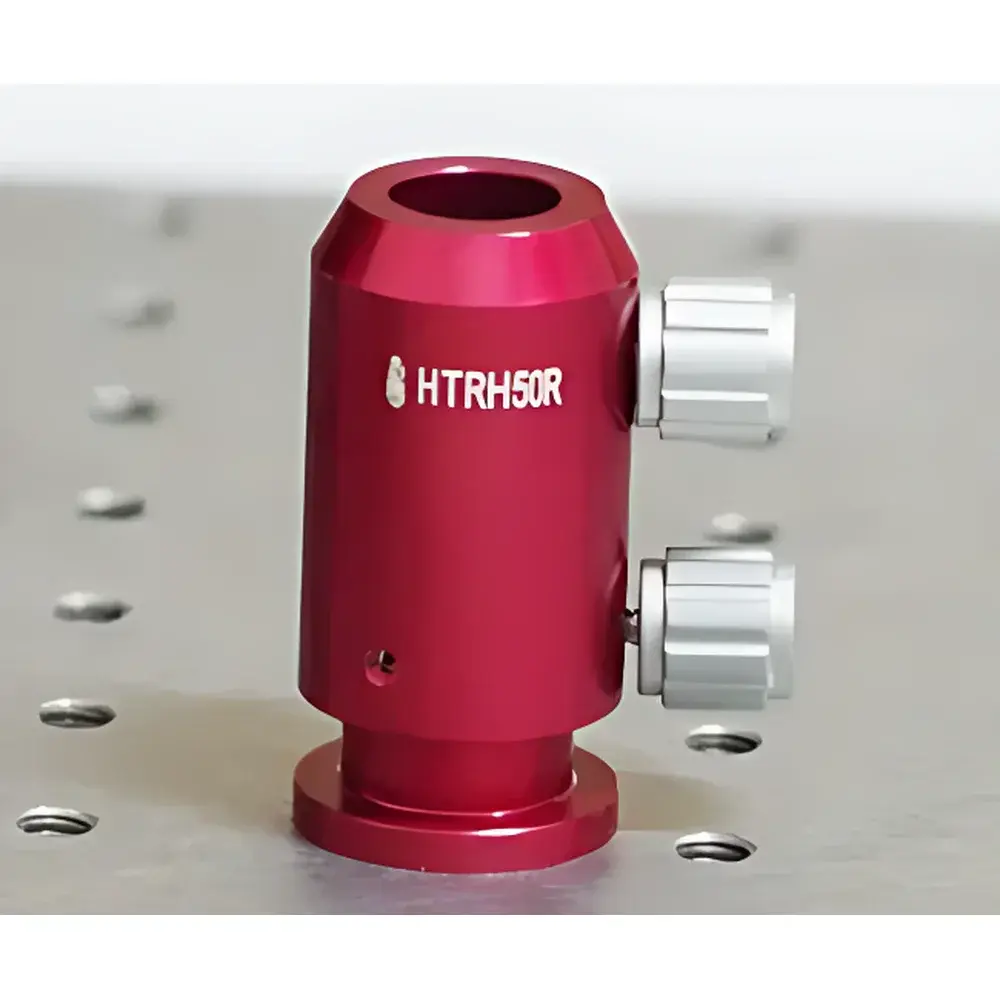
HT HTRH50R Precision Rotational Post Holder with Magnetic Base
| Brand | HT |
|---|---|
| Model | HTRH50R |
| Rod Length | 50 mm |
| Origin | Jiangsu, China |
| Distribution Type | Authorized Distributor |
| Compliance | Designed for ISO/IEC 17025-aligned optical alignment workflows |
Overview
The HT HTRH50R Precision Rotational Post Holder is a modular, high-stability optical mounting solution engineered for sub-degree angular repeatability and long-term mechanical integrity in laboratory-scale optical alignment tasks. It operates on a coaxial rotation principle: the upper post assembly rotates freely about its central axis while maintaining fixed translational position relative to the base—enabling precise azimuthal orientation of mounted optical components without lateral or vertical drift. The rotation interface employs a preloaded precision ball bearing, minimizing play and hysteresis during fine adjustment. Unlike friction-based or set-screw locking alternatives, this design ensures consistent torque transmission and positional retention across repeated cycles, critical for interferometric setups, polarization-sensitive configurations, and multi-axis alignment sequences where cumulative angular error must remain below ±0.1° over extended operation.
Key Features
- 360° continuous, backlash-free rotational capability around the post axis, with independent lockable fixation of both the rotating collar and the vertical rod section
- Integrated high-retention neodymium magnetic base (N52 grade), compatible with steel optical tables and breadboards; base surface includes non-marring elastomeric coating to prevent table scratching
- Machined aluminum alloy housing (6061-T6) with black anodized finish for corrosion resistance and dimensional stability under thermal cycling (operating range: 15–30 °C)
- Standard M4 threaded top mount and M6 base threads, ensuring compatibility with industry-standard posts, kinematic mounts, and translation stages from Thorlabs, Newport, and Standa
- Zero-centering design: rotation axis coincides precisely with the central longitudinal axis of the 50 mm rigid stainless-steel rod, eliminating eccentric loading during cantilevered mounting
Sample Compatibility & Compliance
The HTRH50R supports standard Ø12.7 mm (1/2″) and Ø25.4 mm (1″) optical components—including mirrors, waveplates, polarizers, detectors, and fiber launch assemblies—when used with appropriate adapter rings or clamping collars. Its mechanical design conforms to common optical bench integration standards, including ANSI/ISO 80000-4 for angular measurement units and ISO 10110-7 for optical component mounting tolerances. While not certified to specific regulatory frameworks (e.g., FDA or CE marking is not applicable for passive mechanical mounts), the device is routinely deployed in GLP-compliant laboratories conducting ASTM E2912 (standard practice for alignment of optical systems) and ISO/IEC 17025-accredited calibration procedures. Magnetic base operation requires adherence to IEC 61000-4-8 guidelines regarding proximity to sensitive instrumentation—users are advised to maintain ≥15 cm clearance from analog watches, magnetic storage media, and electron-optical detectors.
Software & Data Management
As a purely mechanical alignment component, the HTRH50R does not incorporate embedded electronics, firmware, or digital interfaces. Its performance documentation—including angular repeatability test reports, thermal expansion coefficients (α = 23.6 × 10⁻⁶ /°C for 6061-Al), and load-deflection curves under 5 N axial force—is provided in manufacturer-supplied technical datasheets compliant with ISO 9001:2015 documentation control requirements. Integration into automated optical alignment workflows is achieved via external coordinate measurement systems (e.g., laser trackers or vision-based metrology tools), where positional metadata may be logged into LIMS or ELN platforms supporting ASTM E2500-22 data traceability protocols.
Applications
- Laser cavity alignment in CW and pulsed diode-pumped solid-state (DPSS) systems
- Polarization state tuning in ellipsometry and Mueller matrix spectroscopy setups
- Beam steering validation in free-space quantum optics experiments requiring angular reproducibility
- Multi-wavelength source collimation verification using retroreflector-based alignment targets
- Educational optics labs: demonstration of rotational symmetry, Malus’ law, and Jones calculus implementation
FAQ
Can the magnetic base be deactivated or shielded for use on non-ferrous optical tables?
No—the magnet is integral and non-removable. For aluminum or composite tables, users must employ mechanical clamps or vacuum bases as auxiliary stabilization.
What is the maximum recommended static load for the 50 mm rod when mounted vertically?
12 N (equivalent to ~1.2 kg mass) at room temperature; load capacity decreases by 18% at 40 °C due to aluminum yield strength reduction.
Is the bearing sealed against particulate ingress in cleanroom environments?
Yes—the double-lip rubber seal meets ISO 14644-1 Class 5 particulate limits when operated within specified humidity ranges (30–60% RH).
Does HT provide calibration certificates traceable to NIST or PTB standards?
No—angular calibration is user-performed using autocollimators or digital theodolites; however, dimensional drawings include GD&T callouts per ASME Y14.5-2018.




