
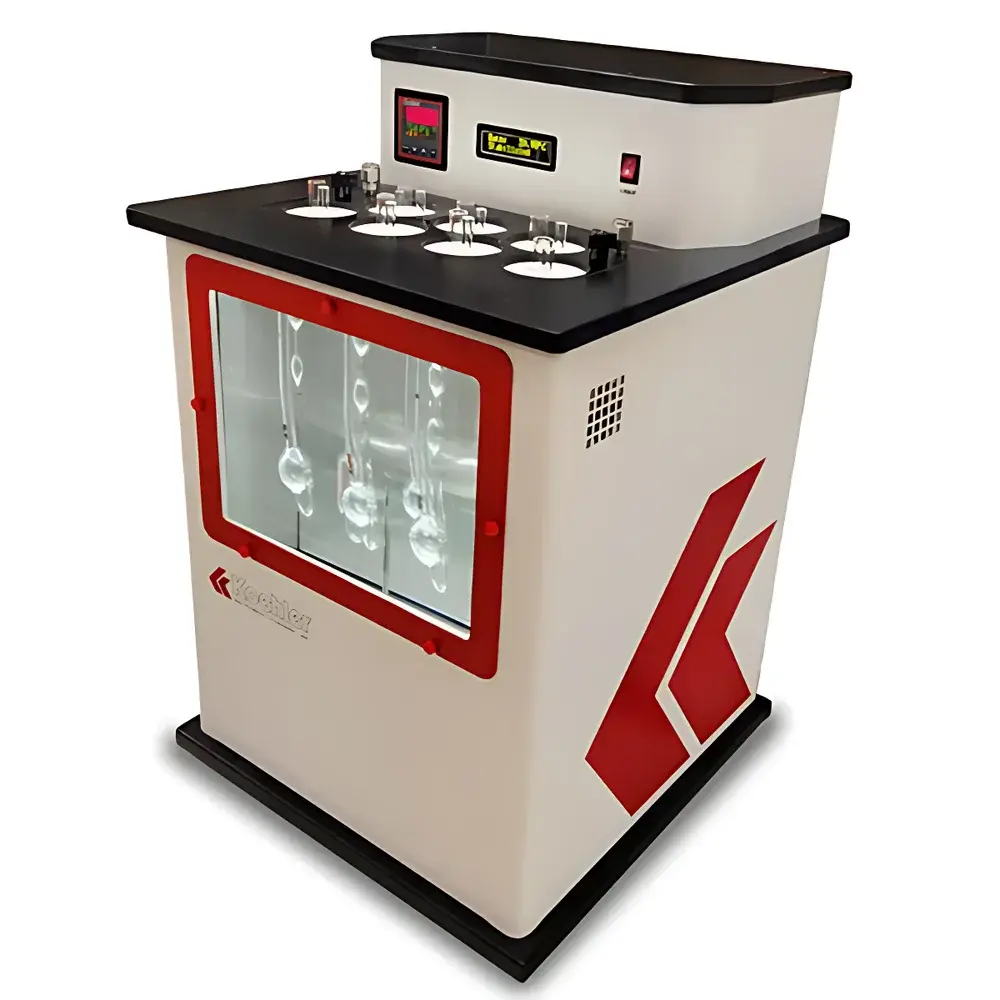
Koehler K23900 Kinematic Viscosity Bath System
| Brand | Koehler |
|---|---|
| Origin | USA |
| Manufacturer Status | Authorized Distributor |
| Product Origin | Imported |
| Model | K23900 |
| Pricing | Upon Request |
Overview
The Koehler K23900 Kinematic Viscosity Bath System is a precision-engineered, ASTM D445–compliant instrument designed for accurate determination of kinematic viscosity in petroleum-based and related transparent, Newtonian or near-Newtonian liquids at standardized temperatures—primarily 40 °C and 100 °C. It operates on the capillary viscometer principle, where kinematic viscosity (ν, in mm²/s or cSt) is calculated as the product of efflux time (t, in seconds) and the calibrated capillary constant (C, in mm²/s²), i.e., ν = C × t. The system provides stable, uniform thermal environments essential for reproducible capillary flow measurements, meeting the stringent temperature uniformity and stability requirements defined in ASTM D445, ISO 3104, and IP 71. Its architecture integrates microprocessor-based PID temperature control, low-turbulence bath circulation, and modular timing/detection options to support manual, semi-automated, and fully automated workflows across QC laboratories, refinery testing facilities, and independent petroleum product certification labs.
Key Features
- Microprocessor-controlled PID heating system maintaining bath temperature from ambient to 150 °C with ±0.01 °C calibration traceability and ±0.1 °C operational stability over full range
- Uniform temperature distribution achieved via motor-driven, non-turbulent bath circulation—exceeding ASTM D445’s requirement of ≤0.02 °C gradient across immersion depth
- Integrated digital timer with 0.01-second resolution and <0.01% timing accuracy; KV3000 variant supports seven independent timers for parallel capillary measurements
- Dual-line LED display showing both setpoint and real-time bath temperature simultaneously
- Redundant safety systems including high-temperature cutoff and low-bath-level shutoff to prevent heater dry-firing
- Optional integrated cooling interface compatible with tap water or recirculating chillers, enabling operation down to 10 °C per ASTM D445 Annex A2 for low-temperature viscosity profiling
- Bath chamber accommodates up to seven Ubbelohde-, Cannon-Fenske-, or BS/IP-type glass capillary viscometers of varying dimensions and constants
Sample Compatibility & Compliance
The K23900 is validated for use with clear, homogeneous, low-volatility liquid samples including base oils, lubricants, diesel fuels, jet fuels, transformer oils, and hydraulic fluids—provided they remain Newtonian under test conditions and do not degrade or precipitate at operating temperatures. It conforms fully to ASTM D445 (Standard Test Method for Kinematic Viscosity of Transparent and Opaque Liquids), ISO 3104 (Petroleum products — Determination of kinematic viscosity and calculation of dynamic viscosity), and IP 71 (Determination of kinematic viscosity of petroleum products). All temperature sensors are NIST-traceable, and the system supports GLP-compliant recordkeeping when used with optional data logging modules. For regulated environments (e.g., API Monogram, ISO/IEC 17025-accredited labs), the K23900’s deterministic timing logic and closed-loop thermal control provide auditable repeatability required for method validation and instrument qualification.
Software & Data Management
The K23900 operates as a standalone benchtop unit without mandatory PC connectivity. However, its KV4000 and KV5000 configurations include embedded firmware capable of storing up to 200 test records—including efflux time, user-entered capillary constant, calculated kinematic viscosity, temperature, and operator ID. The KV5000 variant features an optical flow detection system with five programmable sensor ports and two auxiliary manual timing inputs, enabling unattended multi-sample runs with auto-start/stop triggering. While no proprietary software is required for basic operation, optional Koehler DataLink™ export utilities (via RS-232 or USB) allow CSV-formatted output compliant with LIMS integration and FDA 21 CFR Part 11–aligned audit trails when paired with validated third-party laboratory information management systems.
Applications
- Quality control of finished lubricants and base stocks per OEM specifications (e.g., SAE J300, ACEA, API licensing requirements)
- Viscosity grading of aviation turbine fuels (ASTM D1655) and marine distillate fuels (ISO 8217)
- Monitoring thermal degradation of heat transfer fluids during service life assessment
- Batch release testing of transformer oils per IEEE C57.106 and IEC 60296
- Research and development of synthetic ester-based lubricants and bio-derived fuels requiring precise low-shear viscosity characterization
- Calibration verification of secondary viscometers using certified reference standards (e.g., NIST SRM 2783)
FAQ
Does the K23900 require external software to calculate kinematic viscosity?
No—the KV4000 and KV5000 models perform real-time calculation internally using user-input capillary constants and measured efflux times.
Can the bath accommodate both Ubbelohde and Cannon-Fenske viscometers simultaneously?
Yes—the chamber geometry and support rack design allow mixed insertion of ASTM D445–approved capillary types, provided total count does not exceed seven.
Is the temperature uniformity verified across the entire immersion zone?
Yes—Koehler certifies uniformity to ≤±0.015 °C at 40 °C and 100 °C per internal mapping protocol aligned with ASTM D445 Section 7.3.2.
What cooling options are supported for sub-ambient operation?
Tap water connection (with flow regulator) or external recirculating chiller (minimum 1 L/min, 10 °C outlet capability); chiller interface is standard on all K23900 variants.
How is instrument calibration documented for ISO/IEC 17025 compliance?
NIST-traceable temperature sensor certificates and timing accuracy reports are supplied with each unit; annual recalibration services include full performance verification against ASTM D445 Annex B criteria.



