
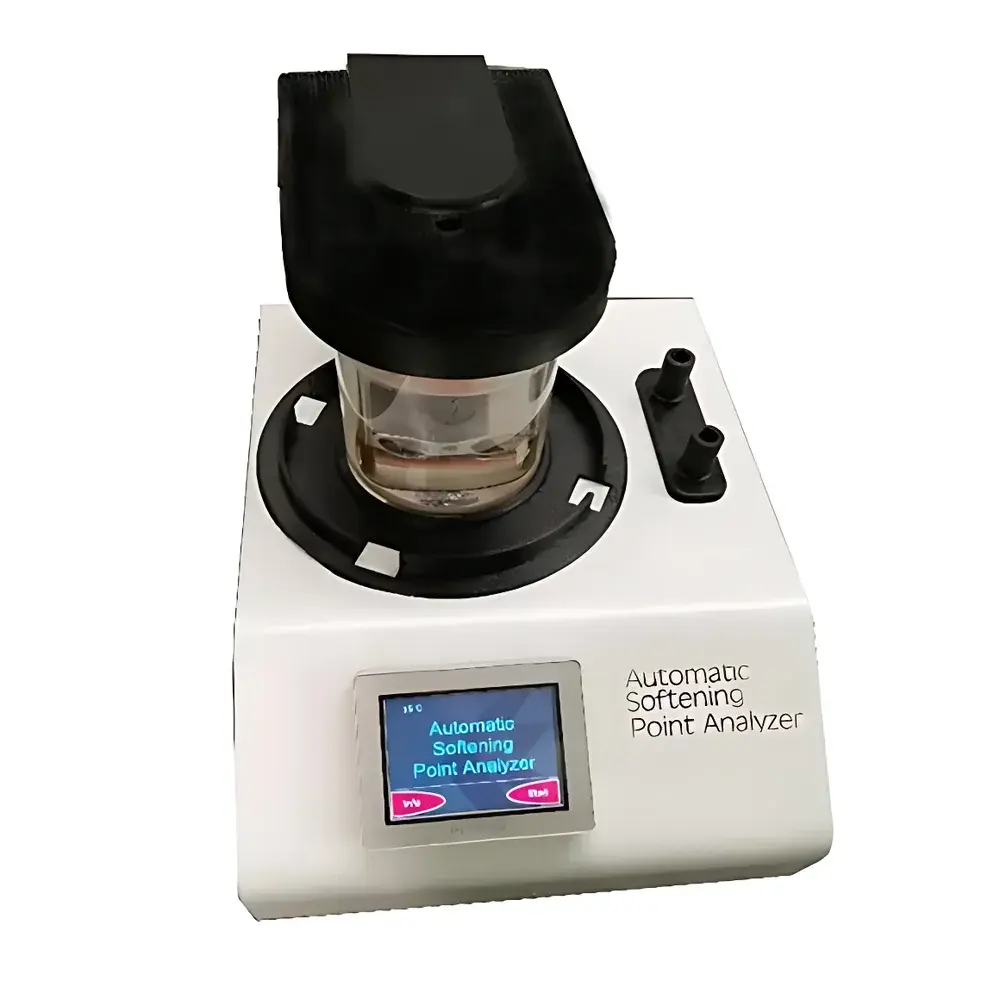
Koehler K95100 Automatic Ring-and-Ball Softening Point Tester
| Brand | Koehler |
|---|---|
| Origin | USA |
| Model | K95100 |
| Standards Compliance | ASTM D36, ISO 4625, EN 1427, DIN 52011, AFNOR T66-008, IP 58, NF EN 1427 |
| Heating Range | 30–157 °C (86–315 °F) |
| Media Options | Distilled water (30–80 °C), USP glycerin (80–157 °C), ethylene glycol (30–110 °C) |
| Power | 3000 W |
| Electrical | 110–240 VAC, 50/60 Hz, 1500 W (single-phase) |
| Dimensions | 39.1 × 43.7 × 62.0 cm (15.4 × 17.2 × 24.4 in) |
| Net Weight | 32.7 kg (72 lb) |
Overview
The Koehler K95100 Automatic Ring-and-Ball Softening Point Tester is an engineered solution for precise, repeatable determination of the softening point of bituminous materials—including paving-grade asphalts, roofing asphalts, coal tars, and modified bitumens—according to internationally recognized thermal transition test methods. Based on the classical ring-and-ball principle defined in ASTM D36 and harmonized across ISO 4625, EN 1427, and DIN 52011, the instrument measures the temperature at which a standardized asphalt disc, constrained within a brass ring and loaded with a 3.5 g steel ball, deforms under controlled thermal ramping until the ball contacts a lower support plate—defined as the softening point. Unlike manual setups requiring visual endpoint judgment, the K95100 employs a non-contact laser displacement sensor to detect the exact moment of ball descent with sub-millimeter resolution, eliminating observer bias and ensuring metrological traceability. Its dual-test architecture enables parallel analysis of two samples under identical thermal conditions, improving throughput without compromising inter-test consistency.
Key Features
- Dual independent test stations with synchronized thermal control and individual laser detection circuits
- High-resolution capacitive touchscreen interface supporting multi-step programmable heating ramps (e.g., initial soak, linear ramp, hold segments)
- Integrated magnetic stirrer with variable speed control (0–600 rpm) for uniform heat distribution across the 800 mL bath medium
- Automated sample loading assistance mechanism reducing operator handling and positional variability
- Laser-based endpoint detection system calibrated to detect vertical displacement ≥0.2 mm with ±0.1 °C repeatability (per ASTM D36 repeatability criteria)
- Onboard data logging with timestamped temperature, displacement, and ramp profile parameters; exportable via USB to CSV or PDF report formats
- Compliance-ready firmware architecture supporting audit trails, user access levels, and electronic signature capability per FDA 21 CFR Part 11 requirements when deployed in regulated QA/QC environments
Sample Compatibility & Compliance
The K95100 accommodates standard ASTM/ISO-compliant brass rings (15.9 mm inner diameter, 12.7 mm height), shoulder rings, ball centering devices, and 9.53 mm diameter steel balls (3.50 ± 0.05 g). It supports three validated heat transfer media—distilled water (30–80 °C), USP-grade glycerin (80–157 °C), and ethylene glycol (30–110 °C)—each selected based on expected softening range and thermal stability. All components are corrosion-resistant and chemically inert to common asphalt solvents and bath media. The system is fully compliant with ASTM D36, ISO 4625, EN 1427, DIN 52011, AFNOR T66-008, IP 58, and NF EN 1427. Its design facilitates GLP and GMP-aligned operation through configurable user authentication, tamper-evident data logs, and calibration certificate tracking.
Software & Data Management
The embedded operating system provides real-time graphical display of temperature vs. time curves, displacement trends, and ramp deviation alerts. Users may define, store, and recall up to 20 custom test protocols—including media selection, start temperature, ramp rate (0.5–5.0 °C/min), hold durations, and pass/fail thresholds. All measurement data—including raw sensor outputs, calculated softening point, and environmental metadata—are stored internally with UTC timestamps and exported via USB mass storage mode. Optional Koehler LabLink™ software (Windows-compatible) enables remote monitoring, batch reporting, statistical process control (SPC) charting, and integration into LIMS platforms via CSV or direct ODBC connectivity.
Applications
The K95100 serves critical roles in asphalt production QC labs, road construction material certification bodies, petroleum refinery quality assurance departments, and independent testing laboratories accredited to ISO/IEC 17025. It is routinely used to verify conformance of polymer-modified binders (PMBs), reclaimed asphalt pavement (RAP) blends, and crumb rubber–modified asphalts to specification limits in AASHTO M226, EN 13924, and SHRP binder grading protocols. Its precision and automation support method validation studies, aging effect assessments (e.g., RTFO and PAV residue evaluation), and comparative formulation development where thermal stability and viscoelastic transition behavior must be quantitatively benchmarked.
FAQ
What heating media are supported, and how are they selected?
Distilled water is used for softening points below 80 °C; USP glycerin is recommended for 80–157 °C; ethylene glycol offers an alternative for intermediate ranges up to 110 °C. Selection is based on thermal stability, viscosity, and clarity at target temperatures.
Does the instrument meet regulatory requirements for electronic records?
Yes—the firmware includes configurable audit trails, user-level permissions, and electronic signature support aligned with FDA 21 CFR Part 11 and EU Annex 11 expectations for computerized systems in regulated environments.
Can test results be integrated into a laboratory information management system (LIMS)?
Yes—exported CSV files are LIMS-compatible; optional Koehler LabLink™ software provides ODBC drivers for direct database ingestion and automated report generation.
Is calibration verification traceable to NIST standards?
The system accepts external platinum resistance thermometer (PRT) calibration checks; Koehler provides NIST-traceable calibration certificates for temperature sensors and displacement modules upon request.
What maintenance is required for long-term reliability?
Routine cleaning of bath vessels and rings after each use; annual verification of laser alignment and stirrer torque; biannual calibration of temperature sensors using certified reference thermometers.
Related Products






