
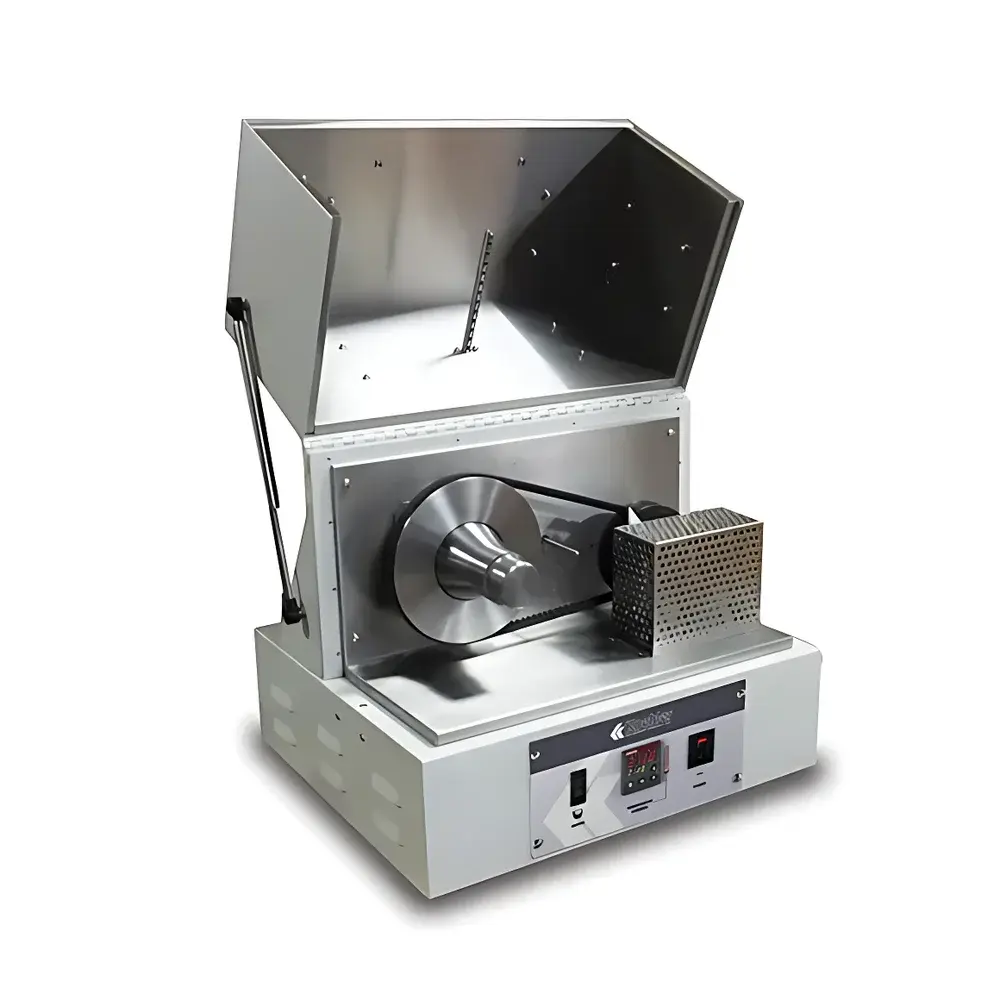
Koehler K18795 Automotive Wheel Bearing Grease Leakage Tester
| Brand | Koehler |
|---|---|
| Origin | USA |
| Model | K18795 |
| Temperature Range | Ambient to 121 °C |
| Temperature Control Accuracy | ±0.1 °C |
| Rotational Speed | 660 rpm ±30 rpm |
| Test Duration | 360 min ±5 min |
| Temperature Setpoint | 104.5 °C ±1.5 °C |
| Drive Motor | 1/3 HP, V-belt coupled |
| Display | Dual-line LED (°C/°F) |
| Enclosure | Stainless steel with corrosion-resistant polyimide enamel coating |
| Dimensions | 52 × 46 × 38 cm |
| Weight | 43.1 kg |
| Power Supply | 220–240 V, 50 Hz, Single-phase, 7 A |
| Compliance | ASTM D1263, SH/T 0326, FTM 791-3454 |
Overview
The Koehler K18795 Automotive Wheel Bearing Grease Leakage Tester is a precision-engineered laboratory instrument designed to quantify grease leakage under controlled thermal and mechanical stress conditions—specifically simulating the operational environment of automotive front-wheel hub assemblies. It operates on the principle of accelerated thermal-mechanical degradation: a standardized modified front-wheel hub and spindle assembly is loaded with test grease and subjected to continuous rotation at 660 rpm ±30 rpm while maintaining a precisely regulated bearing temperature of 104.5 °C ±1.5 °C for 360 minutes ±5 minutes. The mass loss of grease (and/or oil separation) is gravimetrically determined before and after testing, providing a quantitative metric for comparative evaluation of grease retention performance. This method directly correlates with real-world wheel bearing reliability, particularly in high-temperature, high-speed service conditions where excessive leakage compromises sealing integrity, increases contamination ingress risk, and accelerates wear.
Key Features
- Microprocessor-based PID temperature controller ensures rapid thermal equilibration and stable setpoint maintenance within ±0.1 °C across the full operating range (ambient to 121 °C).
- Dual-line LED display simultaneously shows actual and setpoint temperatures in both °C and °F formats, enabling immediate verification during GLP-compliant test execution.
- Integrated overheat protection circuitry automatically interrupts heating if sensor fault or thermal runaway is detected—meeting IEC 61000-6-2 electromagnetic compatibility and functional safety expectations for lab instrumentation.
- V-belt drive system delivers smooth, low-vibration rotation to the modified front-wheel hub assembly, minimizing mechanical noise and ensuring reproducible torque transmission without slippage.
- Corrosion-resistant stainless steel enclosure coated with polyimide enamel provides long-term durability in lubricant-laden laboratory environments and resists degradation from hydrocarbon exposure.
- Compact footprint (52 × 46 × 38 cm) and optimized weight distribution (43.1 kg) facilitate integration into standard analytical lab benches without requiring dedicated floor mounting.
Sample Compatibility & Compliance
The K18795 accommodates standard SAE-type front-wheel hub and spindle assemblies per ASTM D1263 specifications, supporting direct evaluation of NLGI Grade 00 through Grade 3 greases—including lithium, calcium sulfonate, polyurea, and complex soap formulations. It is fully compatible with multi-component grease systems containing thickeners, base oils (mineral, PAO, ester), and additive packages (e.g., anti-wear, oxidation inhibitors). The instrument satisfies mandatory test method requirements for regulatory submissions and internal quality control protocols under ASTM D1263 (Standard Test Method for Loss of Lubricating Grease from Rolling Bearings), SH/T 0326 (Chinese national standard for automotive wheel bearing grease leakage), and U.S. Department of Defense specification FTM 791-3454. Its design supports audit readiness for ISO/IEC 17025-accredited laboratories and aligns with GMP documentation practices for lubricant formulation development.
Software & Data Management
While the K18795 operates as a standalone hardware platform with embedded microcontroller logic, its analog temperature and timer outputs are compatible with optional external data loggers (e.g., Omega OM-DAQPRO-5300 series) for time-stamped acquisition of thermal profiles. All critical operational parameters—including start time, target temperature, actual temperature history, and run duration—are manually recorded in laboratory notebooks per GLP Annex 11 principles. The instrument’s deterministic control architecture eliminates firmware dependencies, ensuring traceability and long-term method stability without software versioning concerns. Calibration certificates for the integrated PT100 temperature sensor and tachometer can be maintained separately to support FDA 21 CFR Part 11 compliance when paired with validated electronic record systems.
Applications
- Comparative screening of grease formulations for OEM qualification and Tier-1 supplier approval.
- Quality assurance testing of incoming grease batches against technical data sheet specifications.
- Failure analysis investigations following field reports of wheel-end leakage or premature bearing failure.
- Development of high-temperature, low-leakage greases for electric vehicle (EV) regenerative braking applications where thermal loads exceed conventional ICE duty cycles.
- Supporting ASTM D4950 classification of automotive service greases (e.g., LB, GA, GC, CH, CK classifications).
FAQ
Does the K18795 require calibration certification prior to first use?
Yes—users must obtain and retain a NIST-traceable calibration certificate for the integrated temperature sensor and rotational speed indicator prior to initiating GLP or ISO 17025-compliant testing.
Can the instrument operate continuously at 121 °C?
No—the maximum sustained test temperature is 104.5 °C per ASTM D1263; operation at 121 °C is permitted only for system verification and validation, not routine testing.
Is the modified hub assembly supplied with the instrument?
Yes—the K18795 includes one certified ASTM-compliant modified front-wheel hub and spindle assembly; additional spares are available under Koehler part number K18795-HUB.
What maintenance is required for long-term accuracy?
Biannual verification of thermal uniformity across the hub surface using calibrated contact thermocouples and annual recalibration of the PID controller’s input/output loop are recommended.
Can test results be exported digitally?
The instrument itself does not feature USB or Ethernet connectivity; however, analog voltage outputs (0–5 V DC for temperature, pulse train for RPM) enable integration with third-party SCADA or LIMS platforms via signal conditioning modules.





