
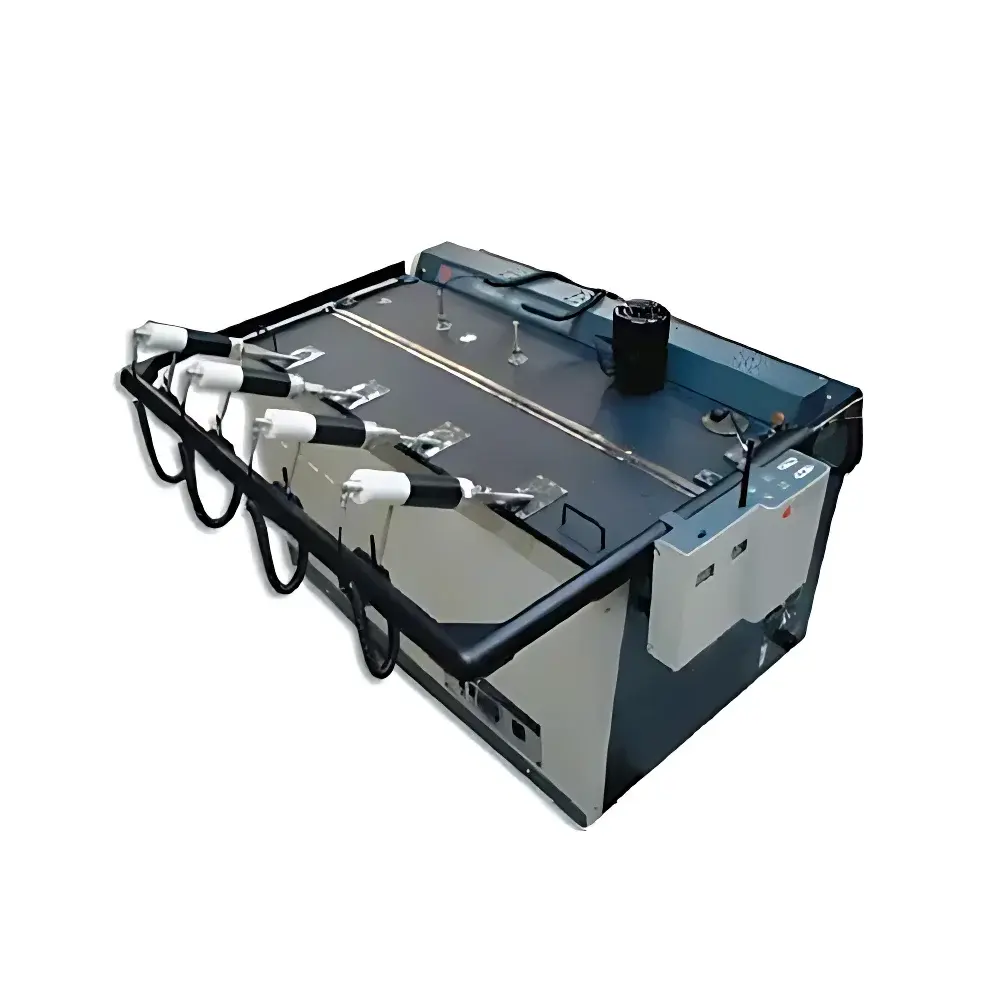
Koehler K70X90 Series Rotating Pressure Vessel Oxidation Stability Tester (RPVOT)
| Brand | Koehler |
|---|---|
| Origin | USA |
| Model | K70290 / K70390 / K70490 |
| Compliance | ASTM D2112, ASTM D2272, ASTM D4742, IP 229, SH/T 0193 |
| Temperature Control Accuracy | ±0.02°C |
| Rotation Speed | 100 rpm |
| Operating Pressure | 90 psi (620 kPa) |
| Bath Configurations | 2-, 3-, or 4-vessel units |
| Power | 0–3750 W |
| Dimensions (W×D×H) | 117 × 66 × 84 cm |
| Weight | 170 kg (4-vessel configuration) |
| Software | Oxidata™ for Windows |
| Data Channels | up to 12 pressure + 4 temperature channels |
| Safety | Over-temperature protection, corrosion-resistant polyurethane coating |
Overview
The Koehler K70X90 Series Rotating Pressure Vessel Oxidation Stability Tester (RPVOT) is a precision-engineered instrument designed to quantitatively evaluate the oxidation resistance of lubricating oils and turbine oils under accelerated, high-pressure, high-temperature conditions. Based on the rotating pressure vessel principle—where sample oxidation kinetics are monitored via real-time oxygen pressure decay—the system adheres strictly to internationally recognized test standards including ASTM D2112 (for steam turbine oils), ASTM D2272 (standard RPVOT method), ASTM D4742 (for diesel engine oils), IP 229, and SH/T 0193 (Chinese national standard). During testing, a precisely weighed oil sample, deionized water, and a copper catalyst coil are sealed in a borosilicate glass sample cup, which is then placed inside a stainless-steel pressure vessel. The vessel is pressurized to 90 psi (620 kPa) with pure oxygen and rotated at a constant 100 rpm within a thermally stabilized bath. As oxidation proceeds, dissolved oxygen is consumed, resulting in a measurable decline in internal pressure. The time required for pressure to drop by a defined threshold—typically 25.4 psi (175 kPa) from the initial value—is recorded as the induction period (IP), a critical indicator of oxidative stability.
Key Features
- Triple-certified compliance with ASTM D2112, ASTM D2272, and IP 229 ensures data acceptance in regulatory submissions, OEM specifications, and international quality audits.
- Modular bath architecture supports 2-, 3-, or 4-vessel configurations (K70290, K70390, K70490), enabling flexible throughput scaling without compromising thermal uniformity.
- High-stability temperature control system maintains setpoint accuracy within ±0.02°C across all vessels—critical for reproducible kinetic measurements per ASTM requirements.
- Dual-safety architecture includes redundant over-temperature cutoffs and a robust polyurethane-coated external housing resistant to oil vapors, condensate, and laboratory cleaning agents.
- Integrated 100 rpm positive-drive gearmotor eliminates slippage or speed drift, ensuring consistent shear input and mechanical activation of oxidation pathways.
- Hermetically sealed pressure manifolds and calibrated transducers deliver long-term pressure measurement repeatability essential for detecting subtle differences in antioxidant depletion rates.
Sample Compatibility & Compliance
The K70X90 series accommodates a broad range of petroleum-based fluids, including mineral and synthetic turbine oils, hydraulic fluids, compressor oils, and transformer oils. Sample preparation follows strict procedural guidelines outlined in ASTM D2272: use of standardized copper catalyst coils (ASTM F21 specification), controlled water addition (0.5 mL per 50 mL oil), and validated glassware dimensions. All hardware components—including oxygen-rated stainless-steel vessels, borosilicate sample cups, and pressure-sealing mechanisms—meet ASME B31.3 process piping and ISO 17025 calibration traceability requirements. Test reports generated by Oxidata™ software include full metadata (operator ID, calibration certificate numbers, environmental conditions) to support GLP/GMP documentation and FDA 21 CFR Part 11-compliant audit trails when configured with electronic signatures.
Software & Data Management
Oxidata™ software operates natively on Windows 10/11 platforms and provides fully automated acquisition, visualization, and reporting for up to 12 independent pressure channels and 4 temperature monitoring points. Each test session logs raw pressure vs. time and temperature vs. time datasets at user-selectable intervals (default: 1-second resolution). Real-time derivative analysis identifies inflection points corresponding to rapid oxidation onset; the software automatically calculates and flags the official induction period per ASTM D2272 Annex A1. Export options include CSV, PDF, and XML formats compatible with LIMS integration. Data storage is unlimited and indexed by batch ID, sample ID, operator, and date/time stamp. Audit logs record all user actions—including parameter changes, manual overrides, and calibration events—to satisfy ISO/IEC 17025 clause 7.7 and internal quality system requirements.
Applications
This instrument is routinely deployed in refinery QC labs, lubricant additive development centers, and independent testing laboratories for: evaluating antioxidant package efficacy during formulation; monitoring in-service oil degradation in power generation and industrial machinery; validating shelf-life claims for new base stocks; supporting OEM qualification protocols (e.g., GEK 32568, Siemens TL 9013); and generating data for technical service bulletins and material safety data sheets (MSDS/SDS). Its ability to resolve small differences in induction period—often <2% CV across replicate runs—makes it indispensable for comparative studies involving amine- vs. phenolic-based inhibitors or zinc dialkyldithiophosphate (ZDDP) concentration gradients.
FAQ
What standards does the K70X90 series explicitly support?
ASTM D2112, ASTM D2272, ASTM D4742, IP 229, and SH/T 0193.
Can multiple vessels operate at different temperatures simultaneously?
No—thermal uniformity is maintained across all vessels within a single bath; independent temperature zones are not supported.
Is Oxidata™ software compliant with FDA 21 CFR Part 11?
Yes, when deployed with validated Windows domain authentication, electronic signature modules, and audit-trail archiving enabled.
What maintenance is required for long-term pressure sensor accuracy?
Annual recalibration against NIST-traceable deadweight testers is recommended; Koehler-certified service technicians perform field verification every 6 months.
Are replacement parts such as glass cups and copper coils supplied with traceable certification?
Yes—all consumables ship with lot-specific CoA (Certificate of Analysis) confirming dimensional tolerances, copper purity (>99.9%), and hydrolytic stability per ASTM D2272 Annex B.
Related Products







