
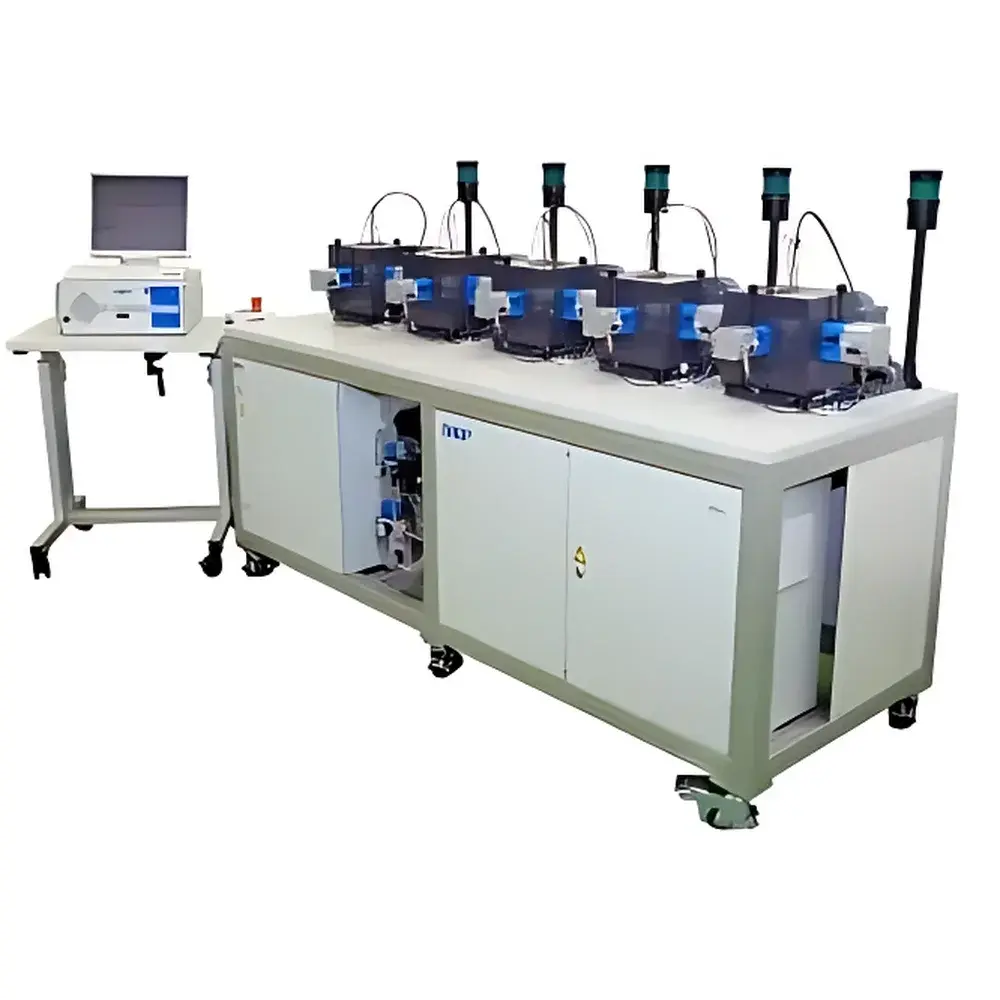
SKF ROF+ Grease Bearing Life Tester
| Origin | Austria |
|---|---|
| Manufacturer Type | Authorized Distributor |
| Origin Category | Imported |
| Model | ROF+ |
| Pricing | Available Upon Request |
Overview
The SKF ROF+ Grease Bearing Life Tester is an engineered test system designed to evaluate the operational endurance of lubricating greases under rigorously controlled, application-representative conditions—specifically high temperature, high radial/axial load, and elevated rotational speed. It operates on the principle of accelerated life testing using standardized rolling-element bearing configurations (typically SKF deep-groove ball bearings), where grease performance is quantified by time-to-failure under defined mechanical and thermal stress. Failure is objectively determined by predefined torque threshold exceedance, catastrophic bearing seizure, or loss of rotational stability—events directly correlated with grease degradation mechanisms including oxidation, oil bleed depletion, thickener breakdown, and loss of film-forming capability. The instrument complies with internationally recognized standards including ASTM D3336 (Standard Test Method for Life of Lubricating Grease in Ball Bearings at Elevated Temperature), SH/T 0428 (Chinese standard for grease life testing under high-temperature, high-load conditions), and proprietary SKF internal specification ROF (Rolling Oil/Fat Life) methodology. Its architecture enables systematic mapping of grease performance envelopes—defining maximum sustainable speed, load, and temperature limits for specific grease formulations.
Key Features
- Modular five-station mechanical test unit, each station housing dual precision-mounted SKF ball bearings on independent shafts
- Dual-axis pneumatic loading system: radial load range 22.3–900 N; axial load range 66.7–1100 N—calibrated and traceable to national metrology standards
- Belt-driven motor system delivering precise rotational speeds from 5,000 to 25,000 rpm with closed-loop feedback control
- Independent dual-zone heating modules per station, enabling temperature control from ambient to 250 °C with ±0.1 °C display resolution and ±1.5 °C uniformity across bearing raceways
- Real-time torque monitoring via calibrated strain-gauge-based transducers, capturing frictional torque evolution throughout test duration
- Integrated high-accuracy temperature sensors (Pt100 class A) embedded adjacent to bearing outer rings for localized thermal profiling
- Automated data acquisition system logging time-synchronized parameters: rotational speed, applied loads (radial/axial), bearing temperature, measured torque, and elapsed runtime
Sample Compatibility & Compliance
The ROF+ accommodates standardized 6204 or 6205 deep-groove ball bearings (ISO 15:2011) pre-packed with user-supplied grease samples. It supports comparative evaluation across NLGI grades 00 to 3 and diverse thickener chemistries (lithium, calcium sulfonate, polyurea, clay, etc.) under identical boundary conditions. All test protocols are structured to meet GLP (Good Laboratory Practice) documentation requirements. Data audit trails—including operator ID, calibration timestamps, parameter setpoints, and raw sensor outputs—are retained in accordance with FDA 21 CFR Part 11 compliance guidelines when configured with validated software modules. Test reports generated are suitable for regulatory submissions requiring traceability to ASTM D3336 or OEM-specific qualification protocols.
Software & Data Management
The dedicated ROF+ control and analysis software runs on a Windows-based industrial PC integrated into the system cabinet. It provides real-time visualization of all live parameters via customizable dashboards, configurable alarm thresholds (e.g., torque >120% baseline for >30 s), and automatic test termination upon failure criteria activation. Raw data is stored in .csv and binary formats with embedded metadata (test ID, calibration certificate IDs, environmental logs). Post-test analysis tools include torque vs. time curve fitting, Arrhenius-based lifetime extrapolation, Weibull distribution modeling for reliability assessment, and comparative overlay of multiple grease formulations. Export functions support PDF report generation compliant with ISO/IEC 17025 technical record requirements.
Applications
- Formulation development and benchmarking of high-performance greases for electric vehicle (EV) traction motors and gearbox applications
- Qualification of greases for wind turbine pitch/yaw bearings operating under variable load and wide thermal cycles
- Supporting OEM lubricant approval processes requiring empirical life validation beyond standard dropping point or worked penetration tests
- Failure root-cause analysis of field-reported bearing wear incidents through controlled replication of service conditions
- Accelerated aging studies correlating ROF+ lifetime data with Fourier-transform infrared (FTIR) spectroscopic indicators of oxidation and additive depletion
FAQ
What defines “failure” in an ROF+ test?
Failure is triggered when measured torque exceeds a user-defined threshold (typically 150–200% of initial running torque) for a sustained period (e.g., ≥60 seconds), or upon detection of rotational arrest, abnormal vibration signature (via optional accelerometer integration), or thermal runaway (>5 °C/min rise).
Can the ROF+ test greases intended for low-speed, high-torque applications?
Yes—while optimized for high-speed regimes, the pneumatic loading system allows stable application of static and quasi-static loads down to 22.3 N radial, enabling simulation of slow-rotation, heavily loaded conditions typical in construction or mining equipment.
Is third-party calibration certification available for the load and temperature sensors?
All primary sensors are supplied with factory calibration certificates traceable to PTB (Physikalisch-Technische Bundesanstalt) standards. On-site recalibration services—including full uncertainty budgeting per ISO/IEC 17025—are offered annually by authorized SKF service partners.
How is cross-contamination between test stations prevented?
Each of the five cast-iron dust shields is mechanically isolated, with independent air purge lines and sealed bearing housings. Bearings are replaced and grease chambers fully cleaned between tests per documented SOPs to eliminate carryover effects.





