
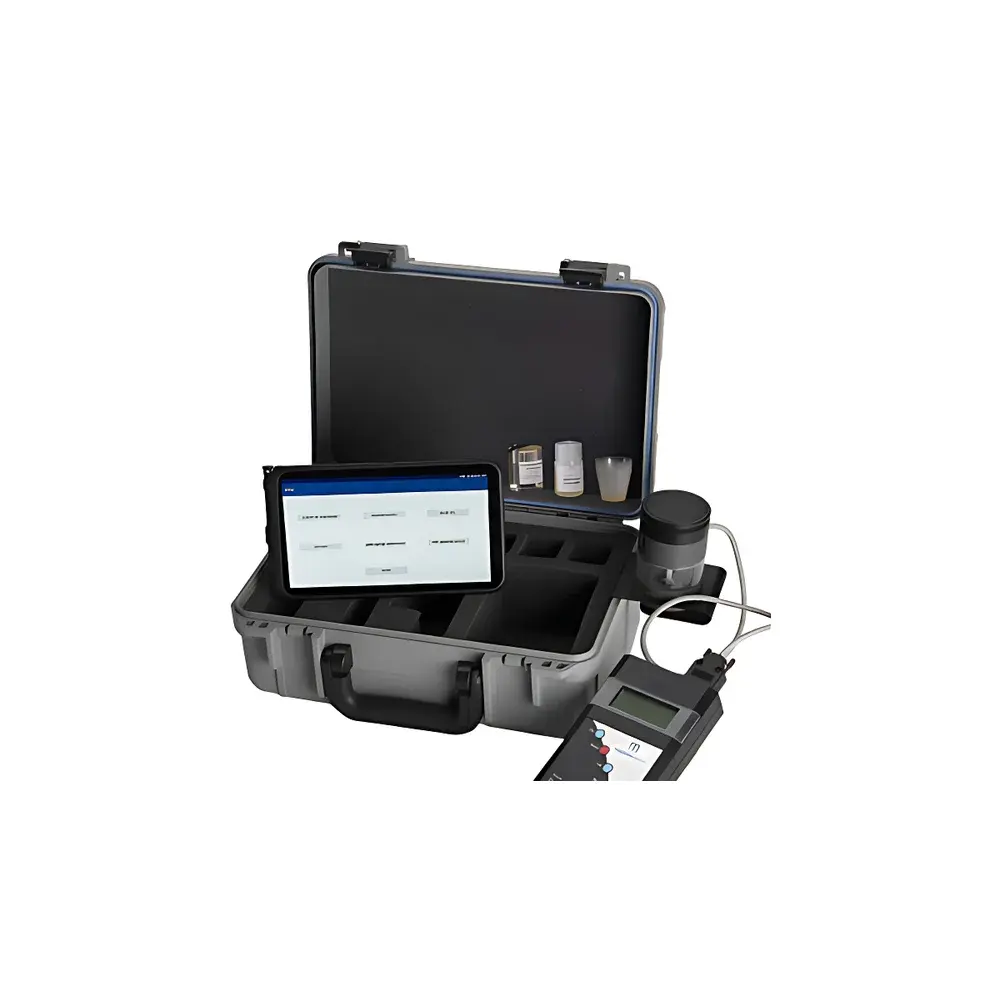
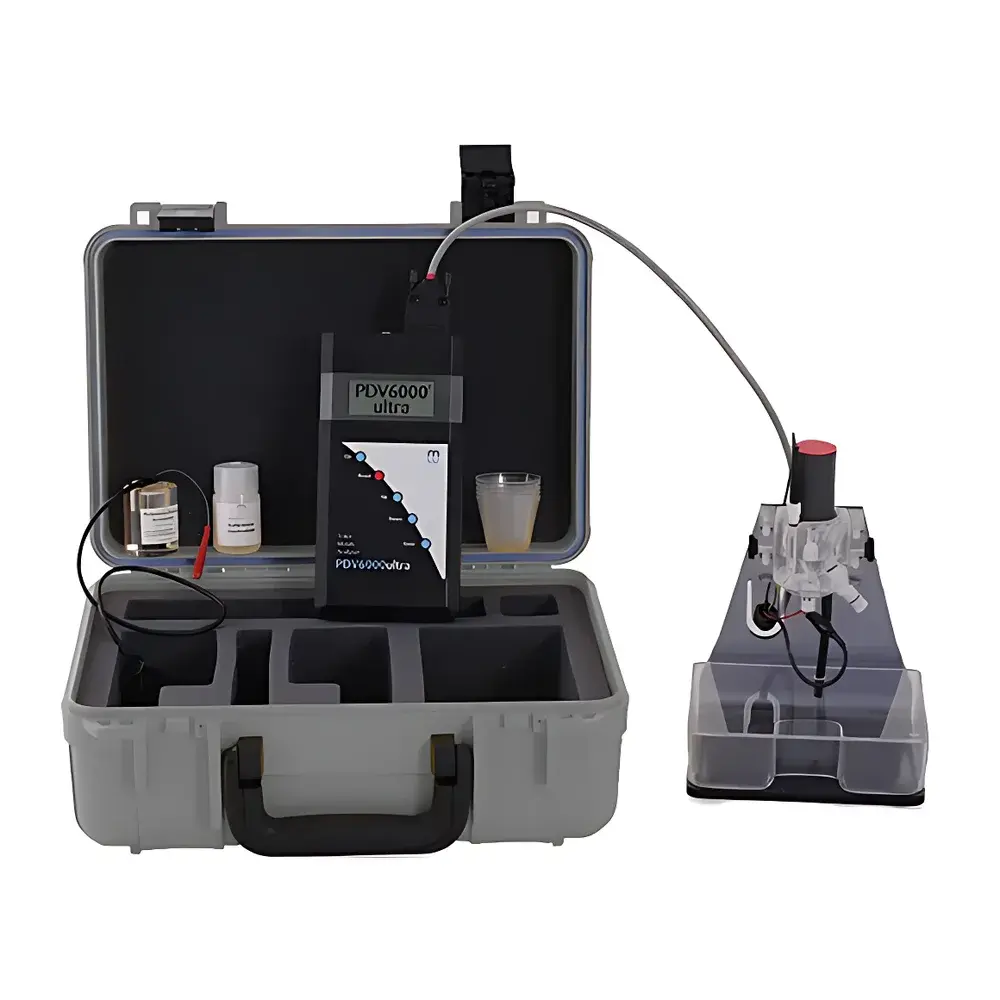
Modern Water PDV 6000ultra Portable Heavy Metals Analyzer
| Brand | Modern Water |
|---|---|
| Origin | United Kingdom |
| Model | PDV 6000ultra |
| Instrument Type | Portable |
| Detection Principle | Anodic Stripping Voltammetry (ASV) |
| Detectable Metals | Up to 24 elements (e.g., Pb, Cd, Cu, Zn, As, Hg, Ni, Cr, Mn) |
| Analysis Time | ≤5 minutes per sample |
| Accuracy/Precision | ±5–10% RSD |
| Resolution | 1 ppb (µg/L) |
| Detection Limit | 0.1 µg/L for most target metals |
| Power Supply | 110–240 V AC adapter, 8–12 V DC input, or 4× AA batteries |
| Dimensions (main unit) | 360 × 270 × 155 mm (L×W×D) |
| Display | Integrated LCD |
| CE Certified | Yes |
| Electrode Options | Solid-state gold or glassy carbon working electrodes (mercury-free) |
| Compatible Software | VAS Desktop Software (Windows), embedded firmware, and Android tablet app (VAS Mobile) |
| Compliance | Designed for field deployment in accordance with ISO 17294-2, ASTM D3559, EPA Method 7000B, and GLP-aligned data integrity practices |
Overview
The Modern Water PDV 6000ultra is a field-deployable, mercury-free portable heavy metals analyzer engineered for rapid, quantitative determination of trace-level toxic metals in aqueous matrices—including drinking water, surface water, groundwater, wastewater, leachates, and soil extracts. It operates on the electrochemical principle of anodic stripping voltammetry (ASV), a well-established, standardized technique recognized in environmental regulatory frameworks including EPA Method 7000B and ISO 17294-2. In ASV, target metal ions are first pre-concentrated onto a solid-state working electrode (e.g., gold or modified glassy carbon) at a controlled negative potential, followed by oxidative stripping under a linear or pulsed voltage scan. The resulting current peaks—each uniquely positioned by reduction/oxidation potential—enable simultaneous multi-element identification and quantification. With detection limits as low as 0.1 µg/L and resolution down to 1 ppb, the PDV 6000ultra delivers laboratory-grade sensitivity without requiring centralized instrumentation, making it ideal for real-time decision support during site investigations, emergency response, and long-term monitoring programs.
Key Features
- Mercury-free solid-state electrode architecture: Eliminates hazardous mercury handling while maintaining high sensitivity and reproducibility across >10,000 analyses.
- Multi-element capability: Supports quantitative analysis of up to 24 regulated metals—including Pb, Cd, Cu, Zn, As(III), Hg, Ni, Cr(VI), Mn, and Co—via programmable voltage scans and electrode conditioning protocols.
- Field-optimized hardware design: Compact form factor (360 × 270 × 155 mm), integrated LCD interface, and dual-power operation (AA batteries or AC/DC adapter) ensure uninterrupted operation in remote or off-grid locations.
- Three-tier software ecosystem: Native firmware for standalone screening; VAS Desktop Software (Windows) for advanced curve fitting, calibration management, and report generation; and VAS Mobile—an Android tablet application enabling touch-driven method setup, real-time voltammogram visualization, and GPS-tagged sample metadata capture.
- Robust analytical flexibility: Supports standard addition, blank subtraction, and multi-point calibration routines to compensate for matrix effects in complex samples such as industrial effluents or sediment pore waters.
- Regulatory-ready data handling: All measurements include timestamped raw voltammograms, peak identification logs, and concentration outputs. Data export formats (CSV, PDF, XML) support integration into LIMS and comply with audit-trail requirements under GLP and ISO/IEC 17025 environments.
Sample Compatibility & Compliance
The PDV 6000ultra accepts liquid samples with minimal pretreatment—typically filtration (0.45 µm) and pH adjustment (to pH 4.5–5.5 for optimal ASV response). It accommodates direct analysis of filtered surface water, treated drinking water, groundwater, wastewater influent/effluent, and acid-digested soil or biological extracts. Optional SV LabCell modules enable sealed, stirred analysis chambers with integrated waste containment, enhancing precision for low-conductivity or high-organic-content samples. The instrument conforms to CE marking requirements and is validated against internationally accepted reference methods: correlation studies demonstrate strong agreement (R² > 0.98) with ICP-MS and graphite furnace AAS for key analytes across diverse environmental matrices. Its operational methodology aligns with ASTM D3559 (for lead), EPA 7000B (for cadmium, copper, lead, zinc), and ISO 17294-2 (for multi-element water analysis), supporting defensible data submission to regulatory agencies.
Software & Data Management
Data acquisition and processing are supported through three interoperable platforms. The embedded firmware enables immediate single-parameter screening using 10 preloaded test menus—ideal for rapid source identification during spill response. VAS Desktop Software provides full electrochemical data interrogation: baseline correction, peak deconvolution, calibration curve fitting (linear, quadratic, or weighted), and automated interference flagging based on peak shape asymmetry or residual current thresholds. All sessions generate immutable audit trails compliant with FDA 21 CFR Part 11 when configured with user authentication and electronic signature modules. VAS Mobile extends this functionality to Android tablets, allowing field technicians to initiate analyses, view live voltammograms, annotate samples with geotags and photos, and synchronize encrypted datasets to secure cloud repositories or on-premise servers via Wi-Fi or cellular LTE.
Applications
- Environmental site assessment: Rapid delineation of plume boundaries and hotspots during Phase II/III investigations.
- Drinking water safety monitoring: On-site verification of compliance with WHO and EU parametric limits (e.g., Pb ≤ 10 µg/L, Cd ≤ 5 µg/L).
- Industrial effluent compliance: Real-time verification of discharge permits prior to release.
- Remediation performance tracking: Monitoring natural attenuation or treatment efficacy at contaminated sites over time.
- Emergency response: Immediate characterization of accidental releases (e.g., mining tailings, battery recycling leaks).
- Academic and method development research: Platform for developing novel electrode modifications or speciation protocols (e.g., As(III)/As(V) differentiation).
- Food and feed safety screening: Quantitative analysis of extractable metals from agricultural products or animal feed matrices following EN 15510 digestion protocols.
FAQ
What electrode types are supported, and how do they affect analyte coverage?
The PDV 6000ultra supports solid-state gold and glassy carbon working electrodes—both mercury-free. Gold electrodes provide optimal sensitivity for Hg, As(III), Cu, Pb, and Cd; glassy carbon variants (with bismuth or antimony film plating) extend capability to Zn, Ni, and Co. Electrode selection is method-dependent and configurable via VAS software.
Can the instrument distinguish between oxidation states of the same element?
Yes—by optimizing deposition potential and scan waveform parameters, the system can resolve As(III) from As(V), Cr(III) from Cr(VI), and Sn(II) from Sn(IV) in appropriately buffered media, supporting redox-speciation workflows.
Is method validation documentation available for regulatory submissions?
Modern Water provides comprehensive validation reports—including LOD/LOQ studies, precision/recovery data across matrix types, interlaboratory comparison results, and ASTM/EPA method correlation summaries—upon request for QA/QC and regulatory filing purposes.
How is data integrity ensured during field use?
All measurements record raw current-potential datasets, operator ID, GPS coordinates (when enabled), ambient temperature, and electrode history. VAS Desktop and Mobile implement cryptographic hashing of exported files and optional digital signing to meet ALCOA+ (Attributable, Legible, Contemporaneous, Original, Accurate, Complete, Consistent, Enduring, Available) data governance standards.
What maintenance is required for long-term field reliability?
Routine maintenance consists of electrode polishing (glassy carbon) or ultrasonic cleaning (gold), periodic calibration verification using NIST-traceable standards, and annual firmware updates. No consumables beyond standard electrolytes and calibration solutions are required.
Related Products







