
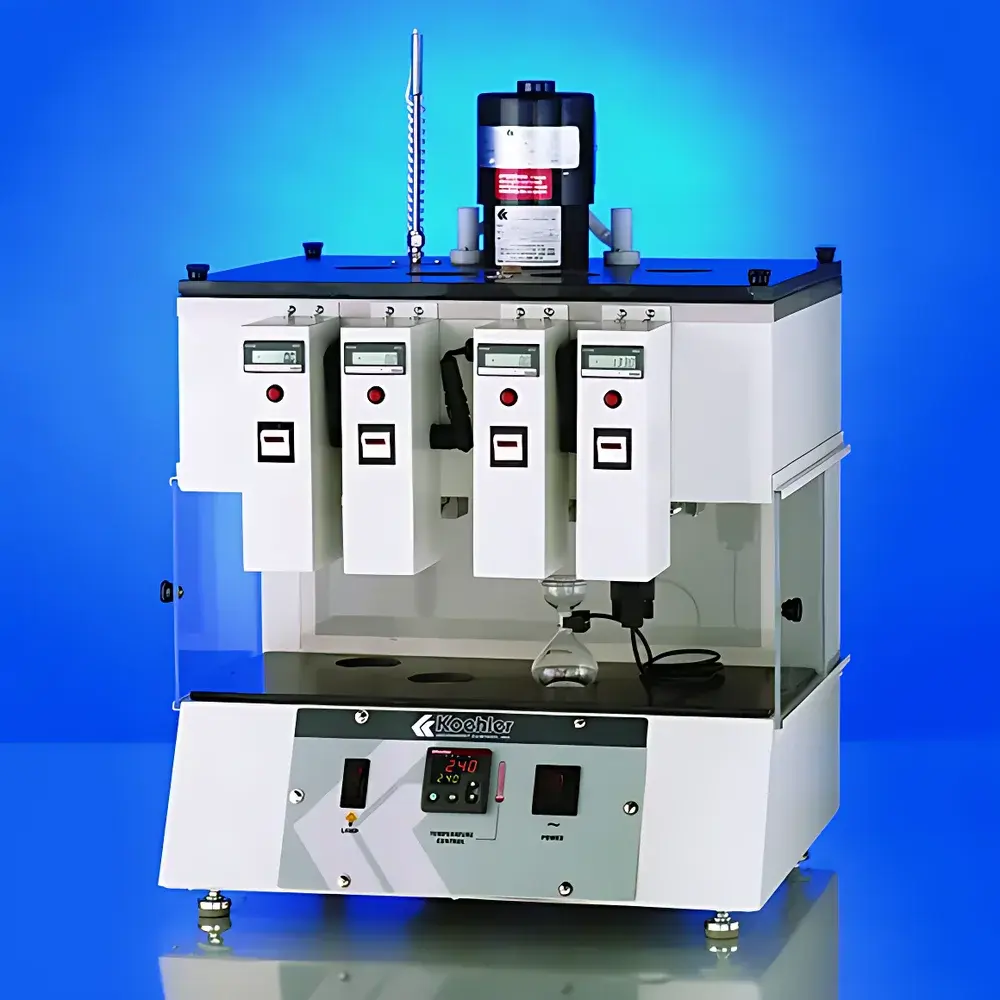
Koehler K21420 / K21424 Saybolt Universal & Saybolt Furol Viscometer
| Brand | Koehler |
|---|---|
| Origin | Canada |
| Manufacturer Type | Authorized Distributor |
| Origin Category | Imported |
| Model | K21420, K21424 |
| Price Range | USD 13,500 – 27,000 |
| Temperature Control Range | Ambient to 240 °C |
| Temperature Accuracy | ±0.03 °C |
| Bath Capacity | 19 L |
| Test Positions | 4 |
| Display | Dual-line LCD (setpoint & actual temperature) |
| Temperature Units | Selectable °C / °F |
| Timing Resolution | 0.1 s |
| Timing Accuracy | ±0.05% |
| Power Supply | 220–240 V, 50/60 Hz, Single-phase, 6.4 A |
| Dimensions (W×D×H) | 74 × 63.5 × 84 cm |
| Net Weight | 29.5 kg |
| Shipping Weight | 37 kg |
Overview
The Koehler K21420 and K21424 Saybolt Viscometers are precision-engineered instruments designed for the standardized measurement of kinematic viscosity in petroleum products using the Saybolt Universal Seconds (SUS) and Saybolt Furol Seconds (SFS) methods. These instruments operate on the principle of gravitational efflux time measurement: a precisely calibrated volume (60 mL) of sample is allowed to flow under gravity through a standardized orifice at a tightly controlled bath temperature. The elapsed time—expressed in seconds—is directly correlated to kinematic viscosity via ASTM-defined conversion tables. The K21420 model supports SUS measurements for lighter hydrocarbons including lubricating oils, insulating oils, and distillate fuels; the K21424 extends capability to SFS testing for heavier fractions such as residual fuel oils and asphaltic materials. Both models comply fully with ASTM D88 (Standard Test Method for Saybolt Viscosity), ASTM D244 (Standard Specification for Asphaltic Materials), ASTM E102 (Standard Practice for Saybolt Viscosity Tables), AASHTO T72, and FTM 791-304—ensuring data integrity across global refining, quality control, and regulatory reporting workflows.
Key Features
- Microprocessor-based PID temperature control delivering ±0.03 °C stability across the full operating range (ambient to 240 °C), validated per ASTM D88 thermal uniformity requirements;
- Four independent test positions accommodating simultaneous Saybolt viscometer tubes and corresponding 60 mL receiving flasks;
- Dual-line LCD display showing both setpoint and real-time bath temperature, with user-selectable °C/°F units;
- Optional automatic timing module (SV4000-compatible) initiating flow measurement upon button press and detecting endpoint at 60 mL discharge with 0.1 s resolution and ±0.05% accuracy;
- Chemical-resistant stainless steel bath interior and epoxy-polyester coated steel enclosure for long-term durability in refinery and lab environments;
- Integrated overflow tube and drain valve simplifying thermal fluid (water or glycol/water mixture) filling and maintenance;
- Removable anti-chemical top plate facilitating unobstructed access for cleaning and calibration verification;
- Cooling coil compatible with tap water or external chiller systems, enabling stable operation near ambient conditions;
- Flicker-free fluorescent illumination optimized for visual observation of efflux behavior without parallax error.
Sample Compatibility & Compliance
The K21420/K21424 platform accommodates a broad spectrum of petroleum-based liquids—from low-viscosity naphthas and turbine oils to high-boiling residual fuels and cutback asphalts. Sample compatibility is governed by ASTM D88’s specified temperature ranges: SUS testing typically conducted at 100 °F (37.8 °C), 122 °F (50 °C), or 210 °F (98.9 °C); SFS testing commonly performed at 122 °F or 210 °F. All components contacting sample or thermal medium meet ASTM E102 dimensional tolerances for Saybolt orifices and capillary geometry. Instrument design supports GLP-compliant operation: temperature logs, timing events, and operator inputs (where enabled via optional software interface) can be archived for audit readiness. While the base unit does not include 21 CFR Part 11 compliance out-of-the-box, its digital architecture allows integration with validated LIMS or ELN systems supporting electronic signatures and audit trails.
Software & Data Management
The K21420/K21424 operates as a standalone benchtop instrument with embedded firmware for temperature regulation and optional timing. For enhanced traceability, Koehler offers optional RS-232 or USB connectivity (via accessory interface modules) enabling direct data export to spreadsheet or laboratory information management systems (LIMS). Time-stamped efflux durations, bath temperatures, and operator IDs (when entered manually) may be captured for batch-level reporting. Conversion from SUS/SFS values to kinematic viscosity (mm²/s or cSt) follows ASTM D2161 standard conversion tables—these calculations can be automated in third-party software or performed offline using Koehler-provided reference charts. Firmware updates are distributed via Koehler Technical Support and maintain backward compatibility with legacy calibration records.
Applications
- Quality assurance of finished lubricants and base oils in ISO-certified manufacturing facilities;
- Routine viscosity screening of crude distillates and intermediate cuts during refinery fractionation;
- Specification conformance testing of marine fuels (ISO 8217) and aviation turbine fuels (ASTM D1655 Annex A2);
- Asphalt binder characterization per ASTM D88 and AASHTO M226 for pavement engineering;
- Research and development of bio-derived fuel blends where Newtonian flow behavior must be verified prior to engine testing;
- Third-party certification laboratories performing accredited testing to ISO/IEC 17025 requirements.
FAQ
What is the difference between Saybolt Universal Seconds (SUS) and Saybolt Furol Seconds (SFS)?
SUS employs a smaller orifice and is used for lower-viscosity materials (typically < 1000 SUS); SFS uses a larger orifice and is intended for higher-viscosity samples (e.g., heavy fuel oils), reducing measurement time while preserving laminar flow conditions.
Does the instrument require calibration with certified reference oils?
Yes—per ASTM D88, periodic verification using NIST-traceable viscosity standards (e.g., Cannon-Manning certified oils) is required to confirm efflux time accuracy and thermal uniformity across all four test positions.
Can the bath accommodate silicone oil or other high-temperature fluids?
The system is rated for use with water, ethylene glycol/water mixtures, or approved heat-transfer fluids up to 240 °C; compatibility with specific silicone oils must be confirmed against Koehler’s chemical resistance guide and thermal expansion specifications.
Is the automatic timer module factory-installed or field-upgradable?
The SV4000 timing module is an optional accessory available at time of order or retrofitted in the field by authorized Koehler service personnel.
How is temperature uniformity validated across the bath?
ASTM D88 specifies maximum allowable thermal gradients (≤0.02 °C/cm vertically, ≤0.05 °C horizontally); Koehler provides a validation protocol using calibrated platinum resistance thermometers (PRTs) at defined spatial points, documented in the instrument’s Certificate of Conformance.
Related Products






