
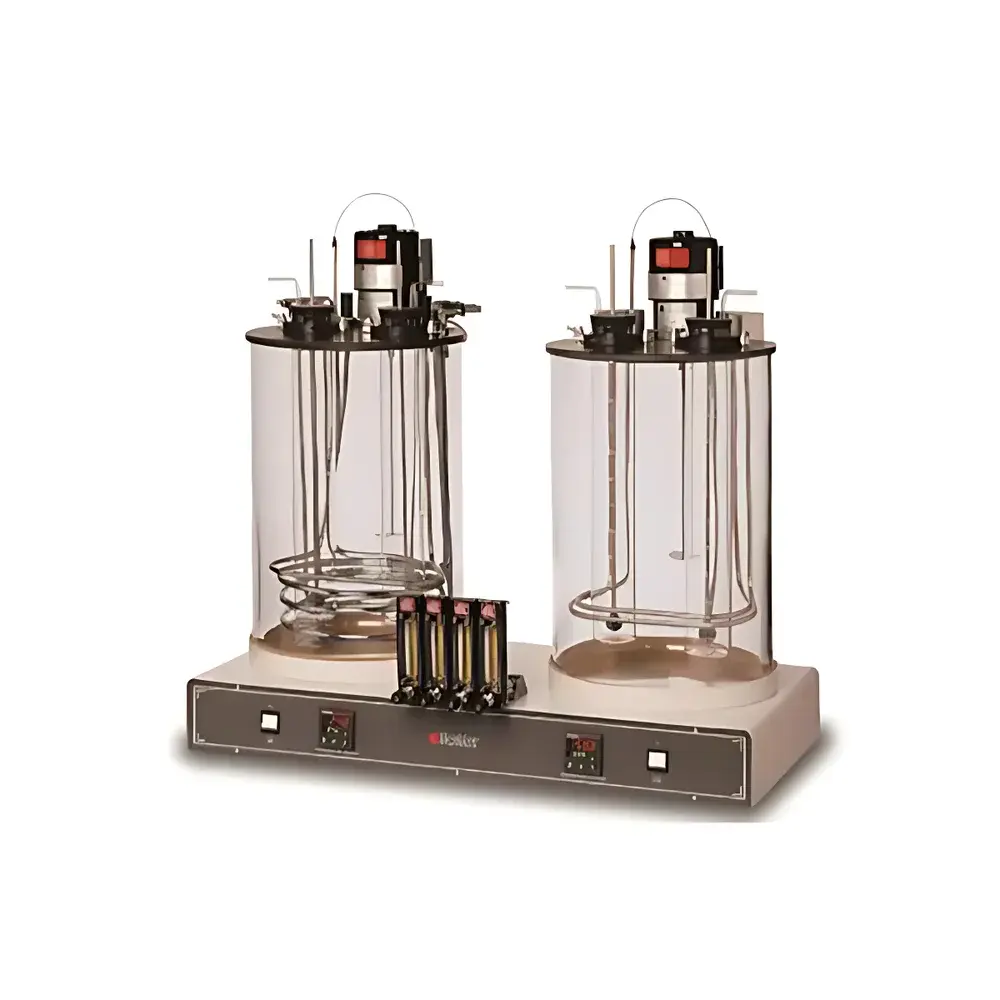
Koehler K43092 Lubricating Oil Foam Characteristics Tester
| Brand | Koehler |
|---|---|
| Origin | USA |
| Model | K43092 |
| Test Temperature | 24 °C and 93.5 °C |
| Temperature Uniformity | ±0.5 °C |
| Air Flow Rate | 94 mL/min |
| Flow Control | Four independently calibrated mass flow meters |
| Stirrer | 1/20 hp recirculating stirrer |
| Bath Configuration | Dual-temperature (24 °C + 93.5 °C), four-test-unit system |
| Cooling | Integrated cooling coil |
| Safety | Over-temperature cut-off protection |
| Compliance | ASTM D892, ASTM D6082, GB/T 12579, IP 146, DIN 51566, FTM 791-3211, NF T 60-129 |
Overview
The Koehler K43092 Lubricating Oil Foam Characteristics Tester is a precision-engineered laboratory instrument designed to evaluate the foaming tendency and foam stability of lubricating oils under standardized thermal and aerodynamic conditions. Based on the principle of controlled air sparging into a heated or ambient oil sample—followed by quantitative volumetric measurement of generated foam—the instrument implements the core methodology defined in ASTM D892 (Standard Test Method for Foaming Characteristics of Lubricating Oils) and its internationally harmonized equivalents. The test sequence involves two critical temperature regimes: an initial evaluation at 24 °C to assess baseline foam formation, followed by a high-temperature cycle at 93.5 °C to simulate operational conditions in engines and hydraulic systems where thermal degradation and surfactant volatility influence foam behavior. After each 5-minute air injection phase, foam volume is recorded immediately and again after 10 minutes of quiescent settling—providing both foam tendency (FT) and foam stability (FS) metrics essential for formulation development, quality control, and OEM specification compliance.
Key Features
- Dual-temperature bath system with independent control of 24 °C and 93.5 °C zones, enabling sequential low- and high-temperature testing without manual reconfiguration.
- Four parallel test stations, each equipped with a calibrated 94 mL/min mass flow meter—individually verified per ISO/IEC 17025 traceable procedures—to ensure inter-channel reproducibility and eliminate cross-flow interference.
- High-stability temperature regulation with ±0.5 °C uniformity across bath volume, achieved via PID-controlled heating, recirculating 1/20 hp stirrers, and integrated copper cooling coils for rapid thermal recovery between cycles.
- Over-temperature safety circuit that interrupts power if bath temperature exceeds user-defined thresholds—critical for unattended operation and long-term instrument reliability.
- Modular ceramic air diffusers and standardized 1000 mL graduated cylinders supplied as part of the base configuration, ensuring geometric consistency and minimizing meniscus-related reading errors.
- Intuitive front-panel interface with dual-scale display (°C/°F), real-time flow monitoring, and manual start/stop controls—designed for GLP-compliant documentation without dependency on external software.
Sample Compatibility & Compliance
The K43092 accommodates a broad range of petroleum-based and synthetic lubricants, including engine oils, turbine oils, hydraulic fluids, and gear oils—regardless of base stock (mineral, PAO, ester, or PAG). Its mechanical design conforms to the dimensional and procedural requirements of ASTM D892 (Method A), ASTM D6082 (for high-temperature foam assessment), and equivalent national standards including GB/T 12579 (China), IP 146 (UK), DIN 51566 (Germany), FTM 791-3211 (U.S. Department of Defense), and NF T 60-129 (France). All thermal, flow, and timing parameters are validated against the reference conditions specified in these methods, supporting audit-ready test execution in ISO/IEC 17025-accredited laboratories and facilities operating under API Q1, IATF 16949, or AS9100 quality management systems.
Software & Data Management
The K43092 operates as a standalone benchtop instrument with no embedded firmware or proprietary software—ensuring long-term maintainability and eliminating licensing dependencies. All test parameters (temperature setpoints, airflow duration, and observation intervals) are manually initiated and recorded using laboratory notebooks or LIMS-integrated data entry forms. For users requiring electronic data capture, the instrument’s analog outputs (optional) support integration with third-party DAQ systems compliant with IEEE 1451.2 or Modbus RTU protocols. While the base model does not include a built-in timer (K43092), the optional K43093 variant adds programmable cycle timing with audible alerts and relay-triggered logging—enabling alignment with FDA 21 CFR Part 11 requirements when deployed with validated electronic records systems and audit trail functionality.
Applications
- Formulation screening of anti-foam additives (e.g., silicone polymers, alkyl acrylates) during R&D of new engine oil grades.
- Batch release testing of finished lubricants against OEM specifications (e.g., GM Dexos, Ford WSS-M2C945-A, VW TL 521 82).
- Root-cause analysis of field-reported foaming issues—including oxidation-induced surfactant accumulation or water contamination effects.
- Stability monitoring of in-service oils via trend analysis of FT/FS values over extended drain intervals.
- Technical support for regulatory submissions requiring ASTM D892 data, such as EPA Safer Choice certification or REACH Annex XIV dossiers.
FAQ
What standards does the K43092 fully support?
ASTM D892 (Methods A and B), ASTM D6082, GB/T 12579, IP 146, DIN 51566, FTM 791-3211, and NF T 60-129—all verified through Koehler’s factory calibration report and NIST-traceable flow/temperature validation.
Is the K43092 suitable for use in GMP-regulated environments?
Yes—when operated with documented SOPs, calibration logs, and manual data recording per ALCOA+ principles; the optional K43093 timer version further supports 21 CFR Part 11 readiness when paired with compliant electronic systems.
Can the instrument be upgraded from K43092 to K43093?
No—timer functionality is hardware-integrated; K43092 and K43093 are distinct SKUs with separate internal controllers and front-panel assemblies.
What maintenance is required for long-term accuracy?
Annual recalibration of flow meters and temperature sensors by an ISO/IEC 17025-accredited lab is recommended; ceramic diffusers should be inspected for clogging before each test series and cleaned ultrasonically in solvent if necessary.
Does the K43092 include software for data export or reporting?
No—the instrument is hardware-only; all data must be transcribed manually or captured externally via optional analog outputs and third-party DAQ platforms.




