
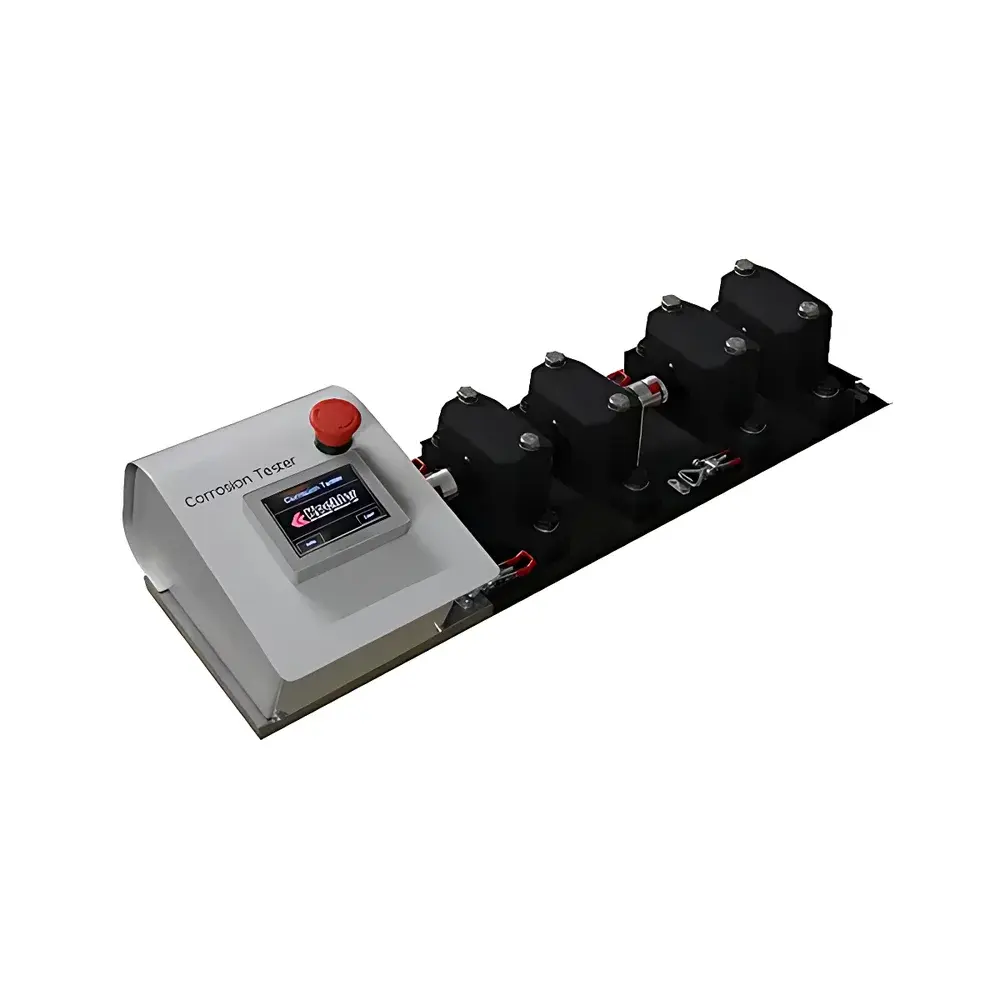
Koehler K94454 Grease Corrosion Resistance Tester
| Brand | Koehler |
|---|---|
| Origin | USA |
| Model | K94454 |
| Compliance | ASTM D6138, ISO 11007, DIN 51802, BS 2000-220, IP 220, SIS 155130, NFT 60-135 |
| Test Positions | 4 |
| Rotational Speed | 80 rpm (adjustable) |
| Test Duration | 168 h (customizable) |
| Power Supply | 110–230 V, 50/60 Hz, ≤150 W |
| Dimensions (Base Unit) | 480 × 250 × 200 mm (W × D × H) |
| Expansion Module Dimensions | 260 × 230 × 170 mm |
| Control Interface | PLC-based touchscreen panel |
| Sample Media | Grease, lubricating oil, or other test media in presence of distilled water, deionized water, NaCl solution, or synthetic seawater |
Overview
The Koehler K94454 Grease Corrosion Resistance Tester is an engineered laboratory instrument designed to evaluate the ability of greases and lubricating oils to inhibit corrosion on rolling-element bearings under controlled aqueous exposure conditions. It operates on the principle of accelerated corrosion testing via dynamic immersion: standardized double-row self-aligning ball bearings—pre-packed with test lubricant—are subjected to cyclic mechanical motion while partially immersed in corrosive aqueous media including distilled water, deionized water, 3.5% NaCl solution, or synthetic seawater. This simulates real-world service environments where bearings are exposed to moisture ingress—such as outdoor enclosures, papermaking machinery, food processing equipment, or submersible systems. The test protocol follows a 168-hour (7-day) cycle comprising alternating periods of rotation (80 rpm) and rest, enabling realistic assessment of film stability, water displacement efficacy, and anti-corrosive additive performance. Post-test, bearing raceways are cleaned and visually inspected for rust formation according to a standardized 0–5 rating scale defined in ASTM D6138.
Key Features
- Four independent test positions for parallel, statistically robust evaluation—expandable modularly up to eight positions using optional K94450-EXT kits
- PLC-controlled touchscreen interface enabling full customization of run time, dwell time, and rotational speed (factory preset: 80 rpm)
- Compliance with globally recognized standards: ASTM D6138, ISO 11007, DIN 51802, BS 2000-220, IP 220, SIS 155130, and NFT 60-135
- Robust electromechanical architecture with precision-machined bearing holders, corrosion-resistant fluid containment trays, and thermal-stable housing
- Universal sample compatibility—validated for greases, mineral and synthetic lubricating oils, and alternative test media formulations
- Low-power operation (≤150 W) and dual-voltage capability (110–230 V, 50/60 Hz) for global laboratory deployment
Sample Compatibility & Compliance
The K94454 accommodates standard ISO 1524-compliant double-row self-aligning ball bearings (typically 1205 or equivalent). Test media include distilled water, deionized water, 3.5% w/w sodium chloride solution, and synthetic seawater formulated per ASTM D1141. Lubricant samples must be applied uniformly within the bearing cavity prior to assembly. The system supports both qualitative pass/fail assessment and quantitative comparative ranking across multiple formulations. All test procedures align with Good Laboratory Practice (GLP) documentation requirements, and raw data—including timestamped operational logs and user-defined parameters—can be exported for audit-ready reporting. While not inherently 21 CFR Part 11 compliant, the instrument’s deterministic control logic and immutable test sequence execution support integration into validated workflows under GMP-regulated environments when paired with qualified LIMS or ELN systems.
Software & Data Management
The integrated PLC-based HMI provides intuitive navigation through preloaded standard methods (e.g., ASTM D6138 default cycle) and fully editable custom protocols. Each test position maintains independent status tracking—including elapsed runtime, cumulative revolutions, and fault alerts. Operational logs are stored internally with date/time stamps and user ID fields (where configured via network authentication). Data export is supported via USB flash drive in CSV format, containing metadata such as start time, stop time, speed profile, and operator notes. No cloud connectivity or remote access functionality is embedded; all data remains resident on-device unless manually exported—ensuring compliance with institutional data sovereignty policies.
Applications
- Formulation development and QC screening of anti-rust additives in lithium-, calcium-, polyurea-, and clay-thickened greases
- Comparative evaluation of base oil oxidation resistance in presence of water-induced hydrolysis
- Validation of grease performance for offshore wind turbine pitch/yaw bearings exposed to marine aerosols
- Supporting OEM specification compliance (e.g., SKF, FAG, Timken) for long-life sealed bearing applications
- Research into micelle formation, boundary film persistence, and interfacial water scavenging mechanisms
- Teaching laboratories demonstrating tribocorrosion fundamentals in materials science and lubrication engineering curricula
FAQ
What bearing type and size does the K94454 require?
Standard ISO 1524 double-row self-aligning ball bearings, typically model 1205 (25 mm bore × 52 mm OD × 15 mm width), are used. Alternative sizes may be accommodated with custom holder inserts subject to mechanical clearance verification.
Can the instrument test non-grease lubricants such as hydraulic oils or gear oils?
Yes—the test methodology applies to any lubricant capable of adhering to and coating the bearing surfaces under static and dynamic conditions. Viscosity and volatility should be considered to ensure retention during cycling.
Is calibration traceable to NIST or other national standards?
The instrument does not require periodic calibration of rotational speed or timing functions, as these are governed by certified quartz-controlled PLC oscillators. Bearing dimensional conformity and aqueous solution concentration accuracy remain the responsibility of the end user per ASTM E200 practice.
How is corrosion severity quantified after testing?
Per ASTM D6138, the outer raceway is cleaned with solvent, dried, and examined under ≥10× magnification. Rust coverage is assigned an integer rating from 0 (no rust) to 5 (severe pitting and flaking covering >50% of raceway surface).
Does Koehler provide validation documentation for IQ/OQ/PQ protocols?
Koehler supplies a Factory Acceptance Test (FAT) report with each unit. Site-specific Installation Qualification (IQ) and Operational Qualification (OQ) templates are available upon request; Performance Qualification (PQ) must be conducted by the end user using reference materials and internal SOPs.




