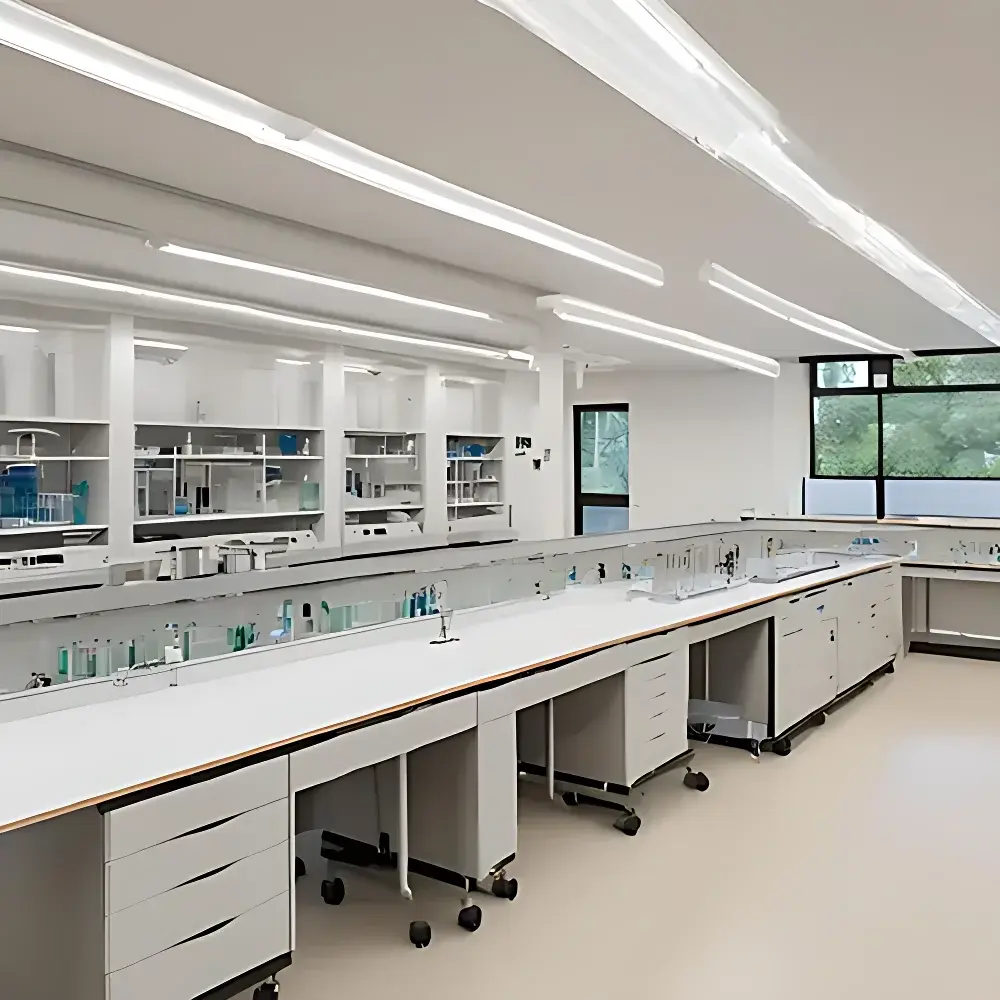
Fullband Laboratory Planning & E+PC Project Management Services
| Brand | Fullband |
|---|---|
| Origin | Beijing, China |
| Manufacturer Type | Authorized Distributor |
| Product Origin | Domestic (China) |
| Model | Custom Engineering Service |
| Quotation | Available Upon Request |
| Design Experience | 10+ Years |
Overview
Fullband Laboratory Planning & E+PC Project Management Services represent a structured, owner-centric delivery model for scientific and industrial laboratory infrastructure development. Unlike traditional turnkey EPC (Engineering, Procurement, Construction), the E+PC approach separates engineering design (E) from procurement and construction execution (PC), enabling the client to retain direct oversight of design integrity, technical specifications, and regulatory alignment—while delegating integrated implementation to a qualified PC contractor. This methodology is engineered for precision in mission-critical environments including analytical chemistry labs, petrochemical QC facilities, pharmaceutical R&D centers, environmental testing laboratories, and public health emergency response units. Fullband’s E+PC framework adheres to internationally recognized laboratory planning principles defined in ISO/IEC 17025:2017, ANSI/AIHA RP-1000, and NFPA 45 (Standard on Fire Protection for Laboratories Using Chemicals), ensuring spatial functionality, process safety, and long-term operational scalability.
Key Features
- Owner-retained design authority: Fullband delivers fully documented, code-compliant architectural, mechanical, electrical, and plumbing (MEP) schematics—including HVAC zoning, fume hood face velocity profiles, gas piping layouts, and emergency egress routing.
- Integrated PC execution: Single-point accountability for all non-structural lab build-out activities—custom casework fabrication, ductwork installation, utility distribution, instrument integration, and commissioning.
- Cross-sector domain expertise: Proven project delivery across oil & gas (CNPC, Sinopec, CNOOC), coal chemical (Shaanxi Coal, Yanchang, Yitai), power generation (China Energy, Datang), customs & border inspection (General Administration of Customs PRC), and third-party testing (Bureau Veritas, SGS, Intertek).
- Regulatory-aligned documentation: As-built drawings, equipment qualification records (IQ/OQ), HVAC validation reports, and hazardous material handling protocols prepared per GLP, GMP, and FDA 21 CFR Part 11 requirements where applicable.
- Life-cycle support extension: Optional transition services including SOP development, staff training, preventive maintenance scheduling, and laboratory information management system (LIMS) interface configuration.
Sample Compatibility & Compliance
Fullband’s E+PC methodology supports laboratories processing diverse sample matrices—including volatile organic compounds (VOCs), heavy metals, petroleum fractions, biological pathogens, food allergens, and radioactive tracers—across Class I–IV containment levels. All ventilation systems comply with ASHRAE 110 tracer gas testing standards; gas supply networks meet CGA G-1.1 and ISO 8573-1 purity classifications; and wastewater pretreatment designs conform to local discharge permits and ISO 14001 environmental management frameworks. Projects are routinely audited against CNAS-CL01 (equivalent to ISO/IEC 17025) accreditation criteria, with traceability maintained from initial functional program to final commissioning certificate.
Software & Data Management
While E+PC is a service—not a hardware product—Fullband integrates digital deliverables throughout the project lifecycle. Design coordination leverages Autodesk Revit BIM models with clash detection and spatial workflow simulation. Equipment procurement includes vendor-supplied electronic manuals, calibration certificates (traceable to NIM or NIST), and firmware version logs. Commissioning data is compiled into structured Excel-based asset registers and exported to client-preferred CMMS platforms (e.g., IBM Maximo, SAP PM). For regulated clients, Fullband provides audit-ready documentation packages supporting 21 CFR Part 11 electronic signature compliance and ALCOA+ data integrity principles.
Applications
- Petrochemical QC laboratories requiring explosion-proof instrumentation zones and hydrocarbon vapor recovery systems.
- Pharmaceutical stability testing suites with ISO Class 5–8 cleanroom certification and temperature/humidity mapping protocols.
- Environmental monitoring labs deploying EPA Method-compliant air sampling trains and ICP-MS-grade ultra-trace metal analysis areas.
- Border inspection facilities integrating rapid screening instruments (FTIR, Raman, GC-MS) with secure data transmission architecture.
- University core facilities needing modular, reconfigurable benchtop infrastructure compatible with future technology upgrades.
FAQ
What distinguishes E+PC from conventional EPC in laboratory projects?
E+PC decouples design responsibility from construction execution—allowing the owner to approve technical specifications, safety reviews, and regulatory documentation prior to PC mobilization. This reduces scope ambiguity and mitigates change-order risk during construction.
Does Fullband provide turnkey instrumentation installation as part of PC scope?
Yes—Fullband coordinates vendor-specific installation, mechanical/electrical interface verification, performance qualification (PQ), and user acceptance testing (UAT) for all analytical, safety, and environmental monitoring equipment.
Can Fullband support international clients outside China?
Yes—Fullband has delivered E+PC services in Southeast Asia, Central Asia, Africa, and Latin America, with documentation available in English and localized compliance adaptations for regional building codes and environmental regulations.
Is laboratory accreditation support included?
Accreditation readiness is embedded in the design phase. Fullband provides gap assessments, document templates aligned with ISO/IEC 17025, and pre-audit walkthroughs—but formal accreditation remains the responsibility of the laboratory operator and its designated accreditation body.
Related Products