
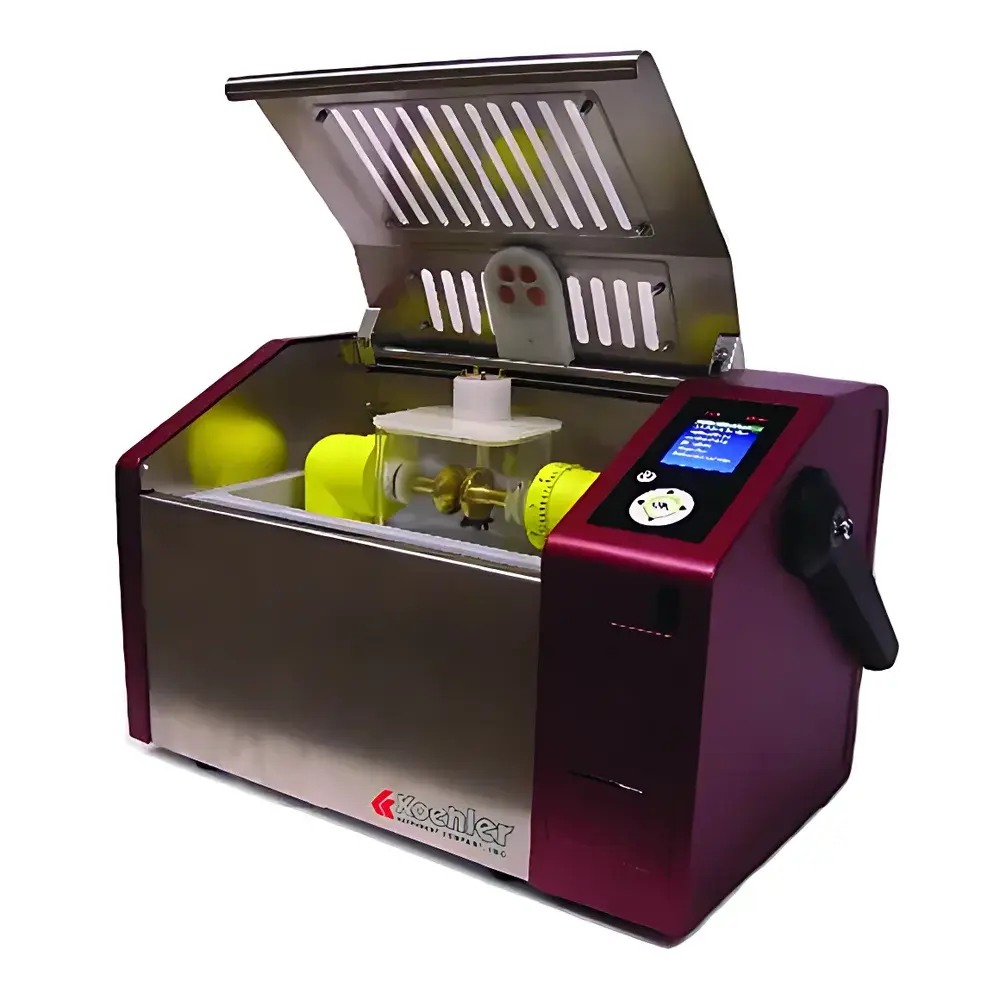
Koehler K16175 Insulating Oil Dielectric Strength Tester
| Brand | Koehler |
|---|---|
| Origin | USA |
| Model | K16175 |
| Output Voltage | 75 kV (RMS, symmetrical) |
| Rising Rate | 0.5–10 kV/s |
| Display Resolution | 0.1 kV |
| Max Power Consumption | 60 VA |
| Oil Temperature Range | 0–100 °C (resolution: 1 °C) |
| Compliant Standards | ASTM D877, ASTM D1816, IEC 60156 |
| Dimensions | 43 × 28 × 25 cm |
| Weight | 22 kg |
| Power Supply | 85–264 VAC, 47–63 Hz |
| Electrode Spacing Auto-Calibration | Yes |
| Integrated Thermal Sensor | Yes |
| Data Export | Bluetooth + USB flash drive interface |
| Built-in Thermal Cut-off & HV Interlock | Yes |
| Onboard Thermal Printer | Yes |
Overview
The Koehler K16175 Insulating Oil Dielectric Strength Tester is an engineered precision instrument designed for the quantitative assessment of dielectric breakdown voltage in transformer oils, silicone fluids, and other insulating liquids used in high-voltage power equipment. Operating on the principle of controlled voltage ramping across standardized electrode geometries—typically spherical or disk-type electrodes submerged in conditioned oil—the K16175 measures the minimum voltage at which electrical arcing initiates between electrodes under defined atmospheric and thermal conditions. This test directly correlates with the oil’s ability to resist electrical conduction under operational stress, serving as a primary indicator of contamination (e.g., moisture, particulates, oxidation byproducts) and degradation. As mandated by international grid reliability protocols, routine dielectric strength testing forms a critical component of predictive maintenance programs for transformers, circuit breakers, bushings, and capacitors—ensuring continued insulation integrity and mitigating unplanned outages.
Key Features
- Fully compliant with ASTM D877 (disk electrodes, 2.5 mm gap), ASTM D1816 (VDE electrodes, 1 mm or 2 mm gap), and IEC 60156 test methodologies—enabling traceable, inter-laboratory comparable results.
- Programmable voltage ramp rate from 0.5 to 10 kV/s, supporting both standard and accelerated testing protocols without compromising measurement repeatability.
- Integrated thermal sensor continuously monitors oil temperature during conditioning and test cycles (range: 0–100 °C, ±1 °C accuracy), enabling real-time correction per ASTM annexes requiring temperature normalization.
- Automatic electrode gap verification via digital caliper function ensures consistent geometry alignment prior to each test—critical for minimizing inter-test variance.
- Dual power operation: internal rechargeable battery support for field deployment (e.g., substation walkdowns) and universal AC input (85–264 VAC, 47–63 Hz) for lab bench use.
- 2.8-inch high-contrast color LCD display with intuitive menu navigation, real-time waveform preview, and on-screen pass/fail status indicators aligned with user-defined limits.
- Embedded thermal printer delivers immediate hardcopy reports containing test ID, date/time stamp, electrode configuration, temperature, breakdown voltage, and compliance flag—fully audit-ready.
- Hardware-level safety architecture includes dual-redundant overtemperature cutoff, automatic HV disconnection within <10 ms post-breakdown, and interlocked enclosure access control.
Sample Compatibility & Compliance
The K16175 accommodates all common insulating liquids—including mineral-based transformer oils, synthetic esters, silicone fluids, and polyalphaolefins—without modification. Its electrode chamber design conforms to ASTM D1816 Annex A1 (VDE-style) and Annex A2 (disk-style), allowing seamless transition between low- and high-sensitivity test modes. All firmware and calibration routines are developed in accordance with ISO/IEC 17025 requirements for testing laboratories. Test reports include embedded metadata required for GLP/GMP documentation workflows and satisfy data integrity criteria under FDA 21 CFR Part 11 when paired with Koehler’s optional secure software suite (version 3.2+).
Software & Data Management
Data export is supported via Bluetooth 4.2 BLE and USB 2.0 host interface, enabling direct transfer to LIMS platforms or Koehler’s proprietary K-DataLink™ desktop application. The application supports batch reporting, statistical trend analysis (X-bar/R charts), historical comparison against baseline values, and automated alert generation when results fall outside configurable tolerance bands. Audit trails record operator ID, calibration events, firmware updates, and test parameter changes—retained locally for ≥12 months with tamper-evident timestamps.
Applications
- Pre-commissioning acceptance testing of new transformer oil batches per IEEE C57.106.
- Routine in-service monitoring of distribution and power transformers per IEC 60422 guidelines.
- Root-cause analysis of insulation failure events in switchgear and cable terminations.
- Quality assurance screening of reclaimed or reconditioned insulating oils.
- Research and development of next-generation dielectric fluids under accelerated aging protocols.
FAQ
Does the K16175 require annual recalibration?
Yes—Koehler recommends annual traceable calibration using NIST-traceable high-voltage dividers and certified reference oils. Calibration certificates include uncertainty budgets per ISO/IEC 17025.
Can the instrument be used for testing non-oil dielectrics such as SF₆ gas or solid epoxy?
No—the K16175 is specifically validated for liquid-phase dielectrics only. Electrode geometry, cell volume, and voltage profile are optimized for fluid immersion testing per ASTM/IEC standards.
Is firmware update capability available over-the-air?
Firmware updates must be performed via USB flash drive using Koehler-signed binaries; no remote or network-based update functionality is implemented to maintain cybersecurity compliance in critical infrastructure environments.
What is the typical time-to-breakdown measurement resolution?
The system captures breakdown initiation with 1 ms temporal resolution and reports final breakdown voltage with 0.1 kV resolution, consistent with ASTM D877 repeatability requirements (±2% of mean).
How does the auto-gap calibration function ensure measurement fidelity?
The integrated capacitive displacement sensor measures actual electrode separation in situ before each test cycle and adjusts the voltage ramp algorithm accordingly—eliminating manual micrometer error and compensating for thermal expansion drift.






