
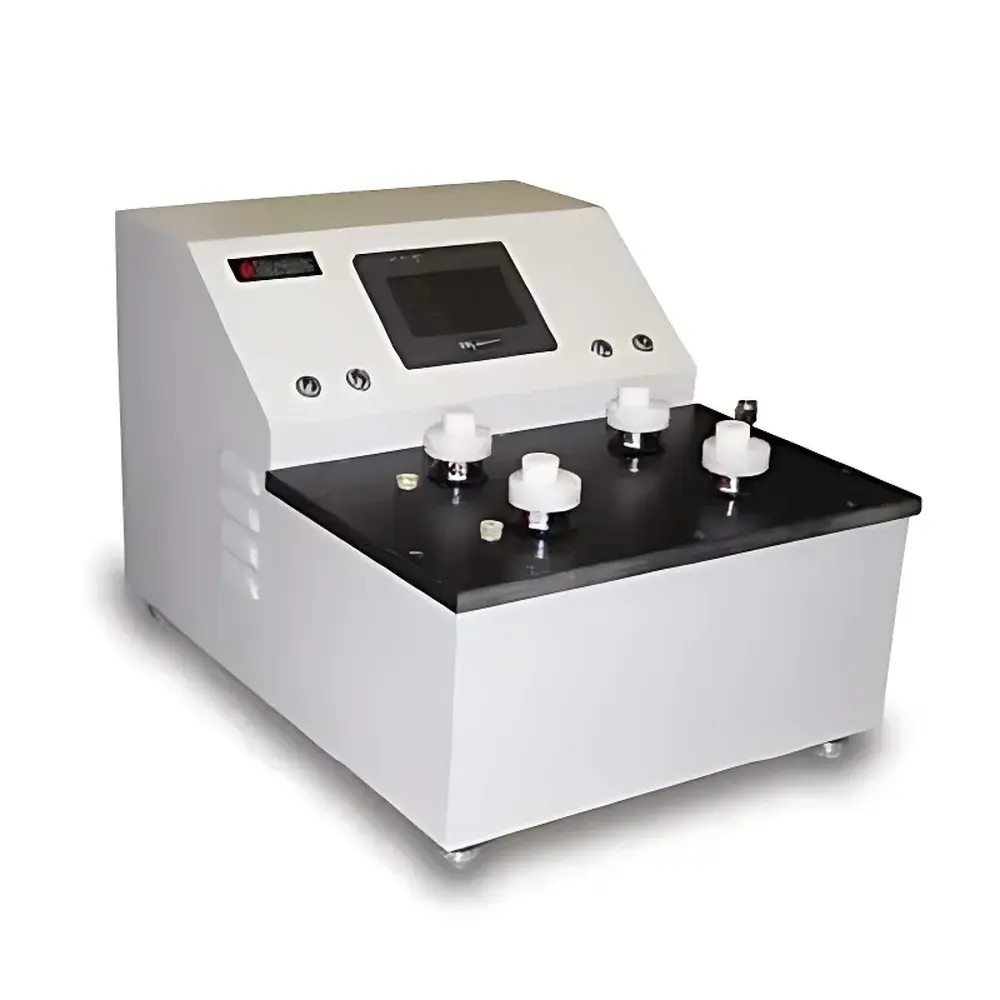
Koehler K30269 Accelerated Iron Corrosion Tester (ASTM D7548 Compliant)
| Brand | Koehler |
|---|---|
| Origin | USA |
| Manufacturer Status | Authorized Distributor |
| Origin Category | Imported |
| Model | K30269 |
| Pricing | Upon Request |
Overview
The Koehler K30269 Accelerated Iron Corrosion Tester is a precision-engineered laboratory instrument designed to evaluate the corrosivity of petroleum-based fuels and fuel blends toward ferrous metals under controlled, accelerated conditions. It operates in strict accordance with ASTM D7548, “Standard Test Method for Determining the Corrosivity of Fuels Toward Iron by the Accelerated Iron Corrosion (AIC) Test.” The method simulates real-world exposure scenarios where trace water, oxygen, and acidic or reactive species in hydrocarbon fuels initiate electrochemical corrosion on iron surfaces—particularly relevant for storage tanks, pipelines, and engine fuel systems. Unlike static immersion tests, the K30269 employs dynamic agitation and precisely regulated thermal control to accelerate corrosion kinetics while maintaining reproducibility and inter-laboratory comparability. Its core measurement principle relies on visual assessment of standardized iron test coupons after defined exposure periods, quantifying corrosion severity per ASTM D665 (for rust evaluation) and correlating results to fuel stability, additive performance, and contamination levels.
Key Features
- Peltier-based heating and cooling system enables rapid, stable temperature control at the ASTM-specified setpoint of 37.8 °C (100 °F), with minimal thermal overshoot and high long-term drift resistance.
- Dual-speed magnetic stirring mechanism provides selectable agitation rates of 100 RPM (for gentle mixing) and 900 RPM (for enhanced mass transfer and boundary layer disruption), both independently verified and digitally displayed.
- 7-inch high-resolution resistive touchscreen interface offers intuitive navigation, real-time parameter monitoring, and password-protected method setup—supporting operator-defined test durations and automatic shutdown.
- Four-position liquid bath accommodates simultaneous testing of up to four iron coupons (per ASTM D7548 requirements), each immersed in identical fuel samples under identical thermal and hydrodynamic conditions.
- Integrated digital timer with audible alert ensures precise adherence to prescribed exposure durations (typically 16–24 hours), eliminating manual stopwatch dependency and reducing procedural variability.
- Compact benchtop footprint (38.1 × 58.5 × 35.5 cm) and lightweight aluminum chassis (15.9 kg) facilitate integration into QC laboratories operating under space-constrained or modular workflows.
Sample Compatibility & Compliance
The K30269 supports a broad spectrum of hydrocarbon fuels and blends as specified in ASTM D7548, including but not limited to: gasoline; E10 (gasoline containing up to 10% ethanol); other gasoline-ethanol blends excluding those containing butane; diesel fuel (No. 1-D and No. 2-D); biodiesel blends B5, B6–B20; diesel/biodiesel mixtures; and aviation turbine fuel (Jet A, Jet A-1). Excluded materials include No. 4-D fuel oil and fuels containing halogenated compounds or strong oxidizers incompatible with iron coupon integrity. All test procedures comply fully with ASTM D7548’s requirements for coupon preparation (ASTM D665), bath fluid composition (deionized water), agitation geometry, and post-test evaluation criteria. The instrument architecture meets general laboratory safety standards for electrical equipment (IEC 61010-1) and is suitable for use in environments adhering to GLP and ISO/IEC 17025 quality management systems.
Software & Data Management
The K30269 operates via embedded firmware with no external PC dependency. All operational parameters—including temperature setpoint, stir speed, elapsed time, and user ID—are logged internally with timestamping and stored in non-volatile memory for up to 1,000 test cycles. Data export is supported via USB flash drive in CSV format, enabling traceable audit trails compatible with FDA 21 CFR Part 11–aligned documentation practices when paired with laboratory information management systems (LIMS). Audit logs record all parameter changes, start/stop events, and error conditions—critical for regulatory inspections and internal quality audits. Firmware updates are delivered via secure Koehler-provided USB image files, ensuring version control and validation compliance.
Applications
- Quality assurance of finished gasoline and diesel fuels prior to distribution, verifying conformance to refinery specifications and industry corrosion limits.
- Evaluation of antioxidant, corrosion inhibitor, and detergent additive efficacy in fuel formulations under accelerated aging protocols.
- Root cause analysis of field-reported tank wall pitting or injector fouling linked to fuel-induced iron degradation.
- Comparative testing of biofuel blends (e.g., B10, B20) to assess compatibility with legacy steel infrastructure and predict long-term storage stability.
- Supporting ASTM D7548 implementation in third-party certification labs serving API, UL, and EPA-regulated fuel markets.
- Research applications investigating the synergistic effects of water content, organic acids (e.g., naphthenic acids), and dissolved metals on iron corrosion kinetics.
FAQ
What iron coupon specifications does the K30269 require?
The instrument uses standardized 1.27 cm × 2.54 cm × 0.16 cm (0.5 in × 1.0 in × 0.063 in) low-carbon steel coupons conforming to ASTM D665 requirements, typically supplied pre-polished and passivated.
Is calibration verification required between tests?
Yes—temperature uniformity across the bath must be verified using a NIST-traceable thermometer before each test series, and stir speed should be confirmed annually with a calibrated tachometer per ASTM D7548 Annex A1.
Can the K30269 be used for non-petroleum samples such as lubricants or solvents?
No—the test method and instrument design are validated exclusively for fuels covered in ASTM D7548; application to other matrices requires method validation per ISO 17025 guidelines.
Does the Peltier system support sub-ambient operation?
No—the unit is optimized for 37.8 °C operation only; it does not provide active cooling below ambient temperature.
How is bath fluid replenishment managed?
The 1.3-gallon (4.9 L) stainless-steel bath is manually filled with deionized water prior to each test; evaporation loss is monitored visually and compensated as needed per ASTM D7548 Section 7.3.





