
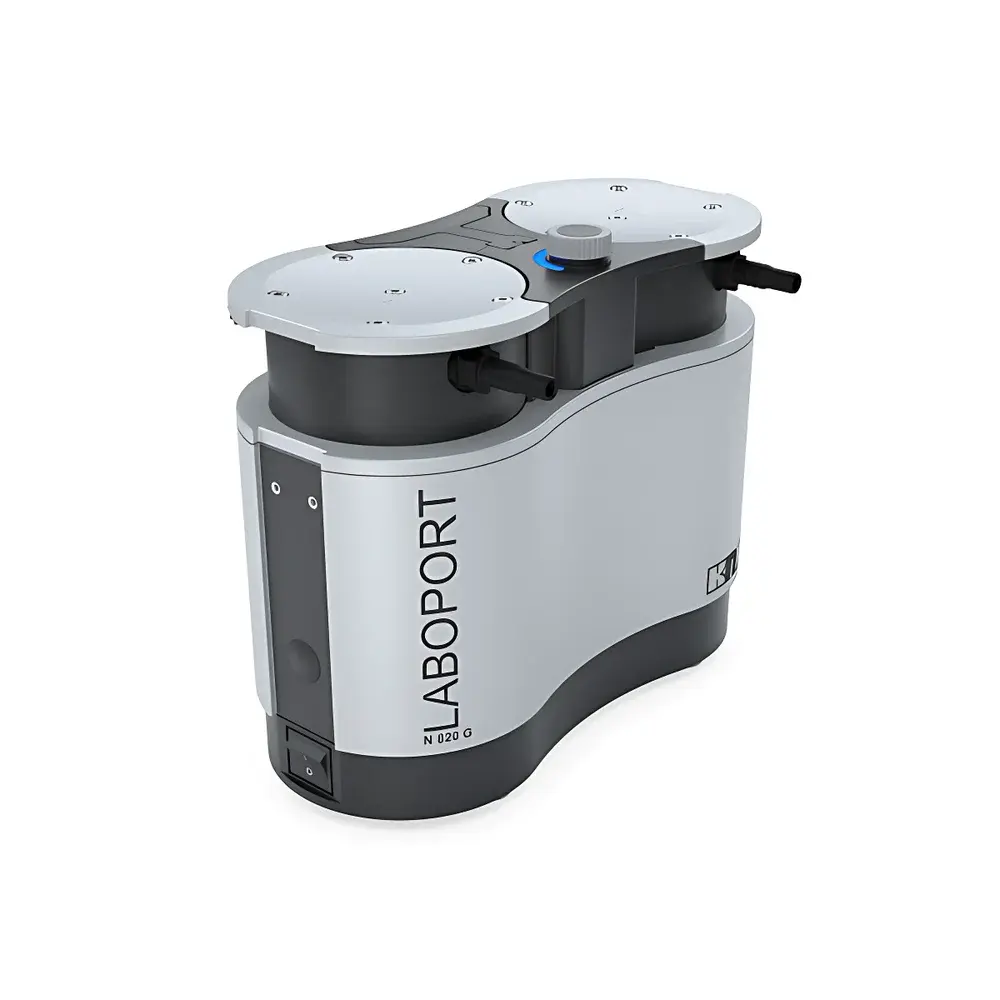
KNF LABOPORT® N 820 G Chemical-Resistant Diaphragm Vacuum Pump
| Brand | KNF |
|---|---|
| Origin | Germany |
| Model | N 820 G |
| Pump Type | Oil-Free Diaphragm Pump |
| Flow Rate | 20 L/min |
| Ultimate Vacuum | 6 mbar (abs.) |
| Operating Pressure Range | 0.1 bar (rel.) |
| Dimensions (W × D × H) | 163 × 220 × 259 mm |
| Weight | 8.8 kg |
| Motor Power | 66 W |
| Diaphragm Material | PTFE-Coated |
| Pump Head Material | PTFE/TFM |
| Valve Material | FFPM |
| Gas Ballast Valve | Integrated |
| Ambient & Media Temperature Range | 5–40 °C |
| ATEX Certification | II 2/-G IIB+H2 T3 |
Overview
The KNF LABOPORT® N 820 G is a compact, oil-free diaphragm vacuum pump engineered for precision and long-term reliability in demanding laboratory environments. Designed using proven positive-displacement diaphragm technology, it generates vacuum through reciprocating motion of a chemically inert, PTFE-coated elastomeric diaphragm—eliminating lubricants, hydrocarbon contamination, and maintenance associated with oil-sealed pumps. Its core architecture prioritizes chemical compatibility over generic performance: the entire wetted path—including pump head (PTFE/TFM), diaphragm (PTFE-coated), and valves (FFPM)—is selected to resist aggressive solvents, acidic vapors, halogenated compounds, and oxidizing agents commonly encountered in analytical sample preparation and synthesis workflows. The integrated gas ballast valve enables controlled admission of ambient air during operation, enhancing vapor handling capability and preventing condensate-induced stalling—critical when processing volatile or condensable media such as acetone, chloroform, or acetic acid vapors.
Key Features
- Chemical resistance certified via full-wetted-path construction: PTFE/TFM pump head, PTFE-coated diaphragm, and perfluoroelastomer (FFPM) valves ensure compatibility with corrosive gases and vapors.
- Oil-free operation guarantees contaminant-free vacuum—essential for mass spectrometry sample introduction, solvent recovery systems, and GLP-compliant evaporation protocols.
- Manually adjustable speed control allows real-time optimization of suction flow (20 L/min max) and ultimate vacuum (6 mbar abs.) to match process requirements—e.g., gentle degassing vs. rapid rotary evaporation.
- ATEX-certified (II 2/-G IIB+H2 T3) for safe use in potentially explosive atmospheres containing hydrogen or Group IIB gases—fully compliant with Directive 2014/34/EU.
- Compact footprint (163 × 220 × 259 mm) and low acoustic emission (<50 dB(A)) support benchtop integration in space-constrained fume hoods or automated workstations.
- Robust brushless DC motor (66 W) delivers stable torque across voltage fluctuations and ensures >20,000 hours MTBF under continuous duty cycles.
Sample Compatibility & Compliance
The N 820 G is validated for continuous exposure to media including but not limited to: hydrochloric acid (HCl) vapor, nitric acid (HNO₃) fumes, chlorine (Cl₂), ozone (O₃), hydrogen sulfide (H₂S), tetrahydrofuran (THF), dichloromethane (DCM), and ethyl acetate. It conforms to ISO 8573-1:2010 Class 0 for oil-free air quality and meets EN 61000-6-3 (EMC emission) and EN 61000-6-2 (immunity) standards. For regulated laboratories, its design supports audit readiness under FDA 21 CFR Part 11 (when paired with compliant control software), EU GMP Annex 11, and ISO/IEC 17025 documentation requirements—particularly where vacuum integrity logs, runtime tracking, and operator authentication are mandated.
Software & Data Management
While the N 820 G operates via analog speed control (potentiometer), it features a standardized 0–10 V DC analog input and digital status output (open-collector) for seamless integration into LabVantage, DeltaV, or custom SCADA platforms. Optional KNF Digital Interface Module (sold separately) enables Modbus RTU communication, enabling remote start/stop, real-time vacuum monitoring, fault logging (e.g., thermal overload, diaphragm fatigue alerts), and time-stamped operational history export—facilitating IQ/OQ validation and preventive maintenance scheduling per ISO 13485 or ASTM E2500 guidelines.
Applications
- Rotary evaporation of acid-labile or halogenated compounds without pump degradation.
- Centrifugal concentration of protein samples under mild vacuum to prevent denaturation.
- Solid-phase extraction (SPE) manifolds requiring consistent, pulse-free vacuum across 24+ channels.
- In-line degassing of HPLC mobile phases containing TFA or formic acid.
- Vacuum drying ovens processing lithium battery cathode materials exposed to HF vapors.
- Gas sampling systems for environmental monitoring of SO₂, NOₓ, or VOCs in stack emissions testing.
FAQ
Is the N 820 G suitable for pumping hydrogen chloride (HCl) gas?
Yes—the full PTFE/FFPM fluid path provides verified resistance to anhydrous HCl at concentrations up to 100% and temperatures ≤40 °C.
Can this pump be used in a Class 1, Division 1 hazardous location?
No—it holds ATEX Category 2 certification (Zone 1 equivalent), not NEC Class I Div 1; consult local authority having jurisdiction (AHJ) for installation approval.
Does the pump require periodic oil changes or filter replacements?
No—its oil-free, diaphragm-based design is maintenance-free under normal operating conditions; only external particulate inlet filters (optional) require annual inspection.
What is the maximum allowable backpressure during venting or purge cycles?
The pump tolerates up to 1.2 bar (g) on the exhaust side without mechanical damage, provided ambient temperature remains within 5–40 °C.
How does the gas ballast valve improve performance with solvent vapors?
It introduces controlled atmospheric air into the compression chamber, lowering partial pressure of condensables and preventing liquid accumulation that could impair diaphragm mobility or cause corrosion.



