
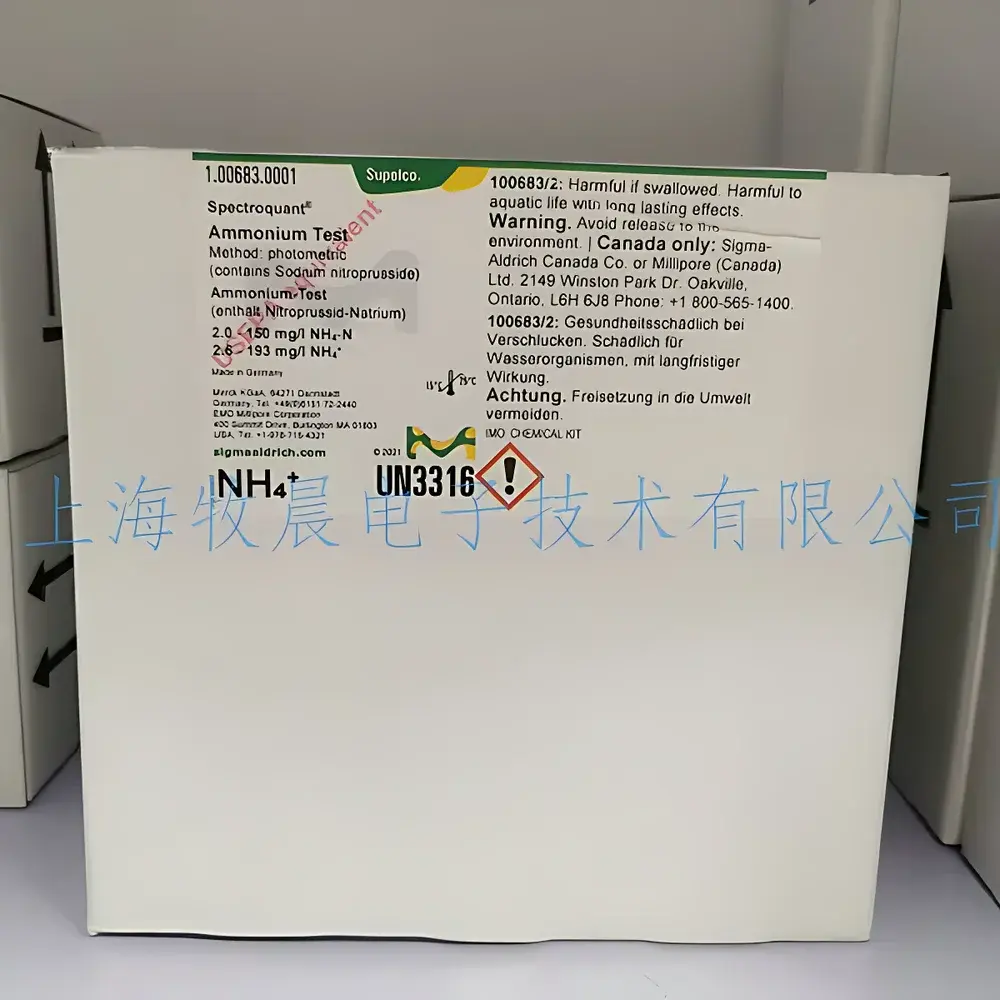
WTW Ammonia-N Test Kit 14558 for Photometric Analysis
| Brand | WTW |
|---|---|
| Origin | Germany |
| Model | 14558 |
| Format | Pre-filled Reagent Tubes |
| Compliance | DIN EN ISO 11732, EPA Method 350.1, DIN 38405-16 |
| Measurement Range (NH₄⁺-N) | 0.5–16.0 mg/L |
| Detection Principle | Indophenol Blue Spectrophotometry |
| Compatible Instruments | photoLab® 6100/6600/7100/7600, NOVA 30/60, Prove®, Move 100, photoFlex®, photoLab S6/S12 |
Overview
The WTW Ammonia-N Test Kit 14558 is a CE-marked, DIN- and EPA-compliant photometric reagent system engineered for precise, trace-level quantification of ammonium nitrogen (NH₄⁺-N) in aqueous matrices. Based on the indophenol blue reaction—where ammonia reacts with hypochlorite and phenol under alkaline conditions to form a stable blue chromophore—the kit delivers high specificity and minimal interferences from common water constituents (e.g., nitrate, chloride, turbidity ≤ 50 NTU). Designed exclusively for use with WTW’s family of benchtop and portable photometers—including photoLab® series, NOVA platforms, and Prove® instruments—the test kit eliminates manual reagent preparation, thereby reducing analyst error, cross-contamination risk, and method validation burden. Each lot undergoes full traceable QC per ISO/IEC 17025 requirements, with Certificate of Analysis (CoA) and Certificate of Quality (CoQ) supplied as standard documentation.
Key Features
- Pre-filled, ready-to-use reagent tubes with integrated barcode for automatic method selection and calibration recall on compatible WTW photometers
- Validated linear dynamic range of 0.5–16.0 mg/L NH₄⁺-N (as nitrogen), optimized for wastewater effluent, surface water, and process monitoring applications
- Stabilized reagents with ≥12-month shelf life at 2–8 °C; no refrigeration required post-opening if used within 30 days
- Batch-specific CoA and CoQ provided with every order, including pH stability data, blank absorbance values (<0.015 AU at 635 nm), and recovery rates (98.2–101.7% spiked at 1.0 and 10.0 mg/L)
- Compliance with DIN EN ISO 11732 (water quality — determination of ammonium — spectrometric method), EPA Method 350.1 (ammonia by direct Nesslerization or indophenol), and German DIN 38405-16
- Barcode-enabled workflow integration supports GLP/GMP audit trails when paired with photoLab® software and FDA 21 CFR Part 11–compliant instrument configurations
Sample Compatibility & Compliance
The 14558 test kit is validated for raw and treated waters across diverse matrices: municipal wastewater influent/effluent, drinking water distribution systems, groundwater, surface water (rivers, lakes), aquaculture recirculation units, industrial cooling towers, and pharmaceutical process water. It tolerates chloride concentrations up to 1000 mg/L and total suspended solids ≤ 20 mg/L without filtration. Samples requiring dilution must be performed using certified deionized water (ISO 3696 Grade 2). The method meets detection limit requirements of <0.05 mg/L NH₄⁺-N (3σ of reagent blank) and demonstrates repeatability (RSD ≤ 2.1%, n = 10 at 2.0 mg/L) and intermediate precision (RSD ≤ 3.4%, inter-day, n = 3) per ISO 5725-2. All reagents are manufactured in WTW’s ISO 9001-certified facility in Weilheim, Germany, and conform to REACH Annex XVII restrictions on hazardous substances.
Software & Data Management
When used with photoLab® 6600/7600 or NOVA 60 instruments, the 14558 kit integrates seamlessly into WTW’s LabStation® software suite. Barcode scanning auto-loads the correct wavelength (635 nm), calibration curve, and unit conversion (NH₄⁺-N vs. NH₃). Raw absorbance data, sample IDs, timestamps, operator logins, and instrument status flags are stored in encrypted SQLite databases compliant with ALCOA+ principles. Optional export to CSV, PDF, or LIMS-compatible XML formats supports laboratory accreditation under ISO/IEC 17025:2017. Audit trail functionality records all method modifications, result edits, and user actions with immutable timestamps—fully satisfying FDA 21 CFR Part 11 electronic record requirements when enabled.
Applications
This reagent kit serves critical monitoring functions in regulated and non-regulated environments: continuous compliance reporting for municipal wastewater discharge permits (EU Urban Wastewater Treatment Directive, US NPDES), source water characterization in drinking water utilities, nutrient loading assessment in eutrophication studies, process control in anaerobic digesters and denitrification basins, QA/QC for membrane bioreactor (MBR) effluents, and routine surveillance in food & beverage production (e.g., brewery spent wash, dairy processing rinse water). Its robustness against matrix effects also supports field deployment in mobile labs conducting emergency response testing after agricultural runoff events or industrial spills.
FAQ
Is this kit compatible with non-WTW photometers?
No. The barcode encoding, calibration algorithms, and optical path optimization are proprietary to WTW instruments. Third-party devices cannot interpret the tube barcodes or apply the embedded method parameters.
What is the recommended storage temperature for unopened kits?
Store between 2 °C and 8 °C in original packaging; do not freeze. Ambient storage (≤25 °C) is permissible for up to 6 weeks prior to first use.
Can I extend the measurement range beyond 16.0 mg/L NH₄⁺-N?
Yes—dilute samples quantitatively with WTW-certified dilution water (Order No. 116101) and apply the appropriate dilution factor in LabStation® or manually. Validation data confirms linearity up to 1:10 dilution.
Are there interference corrections built into the method?
The indophenol chemistry inherently suppresses interference from nitrite (<5 mg/L), calcium (<200 mg/L), and magnesium (1 mg/L residual chlorine, add sodium thiosulfate (1 drop of 10% w/v solution) prior to analysis.
How often should I verify calibration with certified reference materials?
Perform daily verification using WTW Ammonia-N CRM (Order No. 116110, 5.00 ± 0.15 mg/L NH₄⁺-N) before sample batches. Full recalibration is required after opening a new reagent lot or following instrument maintenance.
Related Products







