
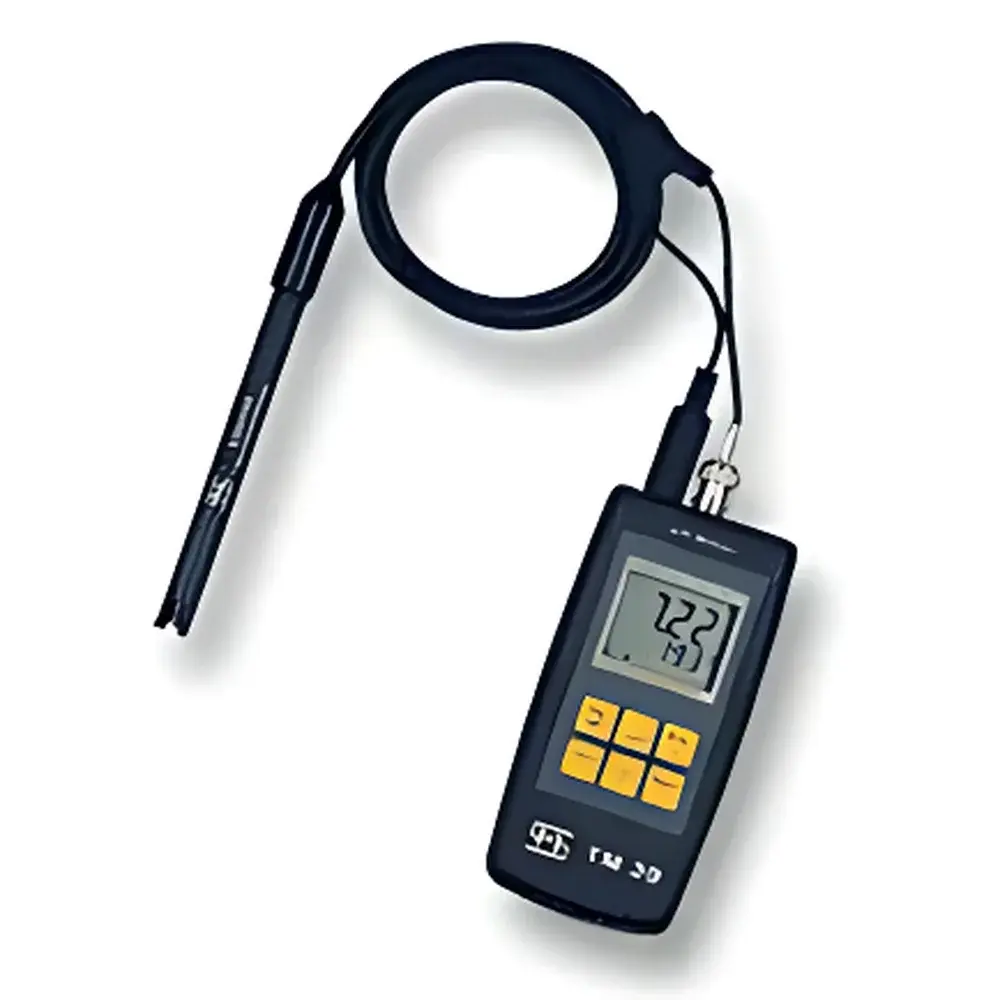
SM TM39 Portable pH/mV/Temperature Meter
| Brand | SM |
|---|---|
| Origin | Germany |
| Model | TM39 |
| Measurement Ranges | pH 0–14, mV −1999 to +1999, Temperature −70 to +250 °C |
| Resolution | 0.01 pH, 1 mV, 0.1 °C |
| Temperature Compensation | Automatic (Pt100) or Manual |
| Calibration | Auto 2-/3-point pH calibration |
| Display | LCD, 2-line × 4-digit |
| Power | 9 V battery (IEC 6F22) |
| Interface | RS-232 (TM39-D variant) |
| Operating Environment | 0–50 °C |
| Dimensions (H×W×D) | 142 × 71 × 26 mm |
| Weight | ~145 g |
| Electrode Connection | BNC (pH/ORP), Mini-DIN (temperature) |
| Compatible Electrode | EGA142/TM39 (pH/Temp composite, Ø12 mm, 120 mm immersion, Pt1000 sensor, Ag/AgCl reference, 3 mol/L KCl gel electrolyte, max. 6 bar) |
Overview
The SM TM39 Portable pH/mV/Temperature Meter is a field-deployable, laboratory-grade electrochemical instrument engineered for precision and operational flexibility across diverse measurement environments. Based on potentiometric principles, the TM39 measures hydrogen ion activity (pH), redox potential (ORP/mV), and temperature simultaneously using standardized electrode interfaces and thermistor- or Pt100-compensated signal conditioning. Its design adheres to fundamental electrochemical measurement standards—including ISO 3696 (water purity for buffer preparation), ASTM D1293 (pH of water), and EN ISO 10523 (water quality—pH determination)—ensuring traceable, repeatable results in compliance with GLP and routine QC workflows. The meter’s compact form factor, low power consumption, and rugged housing support extended use in ambient conditions (0–50 °C), making it suitable for environmental monitoring, process verification, wastewater analysis, and educational laboratories where portability and regulatory readiness are critical.
Key Features
- Simultaneous real-time measurement of pH, ORP (−1999 to +1999 mV), and temperature (−70 to +250 °C) with independent channel resolution: 0.01 pH, 1 mV, and 0.1 °C
- Intelligent electrode diagnostics that assess slope, offset, and response time to flag degradation prior to calibration drift or measurement error
- Auto-ranging 2- or 3-point pH calibration with built-in memory for up to three user-defined buffer sets (e.g., pH 4.01, 6.87, 9.18)
- Flexible temperature compensation: automatic via integrated Pt100 input (or external Pt1000 probe) or manual entry for non-thermistor-equipped electrodes
- Dual-mode rH calculation: derived from measured pH, ORP, and temperature per the Nernst equation (rH = (2 × pH) + (ORP / 295) at 25 °C), supporting redox status interpretation in biological and corrosion studies
- Min/Max data logging with timestamped storage (no external memory required); values retained during battery replacement
- Low-battery indicator and auto-power-off after 10 minutes of inactivity to preserve battery life (IEC 6F22, 9 V)
Sample Compatibility & Compliance
The TM39 supports standard BNC-connected pH and ORP electrodes—including refillable, gel-filled, and solid-state variants—as well as Mini-DIN temperature probes. Its compatibility with the EGA142/TM39 composite electrode (integrated Pt1000, Ag/AgCl reference, 3 mol/L KCl gel electrolyte, 6 bar pressure rating) ensures stable performance in viscous, particulate-laden, or low-conductivity samples such as soil extracts, fermentation broths, and industrial coolants. All measurements conform to IEC 60746-1 (electrochemical analyzers—terminology and definitions) and support audit-ready documentation when used with RS-232 output (TM39-D variant). The device meets CE marking requirements under the EMC Directive 2014/30/EU and Low Voltage Directive 2014/35/EU, and its calibration traceability aligns with ISO/IEC 17025-accredited practices when paired with certified buffer solutions.
Software & Data Management
The TM39-D variant features an RS-232 serial interface enabling direct connection to PCs or LIMS platforms for automated data capture. ASCII-formatted output includes measurement values, timestamps, electrode status flags, and calibration metadata—structured for import into spreadsheet applications or validated software compliant with FDA 21 CFR Part 11 (when deployed with appropriate system controls). No proprietary software is required; terminal emulators (e.g., PuTTY, Tera Term) or custom Python/Node-RED scripts can parse and log streams. Firmware updates are performed via serial command protocol, ensuring long-term maintainability without hardware revision dependency.
Applications
- Environmental fieldwork: surface water, groundwater, and sediment pore-water pH/ORP profiling under EPA Method 9040C and ISO 5667-3
- Pharmaceutical manufacturing: rinse water monitoring, cleaning validation, and bioreactor off-gas scrubber effluent checks per USP and Annex 1 guidance
- Food & beverage QA: brine pH control, fermentation tank redox tracking, and thermal process validation support
- Academic teaching labs: hands-on instruction in electrochemical fundamentals, Nernst behavior, and sensor calibration protocols
- Industrial maintenance: cooling tower chemistry audits, boiler feedwater redox assessment, and electroplating bath stability verification
FAQ
Does the TM39 support GLP-compliant calibration record keeping?
Yes—when used with the TM39-D RS-232 interface and validated data acquisition software, all calibration events (date/time, buffers used, slope/offset values, electrode ID) are exportable with immutable timestamps.
Can the TM39 measure pH in non-aqueous or high-ionic-strength samples?
It is optimized for aqueous systems. For non-aqueous solvents or >1 mol/L ionic strength, use a dedicated electrode with liquid junction optimization and apply manual temperature correction if Pt1000 compensation is unavailable.
Is the EGA142/TM39 electrode suitable for sterilization or autoclaving?
No—the gel-filled electrolyte and polymer body are not rated for steam sterilization. For sterile processes, consider a reusable electrode with autoclavable housing and refillable electrolyte.
What is the recommended recalibration frequency for routine QC use?
Per ISO 7870-2, verify calibration before each analytical session or every 2 hours during continuous operation; full 2-point calibration advised if slope deviates >5% from theoretical (59.16 mV/pH at 25 °C).
Does the TM39 meet FDA 21 CFR Part 11 requirements out-of-the-box?
The hardware provides audit-trail-capable data output, but full Part 11 compliance requires implementation of procedural controls (e.g., electronic signatures, access restrictions, backup integrity checks) at the system level—not the meter alone.




