
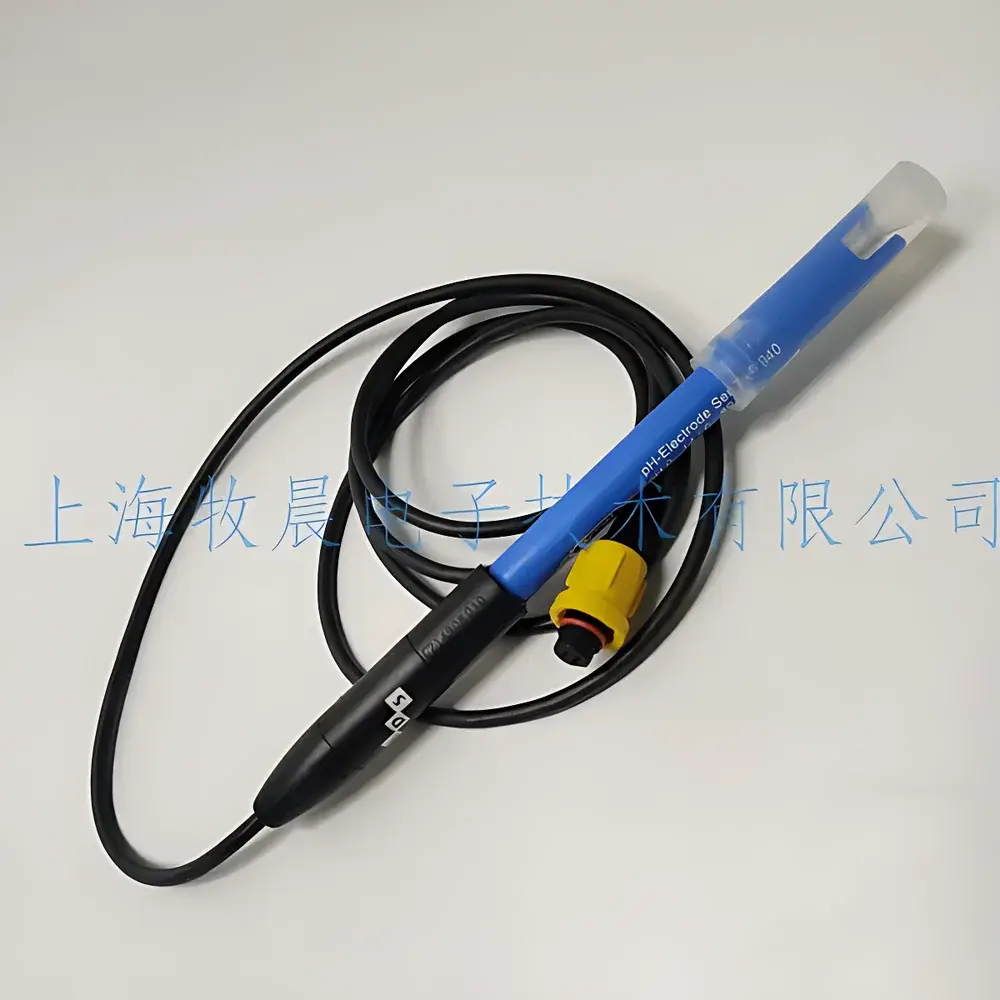
WTW SenTix 940 IDS pH Electrode for Aqueous Solutions
| Brand | WTW |
|---|---|
| Origin | Germany |
| Model | SenTix 940 |
| Measurement Range | 0.00–14.00 pH |
| Resolution | 0.01 pH |
| Temperature Range | 0–80 °C |
| Input Impedance | >1 GΩ (at 25 °C) |
| Cable Length | 1.5 m |
| Connector Type | 4-pin IDS plug |
| Reference Electrolyte | Polymer gel |
| Junction Type | Fiber junction |
| NTC Temperature Sensor | Integrated |
| Housing Material | PPE/PS composite |
| Shaft Diameter | 4.3 mm |
| Minimum Bending Radius (fixed) | 20 mm |
| Minimum Bending Radius (flexible use) | 60 mm |
Overview
The WTW SenTix 940 IDS pH electrode is an intelligent, digital pH sensor engineered for high-precision, routine measurement of aqueous solutions in environmental monitoring, municipal water treatment, laboratory QA/QC, and industrial process control applications. As a member of WTW’s Intelligent Digital Sensor (IDS) platform, it integrates non-volatile memory directly into the electrode connector—enabling automatic recognition, traceable calibration history storage, and instrument-agnostic parameter transfer. Unlike analog electrodes, the SenTix 940 digitally communicates slope, offset, calibration timestamps, and sensor identity to compatible IDS-capable meters (e.g., pH 3310, pH 3400, or Multi 3630), eliminating manual coefficient entry and reducing operator-induced errors. Its robust polymer-gel reference system with fiber junction ensures stable liquid junction potential and resistance to clogging in turbid or low-ionic-strength samples such as drinking water, surface water, and wastewater effluents. The electrode operates on the fundamental principle of potentiometric pH measurement: the voltage difference between the glass sensing membrane and the internal Ag/AgCl reference element—converted via Nernst equation—is linearly proportional to hydrogen ion activity across the full 0.00–14.00 pH range at temperatures from 0 to 80 °C.
Key Features
- Integrated IDS technology: Stores calibration data, slope, offset, and usage history within the electrode’s microcontroller—automatically loaded upon connection to any IDS-compatible meter.
- Polymer-gel reference electrolyte: Eliminates refilling requirements and minimizes diffusion potential drift; compatible with low-conductivity samples (e.g., deionized water, rainwater).
- Fiber junction design: Provides consistent electrolyte outflow and resists blockage from suspended solids or biofilm formation.
- Integrated NTC temperature sensor: Enables real-time, automatic temperature compensation (ATC) without external probes—critical for accurate pH reporting per ISO 7888 and ASTM D1293.
- Chemically resistant PPE/PS composite shaft: Withstands mechanical abrasion and exposure to common disinfectants (e.g., chlorine, sodium hypochlorite) and mild acids/bases.
- Digital signal transmission: Immune to electromagnetic interference and cable-length-induced noise—ensuring metrological integrity over the full 1.5 m cable length.
Sample Compatibility & Compliance
The SenTix 940 is optimized for aqueous matrices including potable water, groundwater, surface water, wastewater, and buffered standards. It is not recommended for use in non-aqueous solvents, strong hydrofluoric acid, concentrated oxidizers, or protein-rich biological fluids due to irreversible membrane fouling or gel degradation. The electrode complies with key regulatory frameworks governing water quality analysis: its performance specifications align with ISO 10523 (water quality — determination of pH), EPA Method 150.1, and DIN EN ISO 15839 (sensors for water quality monitoring). When used with IDS-enabled meters supporting audit trail functionality, it supports GLP-compliant workflows under 21 CFR Part 11 when paired with appropriate software validation protocols.
Software & Data Management
Calibration metadata—including date/time stamps, buffer values, measured mV, calculated slope (%), and asymmetry potential—is permanently stored in the electrode’s EEPROM and synchronized with the host meter’s internal database. This enables full traceability across multiple instruments: a single SenTix 940 can be moved between lab, field, and process meters while retaining its unique calibration identity. Compatible WTW software platforms (e.g., LabX®-compatible drivers or WTW LabManager) allow export of structured CSV or XML files containing raw sensor data, calibration logs, and QC flags—facilitating integration into LIMS environments and automated report generation per ISO/IEC 17025 requirements.
Applications
- Routine pH monitoring in drinking water distribution systems and wastewater treatment plants (primary clarifiers, aeration basins, final effluent discharge points).
- Environmental field surveys requiring rapid, reproducible measurements in streams, lakes, and groundwater wells.
- Quality control of purified water (PW) and water-for-injection (WFI) in pharmaceutical manufacturing, aligned with USP and EU Annex 1.
- Educational laboratories where electrode interchangeability, ease of calibration verification, and student-proof operation are essential.
- Long-term unattended monitoring when paired with WTW’s IQ SensorNet base stations and telemetry modules.
FAQ
How does IDS technology improve measurement traceability?
IDS stores calibration parameters directly in the electrode, enabling automatic recall and cross-instrument consistency—eliminating manual entry errors and supporting ISO/IEC 17025 documentation requirements.
Can the SenTix 940 be used for high-temperature applications?
Yes—rated for continuous operation up to 80 °C; however, prolonged exposure above 60 °C may accelerate reference gel depletion and reduce service life.
What cleaning protocol is recommended after measuring oily or fatty samples?
Rinse thoroughly with deionized water, then soak briefly (≤5 min) in warm water containing mild non-ionic detergent; rinse again with deionized water and recondition in pH 4 or 7 buffer for ≥60 minutes before recalibration.
Is recalibration required when switching between different IDS-compatible meters?
No—the electrode retains its calibration memory; the new meter automatically reads and applies the stored slope and offset values upon connection.
Why does the electrode specify a minimum bending radius?
Exceeding the specified radius (20 mm fixed / 60 mm flexible) may damage internal wiring or compromise the hermetic seal at the cable-to-housing junction, leading to electrolyte leakage or signal instability.




