
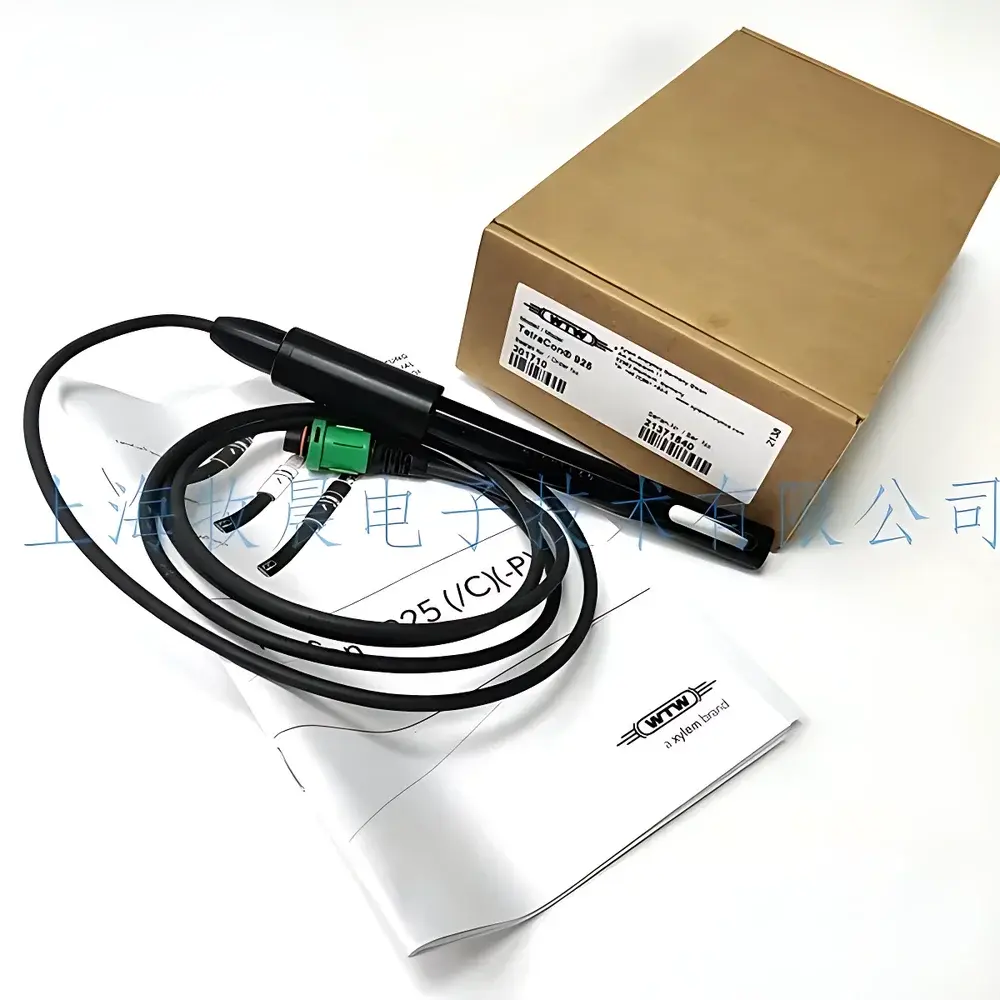
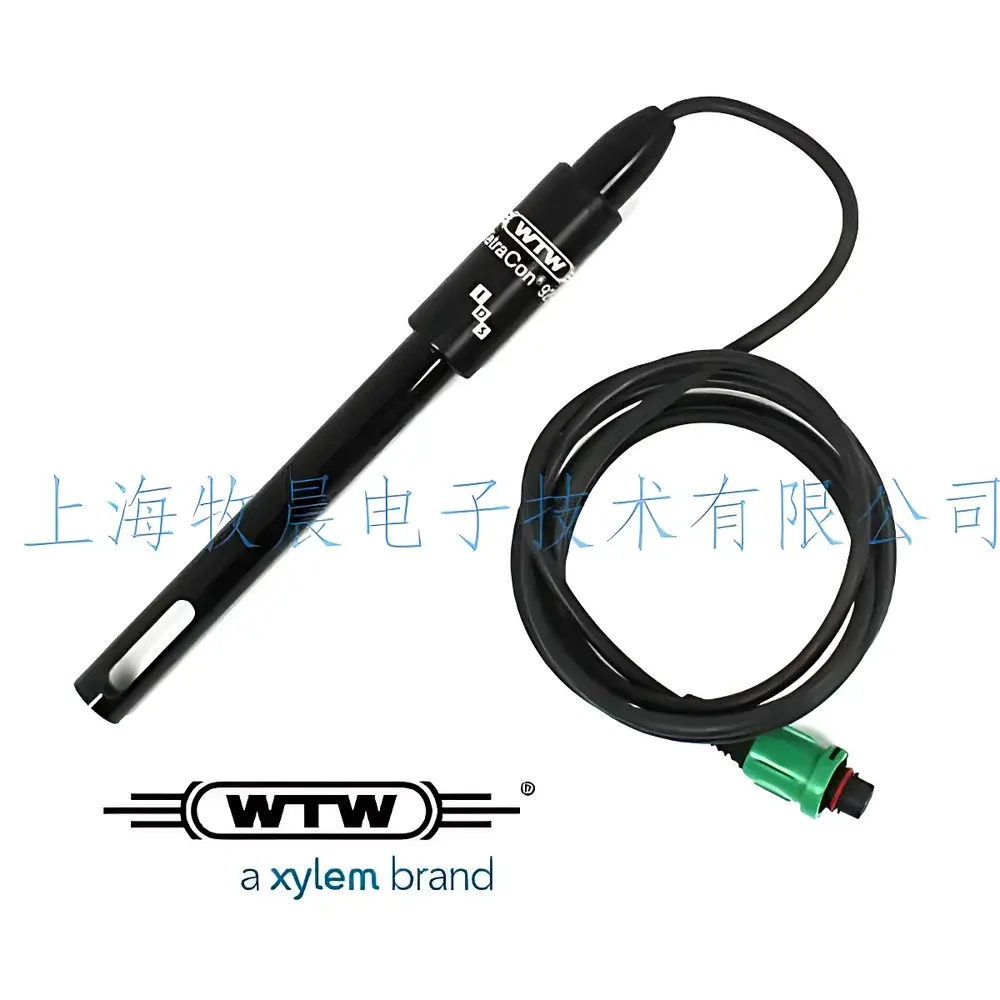
WTW IDS TetraCon 925 and LR 925/01 Conductivity Electrodes
| Brand | WTW |
|---|---|
| Origin | Germany |
| Model | TentraCon925 (TetraCon 925 series) |
| Detection Parameter | Single-parameter (Conductivity) |
| Portability | Portable |
| Application Environment | Laboratory |
| Conductivity Range | 10 µS/cm – 2000 mS/cm |
| Resistance Range | 0.5 Ω·cm – 100 kΩ·cm |
| Salinity Range | 0.0–70.0 ppt |
| TDS Range | 0–1999 mg/L, 0.0–199.9 g/L |
| Temperature Range | 0–100.0 °C |
| Electrode Type | TetraCon 925 (4-electrode graphite), LR 925/01 (coaxial 2-electrode stainless steel) |
| Electrode Body Material | Epoxy resin (TetraCon), Stainless steel (LR 925/01) |
| Dimensions | Ø15.3 × 120 mm (TetraCon), Ø12 × 120 mm (LR 925/01) |
| Cable Length Options | 1.5 m, 3 m, 6 m, 25 m |
Overview
The WTW IDS TetraCon 925 and LR 925/01 conductivity electrodes are precision-engineered electrochemical sensors designed for high-accuracy, traceable, and interference-resistant measurement of electrical conductivity, resistivity, salinity, total dissolved solids (TDS), and temperature in aqueous samples. Built upon WTW’s decades-long heritage in analytical sensor design, these IDS (Intelligent Digital Sensor) electrodes integrate digital signal processing directly at the sensor head—eliminating analog signal degradation, cable-length dependency, and manual electrode constant entry errors. The TetraCon 925 employs a four-electrode (tetrapolar) graphite configuration optimized for medium-to-high conductivity ranges (10 µS/cm to 2000 mS/cm), delivering stable performance even in fouling-prone or high-ionic-strength matrices such as wastewater, brines, and industrial process streams. In contrast, the LR 925/01 utilizes a coaxial two-electrode stainless steel design specifically calibrated for ultra-low-conductivity applications—including ultrapure water, boiler feedwater, and semiconductor rinse water—covering 0.01–200 µS/cm with minimized polarization effects and enhanced stability at sub-1 µS/cm levels.
Key Features
- Digital IDS interface with automatic electrode constant recognition and real-time calibration data storage—ensuring metrological traceability and eliminating manual setup errors.
- TetraCon 925: Four-electrode geometry suppresses polarization impedance and contact resistance artifacts, enabling reliable measurements across five orders of magnitude (10 µS/cm–2000 mS/cm) without range switching.
- LR 925/01: Coaxial dual-electrode architecture with low-noise stainless steel elements and optimized cell geometry for high sensitivity and repeatability below 10 µS/cm—critical for USP , ASTM D1125, and ISO 7888 compliance.
- Robust mechanical construction: epoxy resin body (TetraCon 925) and passivated stainless steel housing (LR 925/01) rated IP68 for continuous submersion; operating temperature range: 0–100.0 °C.
- Modular cable options (1.5 m, 3 m, 6 m, 25 m) with shielded, low-capacitance IDS-specific wiring—maintaining signal integrity independent of length or environmental electromagnetic noise.
- Optional SensoLyt® 900/FDO® 925/TetraCon® 925-compatible removable protective shroud available in plastic or stainless steel—providing mechanical protection in abrasive environments or added ballast for deep-water profiling without compromising pressure response.
Sample Compatibility & Compliance
The TetraCon 925 and LR 925/01 electrodes support compliant measurement workflows across regulated and research-grade laboratories. Their digital architecture ensures full compatibility with WTW’s multi-parameter IDS meters (e.g., Multi 9630 IDS, pHoenix 980 IDS) and supports audit-ready data logging per FDA 21 CFR Part 11 requirements when paired with validated software platforms. The TetraCon 925 meets ASTM D1125 (Standard Test Methods for Electrical Conductivity and Resistivity of Water) for routine water quality assessment and is routinely deployed in wastewater treatment plants for effluent monitoring per EU Directive 91/271/EEC. The LR 925/01 satisfies USP “Water for Pharmaceutical Purposes” specifications for conductivity verification of purified and water-for-injection (WFI) systems, including temperature-compensated and non-compensated modes per pharmacopeial protocols. Both electrodes comply with ISO/IEC 17025 calibration traceability requirements when used with accredited calibration standards (e.g., KCl solutions traceable to NIST SRM 3196).
Software & Data Management
When connected to WTW’s IDS-enabled instruments, the TetraCon 925 and LR 925/01 automatically transmit serial number, calibration history, date stamps, and sensor-specific parameters (e.g., cell constant, temperature coefficient β) via embedded EEPROM. This enables seamless integration into LIMS environments and supports GLP/GMP-compliant documentation through WTW LabX® software, which provides electronic signatures, user access control, change tracking, and exportable PDF reports with metadata embedding. All calibration events—including standardization against certified KCl reference solutions—are timestamped and stored on-device, ensuring full data lineage from measurement to report generation. No external configuration is required: the meter reads and applies the correct cell constant and temperature compensation algorithm based on the electrode’s digital identity.
Applications
- Pharmaceutical water system validation and routine monitoring (PW, WFI, SW) per USP , EP 2.2.38, and JP 2.05.
- Environmental water analysis: surface water, groundwater, seawater, and wastewater effluent per ISO 7888 and EN 27888.
- Power generation: boiler feedwater and condensate purity testing in thermal and nuclear facilities.
- Food & beverage QC: conductivity-based concentration control of brines, syrups, and cleaning-in-place (CIP) solutions.
- Academic and industrial R&D: electrolyte characterization, corrosion studies, and membrane performance evaluation.
- Field-deployable lab-on-site analysis using portable IDS meters with integrated GPS and Bluetooth data transmission.
FAQ
How does the IDS interface improve measurement reliability compared to analog electrodes?
The IDS interface digitizes the signal at the electrode head, eliminating analog voltage drop, noise pickup, and cable capacitance effects—resulting in consistent accuracy regardless of cable length or environmental EMI.
Can the TetraCon 925 be used for ultrapure water measurement?
No—ultrapure water (<1 µS/cm) requires the LR 925/01 due to its optimized low-conductivity cell geometry and reduced polarization error; the TetraCon 925 is designed for robustness above 10 µS/cm.
Is the protective shroud compatible with all IDS sensors?
Yes—the removable shroud is mechanically and electrically compatible with SensoLyt® 900, FDO® 925, and TetraCon® 925 sensors, and is offered in both plastic and stainless steel variants.
Does the electrode require recalibration after cable replacement?
No—calibration data and cell constants are stored in the electrode’s internal memory, not the cable; any IDS-certified cable can be interchanged without recalibration.
What temperature compensation algorithms are supported?
Both linear (α = 2.0 %/°C default) and nonlinear (natural water, NaCl, KCl) models are selectable via the host meter, with automatic application based on electrode ID and measured conductivity range.




