
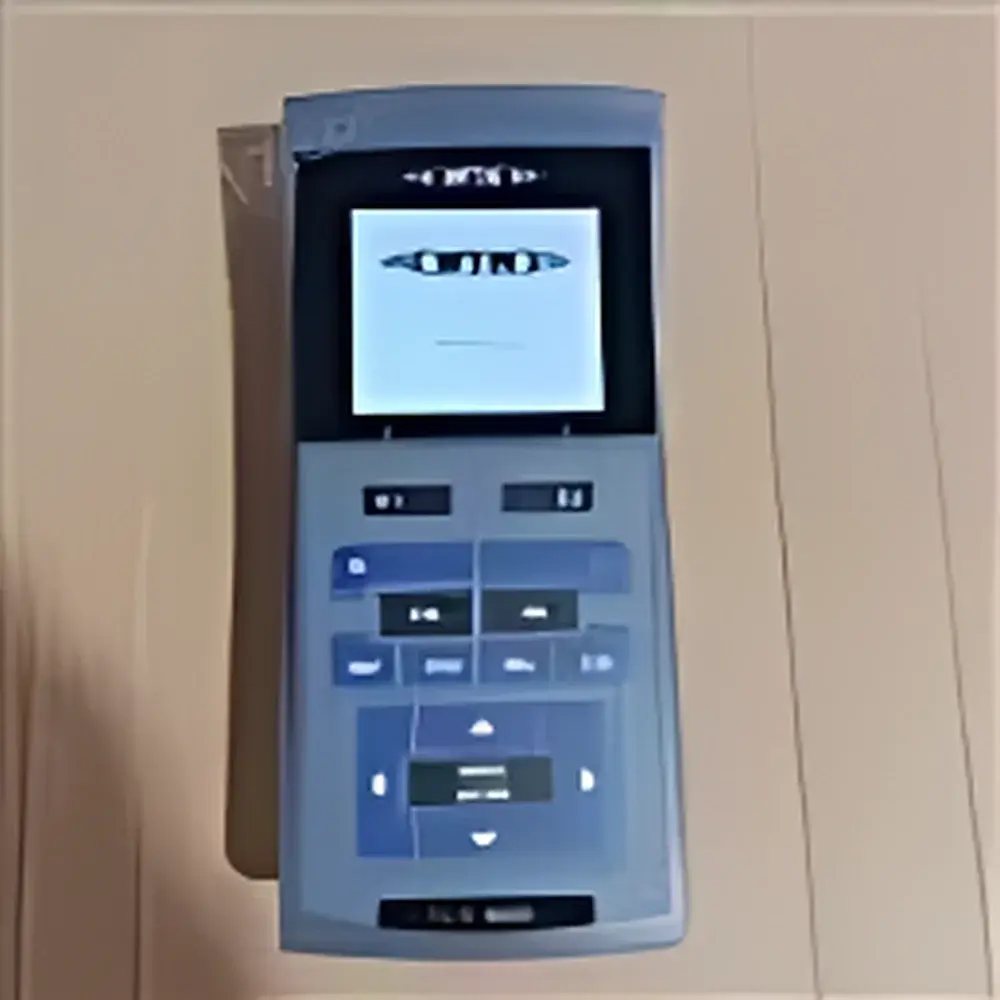
WTW Multi 3420 Portable Multi-Parameter Water Quality Analyzer
| Brand | WTW |
|---|---|
| Origin | Germany |
| Model | Multi 3420 |
| Instrument Type | Portable/Handheld Water Quality Analyzer |
| Measurement Principle | Electrochemical (pH, ORP, Conductivity), Optical (Luminescence-based Dissolved Oxygen), Nephelometric (Turbidity) |
| Measured Parameters | pH, Dissolved Oxygen (DO), Oxidation-Reduction Potential (ORP), Electrical Conductivity, Turbidity |
| Display | High-resolution color TFT screen |
| Data Storage | Up to 10,000 measurement sets with automatic logging |
| Connectivity | Dual USB (standard + mini-USB), U-disk export, PC synchronization |
| Enclosure Rating | IP67 |
| Power Supply | Rechargeable 4×1.2 V NiMH battery (up to 100 h operation) |
| Sensor Interface | Intelligent Digital Sensor (IDS) technology with auto-recognition and embedded calibration memory |
| Compliance | GLP/AQA-compliant data management, supports FDA 21 CFR Part 11 audit trail requirements via software extension |
Overview
The WTW Multi 3420 Portable Multi-Parameter Water Quality Analyzer is a field-deployable, dual-channel electrochemical and optical measurement platform engineered for high-precision, real-time analysis of critical water quality parameters in environmental monitoring, wastewater treatment, drinking water distribution, and aquatic research applications. Built upon WTW’s proprietary Intelligent Digital Sensor (IDS) architecture, the instrument operates on a sensor-driven paradigm: measurement parameters—including pH, dissolved oxygen (DO), oxidation-reduction potential (ORP), electrical conductivity, and turbidity—are determined by the connected IDS probe, not the meter itself. This decoupling ensures inherent flexibility, future-proof scalability, and metrological traceability. DO is measured via fluorescence quenching (FDO® technology), eliminating membrane fouling and electrolyte depletion issues associated with Clark-type electrodes. pH and ORP utilize SenTix® solid-state or gel-filled reference systems with integrated temperature compensation; conductivity employs TetraCon® or LR-type cells with automatic cell constant recognition. All analog signals are digitized at the sensor head, minimizing noise, drift, and cable-length-induced errors—ensuring stable, reproducible readings across variable field conditions.
Key Features
- Intelligent Digital Sensor (IDS) interface: Automatic sensor identification, plug-and-play operation, and on-board calibration history storage within each probe
- Dual independent measurement channels: Simultaneous acquisition from any two compatible IDS probes (e.g., pH + DO, conductivity + turbidity)
- High-brightness 4.3-inch color TFT display with intuitive menu navigation and real-time graphical trend visualization
- Robust IP67-rated housing: Fully sealed against dust ingress and immersion up to 1 m for 30 minutes—suitable for harsh outdoor and industrial environments
- Extended battery life: Up to 100 hours of continuous operation using rechargeable NiMH battery pack; optional AC adapter included
- Dual USB connectivity: Standard USB-A port for direct U-disk data export; mini-USB for firmware updates, PC synchronization, and printer interfacing
- GLP/AQA-compliant data handling: Timestamped measurements, user-defined IDs, and encrypted calibration logs with version-controlled metadata
- AutoRead functionality: Adaptive stabilization detection for rapid, operator-independent endpoint determination
Sample Compatibility & Compliance
The Multi 3420 accommodates a full range of WTW IDS-certified probes optimized for diverse matrices—from freshwater lakes and rivers to brackish estuaries, activated sludge, and potable water networks. Its optical DO sensor (FDO® 925 series) delivers accurate saturation and concentration readings (0.00–20.00 mg/L; 0.0–200.0% air saturation) without oxygen consumption or stirring dependence. The SenTix® 940/980 pH sensors support wide-range operation (−2.000 to 20.000 pH) with automatic temperature compensation (−5.0 to 105.0 °C). Conductivity measurement spans 0.00 µS/cm to 2000 mS/cm using auto-recognized cell constants (K = 0.01–10 cm⁻¹), with built-in TDS and salinity calculation per IOT standards. Turbidity is reported in FNU (Formazin Nephelometric Units) per ISO 7027. The system complies with ISO/IEC 17025 documentation requirements and supports FDA 21 CFR Part 11 compliance when used with WTW LabX® software and configured user access controls.
Software & Data Management
Data generated by the Multi 3420 is structured in a secure, timestamped binary format (.wtw) that preserves raw sensor values, calibration metadata, environmental context (temperature, pressure), and operator annotations. Internal memory stores up to 10,000 datasets with manual or time-triggered logging intervals (1 s to 24 h). Export to USB flash drives enables immediate offline review or transfer to laboratory information management systems (LIMS). Firmware and application updates are delivered free-of-charge via WTW’s online portal and installed through mini-USB. When paired with LabX® software, the instrument supports advanced reporting templates, statistical process control (SPC) charts, automated PDF certificate generation, and electronic signature workflows aligned with GLP, GMP, and EPA Method 160.1 validation frameworks.
Applications
- Regulatory field monitoring under EPA, EU Water Framework Directive (WFD), and national environmental protection agency protocols
- Wastewater influent/effluent characterization during plant commissioning, optimization, and compliance audits
- Drinking water quality verification at source, treatment stages, and distribution points
- Aquaculture and hydroponic system health assessment (DO, pH, conductivity stability)
- Academic and ecological field studies requiring portable, multi-parameter correlation in situ
- Emergency response for contamination events—rapid deployment with pre-calibrated sensor kits
FAQ
Does the Multi 3420 require manual sensor configuration before use?
No. All IDS probes self-identify upon connection, loading their unique calibration coefficients, measurement range, and temperature compensation algorithm automatically.
Can the instrument store calibration records for multiple sensors independently?
Yes. Each IDS probe retains up to 10 calibration events internally; the meter logs date, time, standard values used, and operator ID in its local database.
Is turbidity measurement compliant with international standards?
Yes. The IDS turbidity sensor adheres to ISO 7027:2016 for nephelometric measurement principles and reports results in Formazin Nephelometric Units (FNU).
What battery life can be expected during continuous logging in cold environments?
At 0 °C, runtime remains ≥75 h due to low-power sensor electronics and optimized power management firmware.
How is data integrity ensured during USB transfer or long-term archival?
All exported .wtw files include SHA-256 checksums and digital signatures verified by LabX® software to prevent tampering or corruption.







