
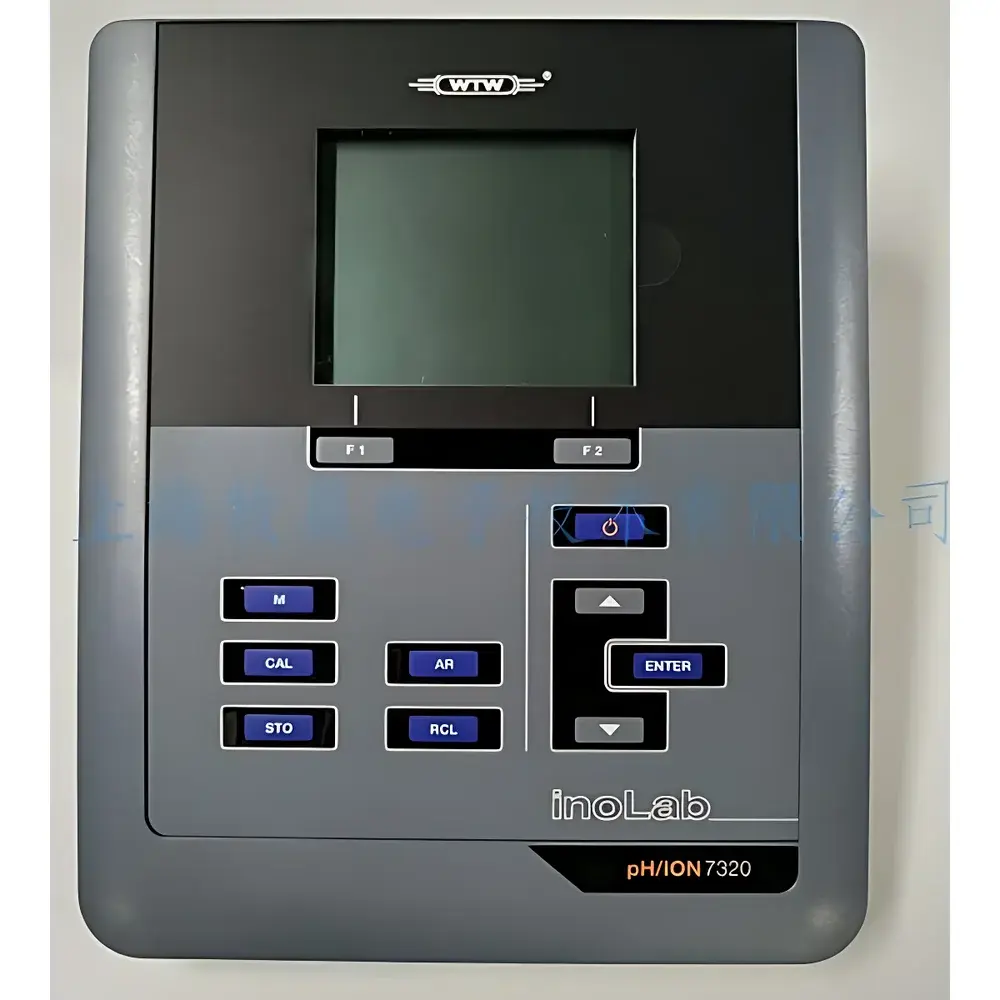
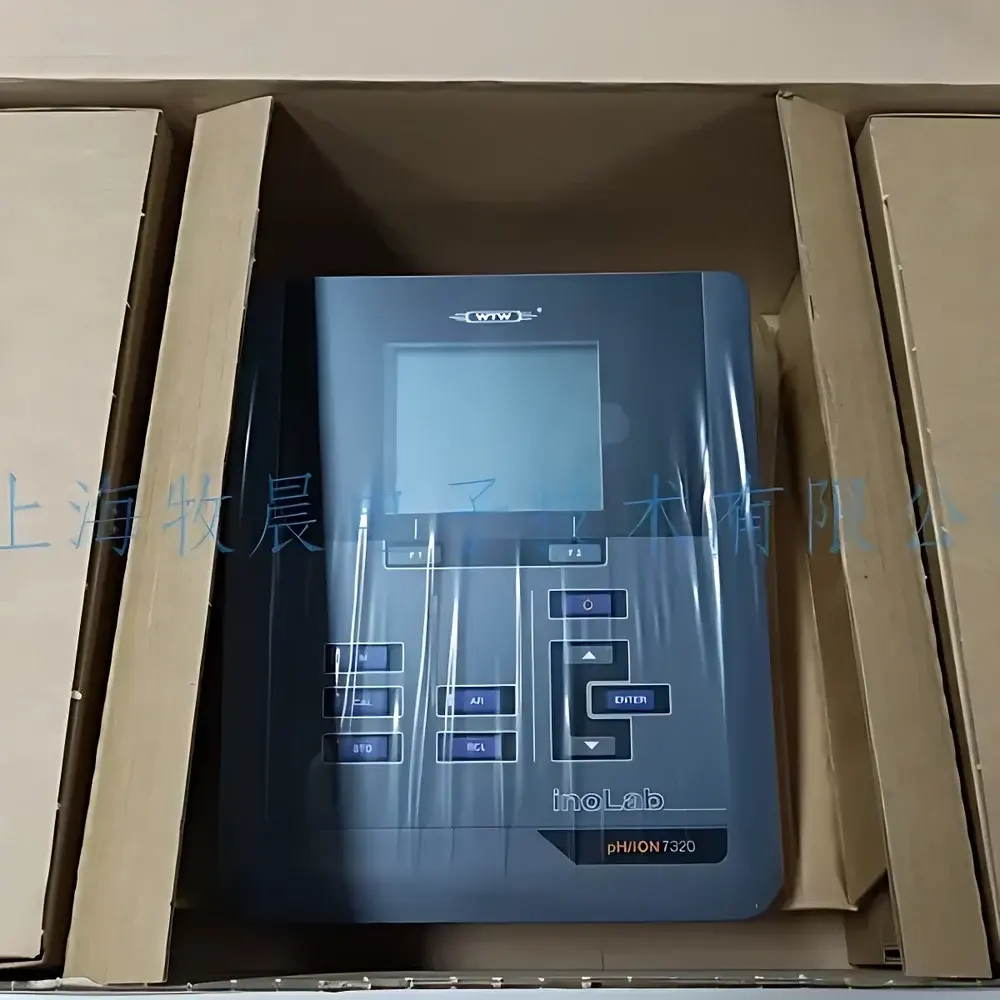
WTW inoLab pH/ION 7320 Benchtop pH and Ion Concentration Meter
| Brand | WTW |
|---|---|
| Origin | Germany |
| Model | inoLab pH/ION 7320 |
| Instrument Type | Benchtop |
| Parameter Types | Multi-parameter (pH, mV, ISE, Temperature) |
| pH Range | –2.000 to 20.000 |
| Accuracy | ±0.004 pH |
| mV Range | –999.9 to +999.9 mV (±0.2 mV), –2000 to +2000 mV (±1 mV) |
| ISE Concentration Range | 0.000–10.000 mg/L, 0.00–100.00 mg/L, 0.0–1000.0 mg/L, 0–2000 mg/L |
| Temperature Range | –5.0 to +105.0 °C |
| Accuracy | ±0.1 °C |
| Calibration | pH up to 5-point |
| Data Storage | 500 manual / 5000 automatic readings |
| Interface | Micro-USB |
| Display | Backlit LCD with graphical prompt support |
| Protection Rating | IP43 |
| Dimensions (7320) | 240 × 190 × 80 mm |
| Weight (7320) | ~0.8 kg |
Overview
The WTW inoLab pH/ION 7320 is a high-precision benchtop electrochemical analyzer engineered for routine and regulatory-compliant pH, redox potential (ORP), and ion-selective electrode (ISE) measurements in analytical laboratories. Built upon WTW’s legacy of metrological rigor and German manufacturing discipline, the instrument employs potentiometric measurement principles compliant with ISO 3696, ASTM D1293, and EN 27888 standards for water and environmental analysis. Its dual-channel input architecture enables simultaneous, independent acquisition from two electrodes—allowing concurrent pH/mV and ISE monitoring without signal crosstalk or sequential switching delays. The device integrates CMC (Continuous Measurement Control), a proprietary algorithm that dynamically evaluates electrode response stability and slope deviation in real time, thereby flagging drift or contamination before data integrity is compromised. Designed for GLP (Good Laboratory Practice) and AQA (Analytical Quality Assurance) workflows, it auto-generates timestamped, user-attributed measurement records—including calibration history, electrode ID, temperature compensation, and environmental metadata—ensuring full traceability per FDA 21 CFR Part 11 requirements when used with validated software.
Key Features
- Dual-channel input supporting simultaneous pH/mV and ISE measurements via interchangeable DIN or BNC electrode interfaces
- High-resolution display with graphical prompts, backlighting, and intuitive menu navigation for rapid method selection and parameter configuration
- CMC function continuously monitors electrode performance during measurement, detecting instability, slow response, or insufficient slope and alerting users prior to data capture
- AutoRead mode with configurable response threshold (default: 15 s) ensures consistent endpoint determination across varying sample viscosities and ionic strengths
- Comprehensive calibration support: pH calibration with up to five points using NIST/DIN traceable buffers; ISE calibration with up to seven points using certified standard solutions
- Five validated ISE calculation methods: Standard Addition, Standard Subtraction, Sample Addition, Sample Subtraction, and Blank-Corrected Standard Addition—enabling rigorous quantification across complex matrices
- Integrated data management: 500 manually triggered or 5000 automatically logged datasets stored onboard, exportable as CSV via micro-USB interface
- Optional built-in thermal printer (58 mm width) for immediate hardcopy generation of GLP-compliant reports including calibration certificates and measurement summaries
Sample Compatibility & Compliance
The inoLab pH/ION 7320 accommodates a broad range of aqueous samples—from ultrapure water and pharmaceutical buffers to wastewater effluents and industrial process streams—provided they fall within the specified temperature (–5.0 to +105.0 °C) and conductivity limits typical for potentiometric sensing. Electrode compatibility includes all WTW SenTix®, TetraCon®, and IonSelect® series sensors, as well as third-party DIN- or BNC-compatible ISEs for fluoride, nitrate, ammonium, calcium, sodium, potassium, chloride, and other monovalent/divalent ions. The instrument conforms to IEC 61010-1 for electrical safety and carries IP43 ingress protection—suitable for controlled laboratory environments but not for continuous splash exposure. All firmware and calibration routines are designed to meet ISO/IEC 17025 documentation requirements, and the system supports audit trails, electronic signatures, and user-level access control when paired with WTW LabX™ or compatible LIMS platforms.
Software & Data Management
Data transfer and archival are facilitated through a standard micro-USB port, enabling direct connection to Windows or macOS systems for file export in comma-separated values (CSV) format—compatible with Excel, MATLAB, and statistical analysis packages. The included PC software provides secure import of calibration logs, measurement histories, and electrode diagnostics, with optional encryption and digital signature verification. Each dataset embeds critical metadata: operator ID, date/time stamp, sensor serial number, ambient temperature, calibration status, and CMC evaluation result. For regulated environments, the instrument supports 21 CFR Part 11 compliance when deployed with validated software configurations, including role-based permissions, immutable audit logs, and electronic record retention policies aligned with GxP frameworks. Firmware updates are delivered via WTW’s official support portal and require cryptographic verification before installation.
Applications
- Environmental testing labs performing EPA Method 9040C (fluoride), 9056 (nitrate), and ISO 10523 (pH of water)
- Pharmaceutical QC/QA departments verifying buffer pH and ionic excipient concentrations per USP and
- Food and beverage laboratories measuring salt content (Na⁺), nitrite (NO₂⁻), or calcium (Ca²⁺) in raw materials and finished products
- Academic research groups conducting ion speciation studies, equilibrium constant determinations, and titration curve modeling
- Industrial process control for electroplating baths, boiler feedwater, and semiconductor rinse water where ppm-level ion monitoring is critical
FAQ
Does the inoLab pH/ION 7320 support automatic temperature compensation (ATC)?
Yes—the instrument accepts input from integrated Pt1000 or external NTC temperature probes and applies matrix-specific algorithms for pH and ISE measurements across its full operating range.
Can calibration data be exported separately from measurement records?
Yes—calibration events are stored as discrete entries with full traceability, including buffer IDs, measured slopes, asymmetry potentials, and acceptance criteria compliance flags.
Is the built-in printer required for GLP compliance?
No—GLP compliance is achieved through electronic records and metadata integrity; the printer is an optional convenience feature for immediate documentation.
What electrode types are certified for use with this model?
WTW SenTix 21, SenTix 41, SenTix 81, TetraCon 325, and all IonSelect ISEs with DIN or BNC connectors are fully supported and factory-validated.
How is data security maintained during USB transfer?
Files are read-only exports; no firmware or configuration parameters can be modified via USB—preventing accidental corruption or unauthorized configuration changes.
Related Products





