
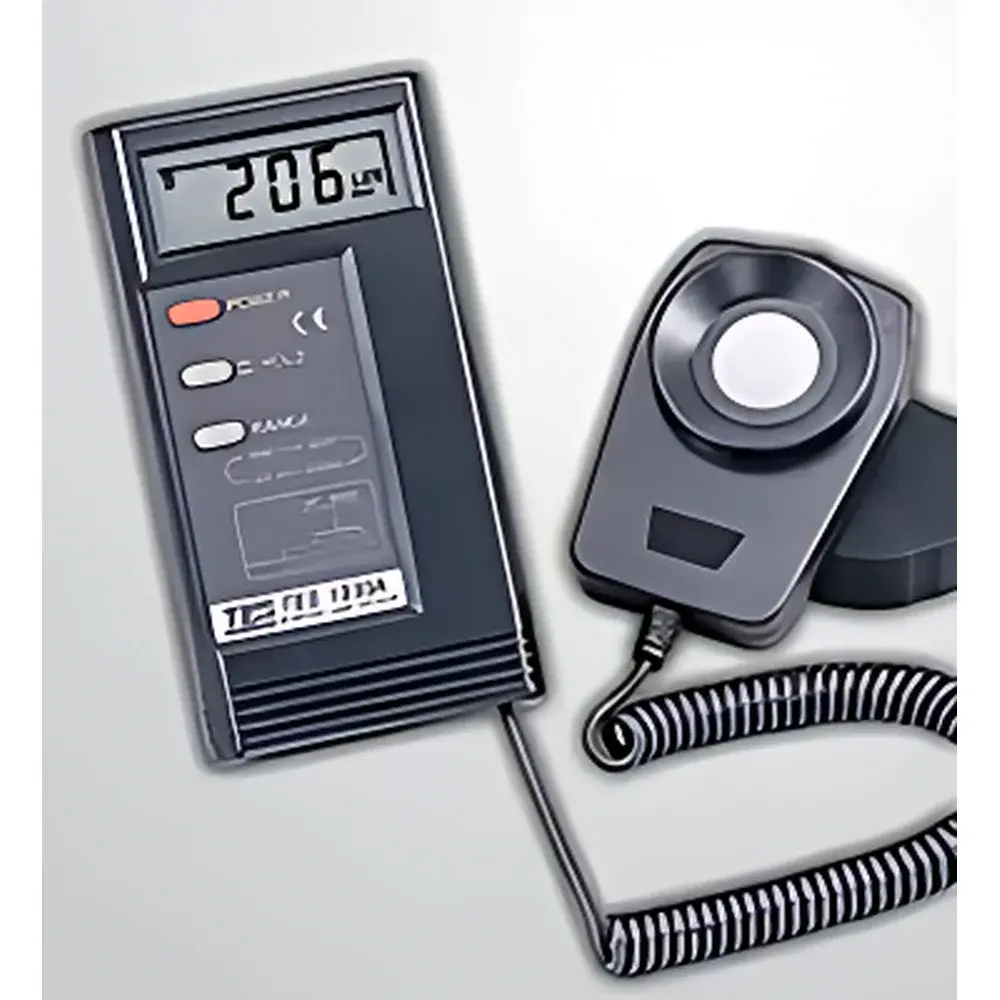
TES-1330A / TES-1332A / TES-1334A Digital Illuminance Meter
| Origin | Taiwan |
|---|---|
| Manufacturer Type | Authorized Distributor |
| Regional Origin | Asia-Pacific |
| Model | TES-1330A / TES-1332A / TES-1334A |
| Display | 3½-digit LCD |
| Measurement Ranges | 20/200/2000/20000 lux (TES-1330A & TES-1334A) |
| Resolution | 0.01 lux (TES-1330A, TES-1334A), 0.1 lux (TES-1332A) |
| Accuracy | ±3% rdg ±0.5% f.s. (<10,000 lux) |
| Repeatability | ±2% |
| Temperature Coefficient | ±0.1% / °C |
| Sampling Rate | ~2 Hz |
| Recorder Output | DC 2 V full-scale (TES-1332A & TES-1334A) |
| Operating Environment | 0–40 °C, <70% RH |
| Power | 9 V alkaline battery |
| Detector Dimensions | 100 × 60 × 27 mm |
| Meter Dimensions | 135 × 72 × 33 mm |
| Weight | 250 g |
| Accessories | Instruction manual, protective carrying case, 9 V battery |
Overview
The TES-1330A, TES-1332A, and TES-1334A are portable, handheld digital illuminance meters engineered for reliable photometric measurement in industrial, architectural, environmental, and occupational health applications. Each model operates on the principle of silicon photodiode-based luminous flux detection, with spectral response closely aligned to the CIE photopic luminosity function (V(λ)) — ensuring traceable, human-eye-weighted illuminance readings in lux (lx) or foot-candles (fc). The instruments comply with fundamental photometric calibration standards referenced to a 2856 K tungsten-filament standard lamp, enabling metrological consistency across routine field assessments. Designed for laboratory-grade repeatability (±2%) and stable thermal performance (±0.1% / °C), these meters support rapid, non-invasive evaluation of lighting conditions in compliance with ISO/CIE lighting assessment protocols and OSHA/IESNA workplace illumination guidelines.
Key Features
- 3½-digit LCD display with auto-ranging capability across four measurement spans — optimized for both low-light precision and high-intensity environments
- Dual-range architecture: TES-1330A and TES-1334A cover 20–20,000 lux; TES-1332A extends to 200,000 lux via ×10/×100 scaling modes
- Real-time data hold function (Data Hold) for stable reading capture during transient or inaccessible measurements
- Peak-hold mode (exclusive to TES-1334A) for recording maximum instantaneous illuminance values — critical for pulsed or modulated light sources
- Analog recorder output (DC 2 V full-scale) on TES-1332A and TES-1334A models, compatible with strip-chart recorders, data loggers, or analog input modules in SCADA systems
- Compact, ergonomic housing (135 × 72 × 33 mm) with integrated detector head (100 × 60 × 27 mm), minimizing shadowing artifacts and enabling single-hand operation
- Low-power design powered by a single 9 V alkaline battery (typical service life >100 hours), suitable for extended field deployment
Sample Compatibility & Compliance
These meters are intended for measuring steady-state and quasi-stationary broadband visible light sources — including incandescent, halogen, fluorescent, LED, and OLED fixtures — within the 400–700 nm spectral band. While not designed for narrowband spectral analysis or UV/IR radiation, their V(λ)-matched photodiode ensures conformity with CIE S 023/E:2013 and IEC 60825-1 safety-related illuminance requirements. Calibration traceability is maintained to national standards through factory alignment against NIST-traceable 2856 K reference lamps. The devices meet general-purpose requirements for ISO 8995-1 (lighting of work places), EN 12464-1 (European lighting standards), and ANSI/IES RP-1-20 (Recommended Practice for Lighting in Industrial Facilities). No CE, UKCA, or FDA regulatory marking is applied, as these are non-medical, non-explosive environment instruments.
Software & Data Management
The TES-1330A/1332A/1334A series operate as standalone analog-digital hybrid instruments with no embedded firmware or USB connectivity. Data acquisition relies on manual recording or external analog logging. For integration into GLP-compliant workflows, users may connect the DC 2 V output signal (TES-1332A/1334A) to validated third-party data acquisition systems supporting IEEE 1057 or IEC 61000-4-30 Class A compliance. While the meters themselves do not provide audit trails or electronic signatures, their analog output enables time-synchronized logging with timestamped, calibrated acquisition hardware meeting 21 CFR Part 11 requirements when paired with appropriate software validation packages.
Applications
- Verification of lighting uniformity and compliance in office, classroom, and healthcare facility installations per IESNA LM-79 and ISO/CIE spatial mapping protocols
- Occupational safety audits assessing minimum illuminance thresholds for visual task performance (e.g., OSHA 1910.303(h)(1), EN 12464-1 Table 3)
- Photobiological safety screening of LED luminaires prior to IEC TR 62778 assessment
- Field validation of daylight harvesting control systems in smart building commissioning
- Quality assurance checks during luminaire manufacturing and retrofitting projects
- Environmental monitoring of light pollution in ecological studies using standardized lux-based metrics
FAQ
What is the spectral response profile of the sensor?
The built-in silicon photodiode incorporates optical filtering to approximate the CIE V(λ) luminous efficiency function, with typical f1′ deviation < 6% — suitable for general-purpose photometry but not spectrally resolved analysis.
Can the meter measure pulsed or flashing light sources?
The sampling rate (~2 Hz) limits effective capture of fast transients; however, the TES-1334A’s peak-hold function enables recording of maximum amplitude from duty-cycle-modulated sources with periods ≥500 ms.
Is calibration certificate included with shipment?
A factory calibration report referencing 2856 K standard lamp conditions is supplied; NIST-traceable certification requires optional third-party recalibration service.
Does the instrument support data logging internally?
No internal memory or logging capability is provided; continuous monitoring requires external analog data acquisition hardware connected to the DC 2 V output port.
What is the recommended recalibration interval?
Annual recalibration is advised under routine use; more frequent verification is recommended after mechanical shock, prolonged exposure to >40 °C, or operation outside specified humidity limits.





