
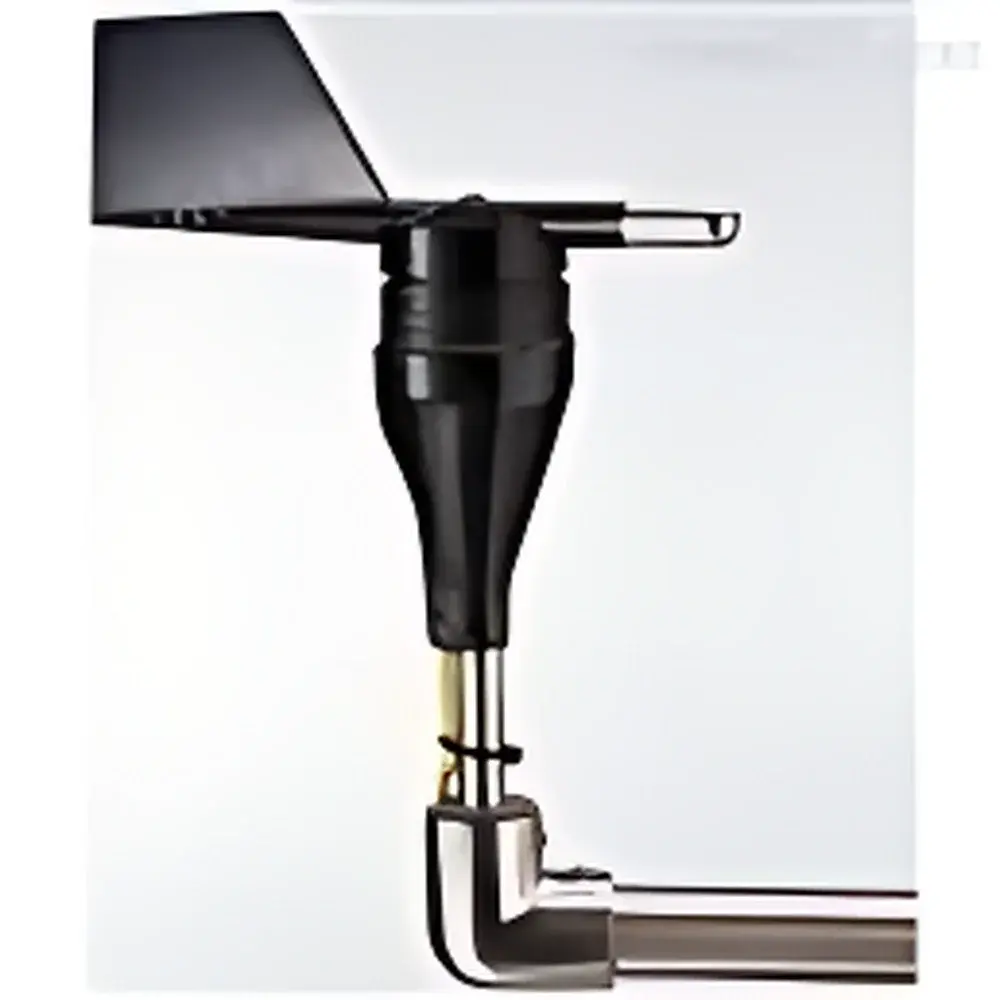
Global Water WE570 Wind Vane Sensor
| Brand | Global Water |
|---|---|
| Origin | USA |
| Model | WE570 |
| Output Signal | 4–20 mA (2-wire loop) |
| Wind Direction Range | 0–360° |
| Sensitivity | ≥1 m/s |
| Accuracy | ±1° (full-scale) |
| Operating Voltage | 10–36 VDC |
| Warm-up Time | ≥3 s |
| Operating Temperature | −40 °C to +55 °C |
| Housing | Marine-grade epoxy-encapsulated electronics |
| Cable | Standard 7.6 m marine-grade shielded cable (custom lengths up to 152 m available) |
| Mounting | 25 mm (1") NPT threaded elbow adapter |
| Dimensions | Ø21.5 cm × 26.7 cm (height) |
| Weight | 0.5 kg |
| Compliance | RoHS, CE-marked for industrial environmental use |
| Standard Kit | WE570 sensor with 7.5 m cable and user manual |
| Optional Accessory | WQEXC extended cable (up to 150 m) |
Overview
The Global Water WE570 Wind Vane Sensor is a rugged, industrial-grade anemometric transducer engineered for continuous, high-reliability wind direction measurement in demanding outdoor environments—including agricultural meteorological stations, coastal monitoring networks, and remote environmental observatories. Based on a precision potentiometric wind vane mechanism, the WE570 converts angular position of the wind vane into a linear 4–20 mA analog current signal—compatible with standard industrial process control systems, data loggers (e.g., GL500), and alarm controllers (e.g., PC320). Its design adheres to marine-grade durability standards: all electronic components are fully potted in corrosion-resistant epoxy resin and housed within a UV-stabilized rubber overmold, ensuring long-term stability under cyclic thermal stress, salt fog exposure, and mechanical vibration.
Key Features
- True 0–360° azimuth resolution with ±1° full-scale accuracy, traceable to NIST-calibrated reference standards during factory verification
- Two-wire 4–20 mA output with intrinsic loop-powered operation—eliminates need for separate signal conditioning or external power at the sensor node
- Marine-specification 7.6 m twisted-pair shielded cable (AWG 22, tinned copper conductors, PVC jacket); optional WQEXC extension cables support installations up to 152 m without signal degradation
- Integrated 25 mm (1″) NPT mounting elbow enables secure, vibration-damped attachment to mast or pole structures without additional brackets
- Extended operational envelope: functional from −40 °C to +55 °C, validated per IEC 60068-2 environmental stress testing protocols
- RoHS-compliant construction and CE marking confirm conformity with EU directives for electromagnetic compatibility (EMC Directive 2014/30/EU) and low-voltage safety (LVD Directive 2014/35/EU)
Sample Compatibility & Compliance
The WE570 is designed for integration into heterogeneous environmental monitoring infrastructures. Its 4–20 mA output is compatible with programmable logic controllers (PLCs), SCADA RTUs, and certified data acquisition systems compliant with IEC 61131-3 and ISO/IEC 17025-accredited calibration practices. When deployed in agricultural meteorological stations, it meets the functional requirements outlined in FAO Irrigation and Drainage Paper No. 56 for evapotranspiration modeling inputs. The sensor’s passive potentiometric architecture ensures immunity to radio-frequency interference (RFI) and electrostatic discharge (ESD), supporting deployment in lightning-prone regions per IEC 62305-2 Level IV surge protection guidelines. All units undergo 100% functional burn-in and temperature-cycling validation prior to shipment.
Software & Data Management
While the WE570 operates as a stand-alone analog transducer, its 4–20 mA output integrates natively with Global Water’s GL500 Series data loggers and PC320 alarm controllers—both supporting configurable scaling, linearization, and time-stamped storage per ISO 14001 environmental management system requirements. When paired with GL500 firmware v4.2+, the sensor supports automatic zero-drift compensation via periodic baseline checks and stores raw mA values alongside derived wind sector statistics (e.g., dominant quadrant, vector-averaged direction). Audit trails, user-access logs, and configuration change history comply with GLP/GMP-aligned data integrity principles, including ALCOA+ attributes (Attributable, Legible, Contemporaneous, Original, Accurate, Complete, Consistent, Enduring, Available).
Applications
- Agricultural microclimate monitoring for irrigation scheduling and frost warning systems
- Wind resource assessment at distributed solar-wind hybrid sites
- Coastal erosion and sediment transport studies requiring directional wind persistence metrics
- Regulatory air quality monitoring networks where wind direction triggers particulate sampling protocols (e.g., EPA Method 201A)
- Educational meteorological stations requiring NIST-traceable, maintenance-free instrumentation
- Industrial stack emission dispersion modeling input under ASTM D6521-22 guidance
FAQ
What is the maximum recommended cable length for accurate 4–20 mA signal transmission?
For optimal signal fidelity and noise immunity, Global Water specifies a maximum loop resistance of 600 Ω. With standard AWG 22 cable (16.5 Ω/100 m), this supports up to 152 m total loop length—including both supply and return legs—when powered at ≥24 VDC.
Is the WE570 suitable for use in explosive atmospheres?
No. The WE570 is not ATEX, IECEx, or UL Class I Div 1 certified. It is rated for general industrial outdoor use only and must be installed outside classified hazardous zones per NEC Article 500.
Can the sensor output be directly interfaced with Modbus RTU systems?
Not natively. A 4–20 mA to Modbus RTU signal converter (e.g., Acromag 963EN-4AI) is required to digitize and protocol-translate the analog output for integration into Modbus-based SCADA architectures.
Does Global Water provide NIST-traceable calibration certificates?
Yes. Optional factory calibration with NIST-traceable documentation (ISO/IEC 17025 accredited lab) is available upon request and includes uncertainty budgets per GUM (JCGM 100:2008).
Related Products







