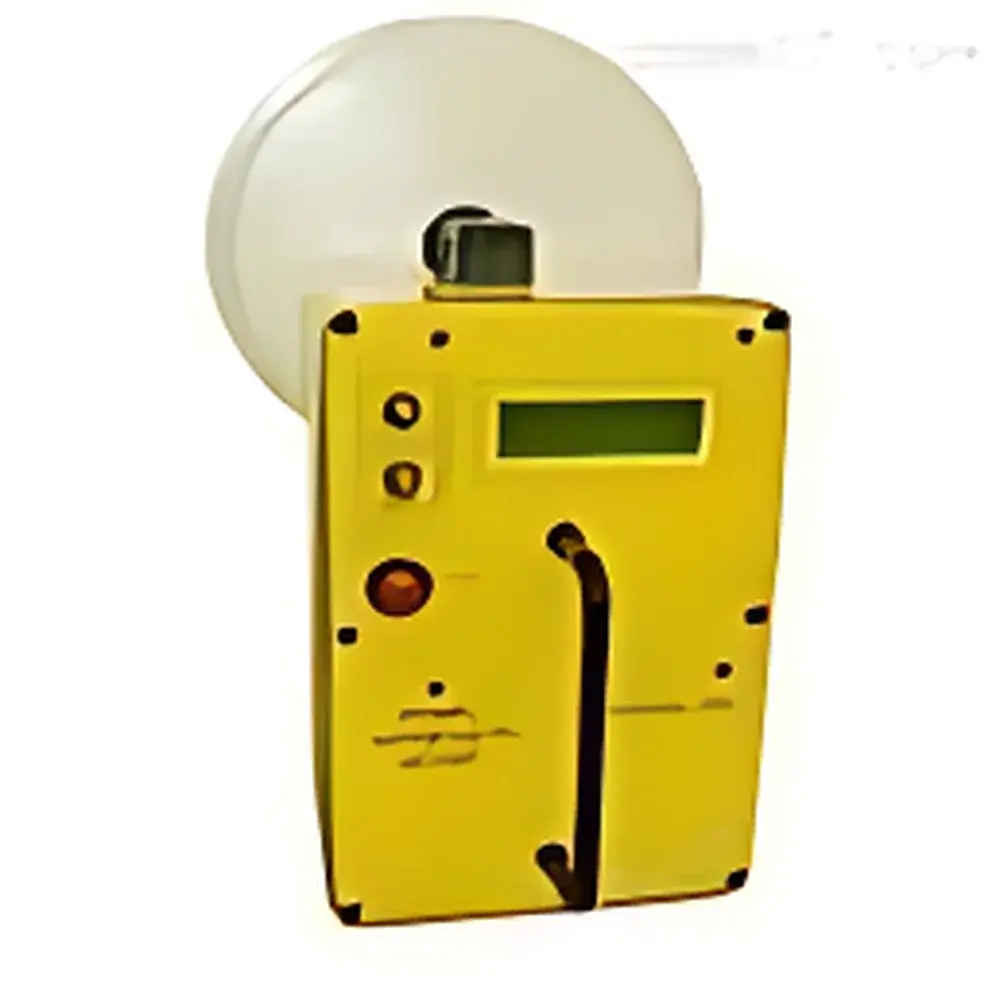
Global Water WL650 Portable Ultrasonic Water Level Meter
| Brand | Global Water |
|---|---|
| Origin | Germany |
| Manufacturer Status | Authorized Distributor |
| Origin Category | Imported |
| Model | WL650 |
| Product Type | Ultrasonic Water Level Meter |
| Measurement Range (Normal Mode) | 3–152 m |
| Measurement Range (Deep Mode) | 61–366 m |
| Display Resolution | 0.1 ft |
| Accuracy | ±0.2% of reading |
| Operating Temperature | −1 to 60 °C |
| Power Supply | 8 × AA alkaline batteries |
| Dimensions | 180 × 100 × 130 mm |
| Transducer Tube Diameter | 16 mm |
| Transducer Tube Length | 50 mm |
| Minimum Aperture | 1/2 inch (12.7 mm) |
| Weight | 1.5 kg |
| Standard Accessories | AM0075 probe reel assembly, user manual |
| Optional Accessory | AM0100 WL610 well cap (6-inch diameter) |
Overview
The Global Water WL650 is a field-deployable, battery-powered ultrasonic water level meter engineered for rapid, non-contact measurement of static water levels and total well depth in unconfined or confined boreholes. Unlike pressure transducers or float-based systems, the WL650 employs time-of-flight ultrasonic pulse reflection from the water surface—eliminating physical immersion, sensor fouling, or hydraulic disturbance. Its transducer emits a 40 kHz acoustic pulse through a rigid 16 mm-diameter polypropylene guide tube; the elapsed time between emission and echo return is converted into distance using the speed of sound in air (temperature-compensated), enabling direct depth-to-water-surface calculation. Designed for geotechnical, hydrological, environmental monitoring, and groundwater resource assessment applications, the WL650 operates reliably across diverse well configurations—including PVC, steel, concrete, and fractured-rock casings—without requiring wellhead modification or electrical continuity.
Key Features
- Two operational modes: Normal mode (3–152 m) for shallow to medium-depth wells; Deep mode (61–366 m) optimized for low-amplitude echo detection in deeper or acoustically attenuating environments.
- Integrated dual-alert system: Simultaneous audible beep and LED flash upon transducer contact with the well bottom—enabling precise total depth determination independent of water level.
- Obstruction-tolerant design: Maintains full accuracy when ≤50% of the well cross-sectional area is occupied by cables, pipes, pump housings, or irregular casing features.
- Universal compatibility: Functions identically across electrically insulating (e.g., PVC, fiberglass) and conductive (e.g., stainless steel, galvanized pipe) well materials—no grounding or shielding required.
- Field-robust mechanical architecture: Precision-machined ABS housing, IP65-rated enclosure, and integrated brake knob prevent cable slippage during transport or storage.
- Self-diagnostic functionality: Press-and-hold test button initiates system verification—including battery voltage check, transducer integrity, and alert circuit validation—prior to deployment.
Sample Compatibility & Compliance
The WL650 is validated for use in vertical or gently deviated boreholes ≥12.7 mm (1/2 inch) internal diameter. It accommodates both open and capped wells, including those fitted with standard 6-inch (AM0100) well caps for sanitary access control. The device complies with IEC 60529 (IP65 ingress protection), meets RoHS Directive 2011/65/EU material restrictions, and supports data collection protocols aligned with USGS NWIS and EPA Method 9020B for groundwater level reporting. While not intrinsically safe for Class I Division 1 hazardous locations, its passive ultrasonic operation and absence of spark-generating components render it suitable for most Class II and general-use field environments.
Software & Data Management
The WL650 operates as a standalone field instrument with no embedded memory or digital interface. All measurements are manually recorded via the calibrated steel tape reel (AM0075) marked in 0.1-ft increments. For traceable data workflows, users integrate readings into external logging platforms (e.g., ESRI Field Maps, AquiferTest, or custom Excel templates) that support metadata tagging—including date/time stamp, well ID, operator name, temperature, and measurement mode. The device’s ±0.2% reading accuracy and temperature compensation (−1 to 60 °C) ensure consistency across seasonal field campaigns and satisfy QA/QC requirements under ASTM D4043 and ISO 5555 for hydrogeological instrumentation.
Applications
- Groundwater monitoring networks: Routine static water level surveys across municipal, agricultural, and regulatory compliance wells.
- Well rehabilitation and development: Pre- and post-pumping evaluation of drawdown recovery and aquifer response.
- Environmental site assessments: Detection of perched water tables, contaminant plume migration, and landfill leachate monitoring.
- Geotechnical instrumentation: Verification of piezometer performance and correlation with settlement or slope stability data.
- Educational and training deployments: Hands-on instruction in hydrogeology, environmental science, and civil engineering field methods.
FAQ
Does the WL650 require calibration before each use?
No—factory calibration is retained across operating temperatures and battery cycles. Users perform a functional self-test prior to deployment to verify transducer output and alert functionality.
Can the WL650 measure water levels in wells with turbulent or aerated surfaces?
Yes—the ultrasonic pulse is reflected from the bulk air–water interface; minor surface agitation does not impair echo detection. However, sustained high-velocity inflow (e.g., active artesian flow) may reduce signal-to-noise ratio in Deep mode.
Is the 16 mm guide tube reusable across multiple wells?
Yes—the polypropylene tube is chemically inert, UV-stabilized, and rated for repeated insertion and withdrawal. Replacement tubes (part #AM0075-TUBE) are available for abrasion-prone conditions.
What is the minimum well diameter for reliable operation?
The system requires ≥12.7 mm (1/2 inch) clear internal aperture to accommodate the transducer tube. Accuracy degrades gradually below 250 mm (10 inches) due to increased acoustic reverberation; optimal performance occurs in 100–250 mm diameter casings.
How does temperature affect measurement accuracy?
The internal thermistor automatically compensates for air temperature variations between −1 °C and 60 °C. Uncertainty introduced by temperature drift is included in the stated ±0.2% reading specification.