
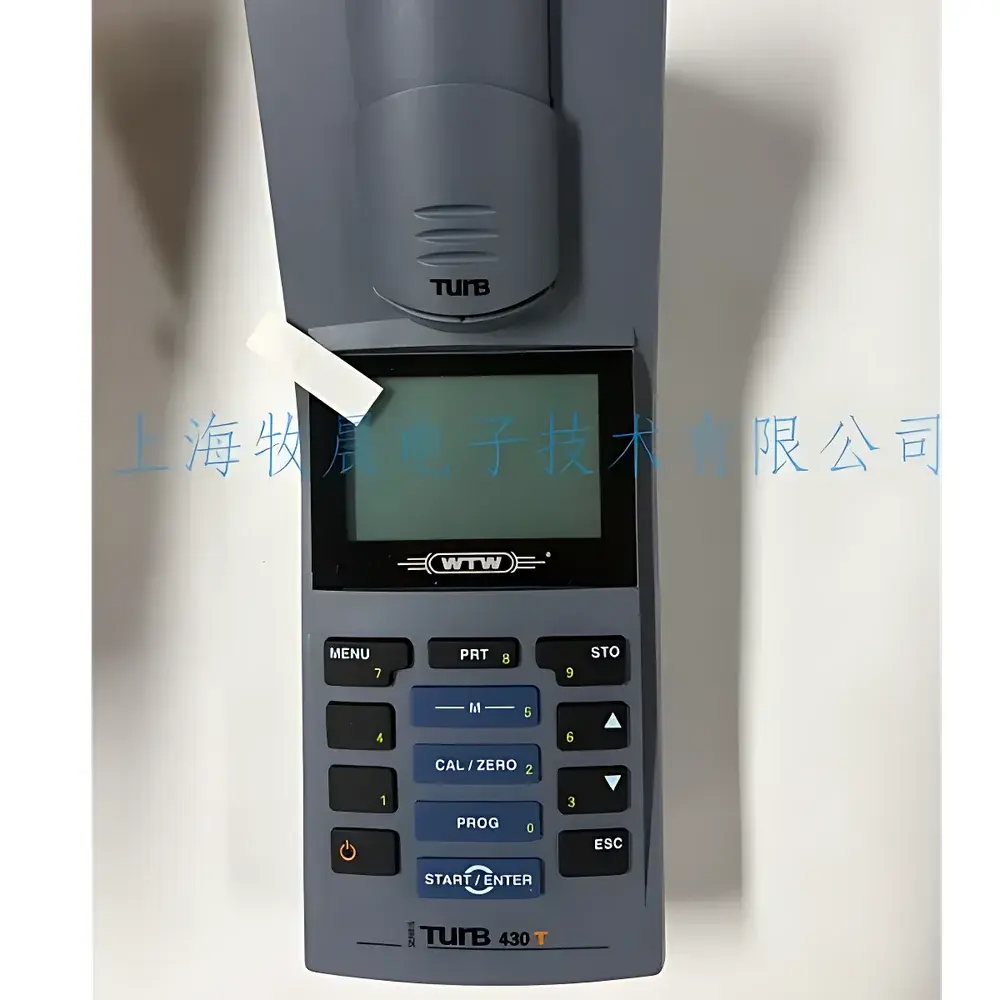
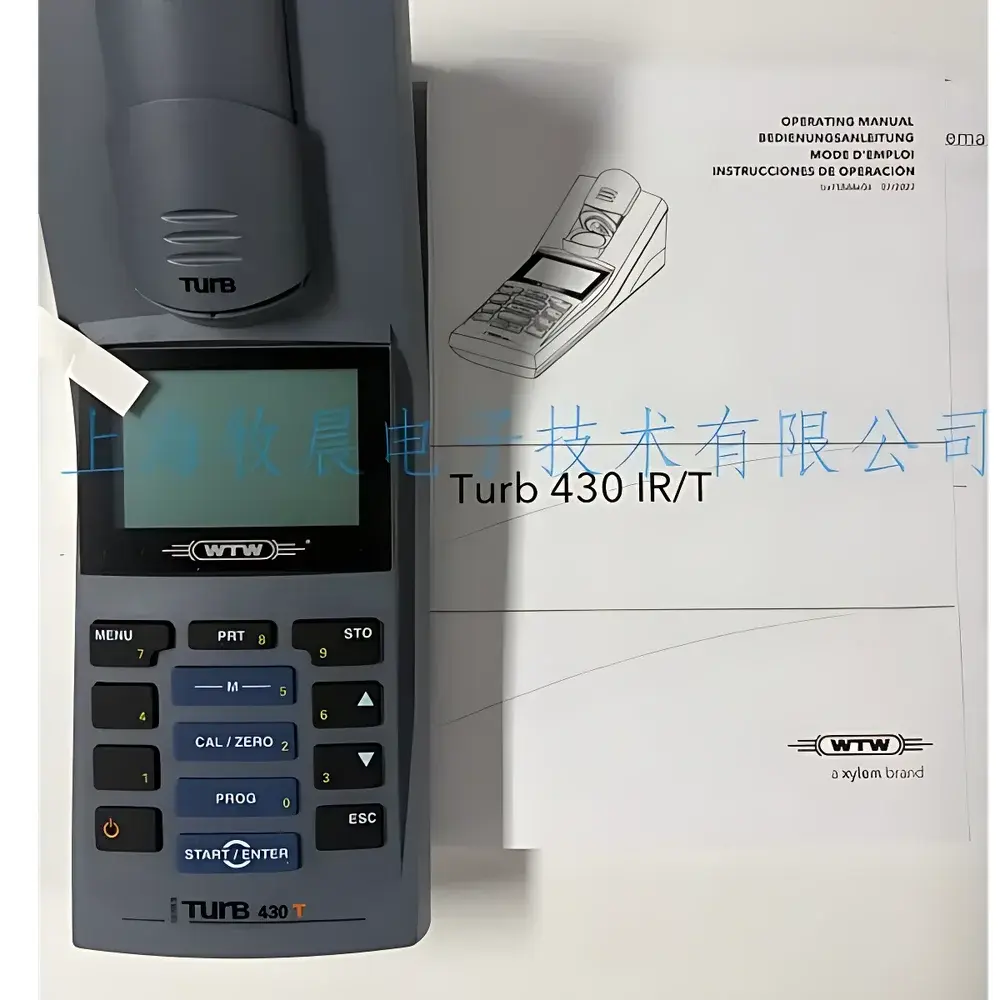
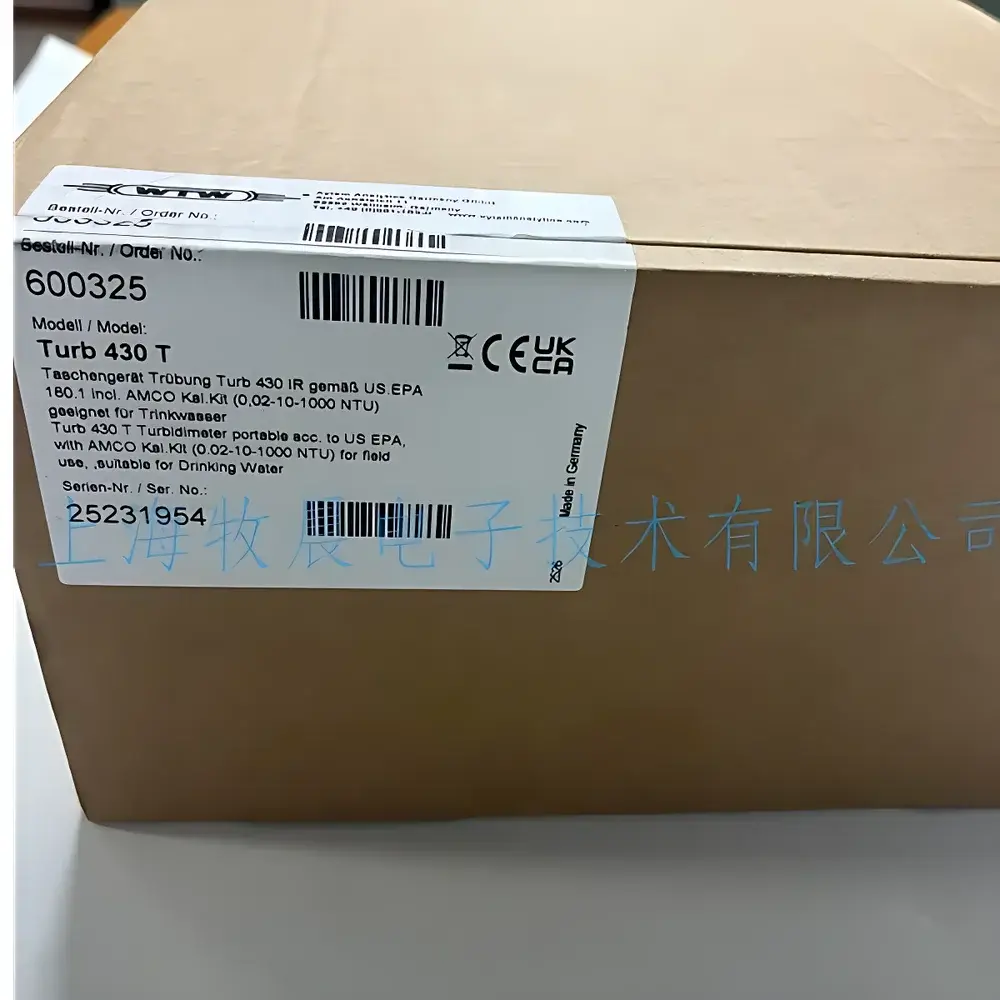
WTW Turb 430T Portable Turbidimeter
| Brand | WTW |
|---|---|
| Origin | Germany |
| Model | Turb 430T |
| Product Type | Portable |
| Measurement Range | 0–1100 FNU/NTU |
| Resolution | 0.01 NTU (0.00–9.99 NTU) |
| Operating Temperature | 0 °C to 50 °C |
| Accuracy | ±2% or ±0.01 FNU/NTU (whichever is greater) for 0–500 NTU |
| Measurement Principle | 90° Nephelometric Scattering (EPA Method 180.1 compliant) |
| Light Source | Tungsten Halogen Lamp |
| Response Time | ≤7 s |
| Sample Cell | 28 × 60 mm cylindrical cuvette (20 mL volume) |
| Data Storage | 1000 measurements with timestamp |
| Interface | RS232 standard, USB optional |
| Ingress Protection | IP67 |
| Certifications | CE, cETLus |
| Calibration | Automatic 1–3 point calibration with AMCO-EPA traceable standards (0.02 / 10 / 1000 NTU) |
Overview
The WTW Turb 430T Portable Turbidimeter is an EPA Method 180.1–compliant nephelometer engineered for field-deployable and laboratory-grade turbidity quantification in water quality monitoring. It employs the standardized 90° scattered light detection principle—where a tungsten halogen lamp illuminates the sample and a photodetector positioned perpendicularly measures the intensity of scattered light proportional to suspended particle concentration. This optical configuration ensures high sensitivity across low- to high-turbidity ranges (0–1100 FNU/NTU), with traceability to AMCO-EPA reference standards. Designed for regulatory compliance in drinking water, wastewater, and environmental sampling, the Turb 430T delivers reproducible results under variable ambient conditions while maintaining full alignment with pharmacopoeial requirements (e.g., USP , EP 2.2.12) and Good Laboratory Practice (GLP) / Analytical Quality Assurance (AQA) frameworks.
Key Features
- True 90° nephelometric measurement geometry conforming to ISO 7027-1:2016 and US EPA Method 180.1
- Auto-ranging optics with dynamic gain control and three-level resolution switching (0.01 / 0.1 / 1 NTU)
- Integrated 1–3 point calibration routine with user-defined intervals and full calibration history logging
- Rugged IP67-rated housing enabling operation in rain, dust, or submerged splash environments (up to 1 m for 30 min)
- On-board real-time data evaluation including drift assessment, outlier flagging, and pass/fail status relative to user-set limits
- Long-life tungsten halogen light source with stable spectral output (400–700 nm), eliminating LED aging-related drift
- Optimized 28 × 60 mm cylindrical cuvette design ensuring consistent path length and minimal wall-scatter interference
Sample Compatibility & Compliance
The Turb 430T accepts standard 20 mL glass or disposable polystyrene cuvettes (28 mm diameter), supporting both clear and highly turbid samples without dilution in most routine applications. Its optical system compensates for color interference up to 500 mg Pt/L (as platinum-cobalt units), meeting ASTM D1889 and ISO 7027-1 criteria for colored water matrices. The instrument satisfies GLP data integrity requirements through embedded audit-trail functionality—including operator ID tagging, calibration event timestamps, and uneditable measurement logs. All firmware and calibration protocols are validated per ICH Q2(R2) guidelines for analytical instrument qualification. Regulatory documentation packages—including 3Q reports (IQ/OQ/PQ), certificate of conformance, and traceable calibration certificates—are available upon request for FDA 21 CFR Part 11–aligned deployments.
Software & Data Management
- RS232 serial interface as standard; optional USB-to-serial adapter enables direct connection to Windows-based PCs
- Compatible with WTW LabStation software for automated report generation (PDF/CSV), statistical process control (SPC) charting, and trend analysis
- Internal memory stores 1000 measurements with full metadata: date/time stamp, operator ID, calibration status, and raw signal values
- Exportable data includes measurement uncertainty estimates derived from built-in accuracy algorithms (±2% + offset term)
- Supports batch export with configurable file naming conventions aligned with LIMS integration workflows
Applications
The Turb 430T serves critical roles across multiple regulated domains: verification of filtration efficiency in municipal drinking water treatment plants; validation of membrane integrity in pharmaceutical purified water (PW) and water-for-injection (WFI) systems; field screening of stormwater runoff and surface water bodies under EPA NPDES permit conditions; and QC release testing of process water in food & beverage manufacturing. Its low-end resolution (0.01 NTU) supports compliance with WHO and EU Directive 98/83/EC thresholds for potable water (<1 NTU at point-of-use), while its upper range accommodates undiluted wastewater influent characterization. The device is routinely deployed by environmental consultants during site assessments, by utility technicians during emergency response events, and by QA/QC labs performing method transfer studies between portable and benchtop platforms.
FAQ
Does the Turb 430T comply with USP and EP 2.2.12 for pharmaceutical water testing?
Yes—its 90° scattering geometry, tungsten lamp spectrum, and AMCO-EPA traceable calibration protocol meet the instrumental requirements specified in both monographs.
Can calibration data be exported and archived for audit purposes?
Yes—calibration events (including standard values, measured responses, deviation calculations, and operator entries) are stored with timestamps and exported via RS232 in human-readable ASCII format.
Is the instrument suitable for use in wet outdoor environments?
Yes—the IP67 ingress protection rating certifies full dust-tightness and resistance to temporary submersion, making it appropriate for riverbank sampling, reservoir monitoring, and construction site runoff testing.
What is the expected lifetime of the tungsten lamp under typical usage?
The lamp is rated for ≥5,000 hours of operation; no user-replaceable optical components are required within the first two years of average field use (≈300 measurements/week).
How does the Turb 430T handle samples with high absorbance or color?
It applies algorithmic compensation based on dual-wavelength signal ratioing (within the visible spectrum), minimizing interference from dissolved humic substances or iron/manganese complexes per ISO 7027-1 Annex B.




