
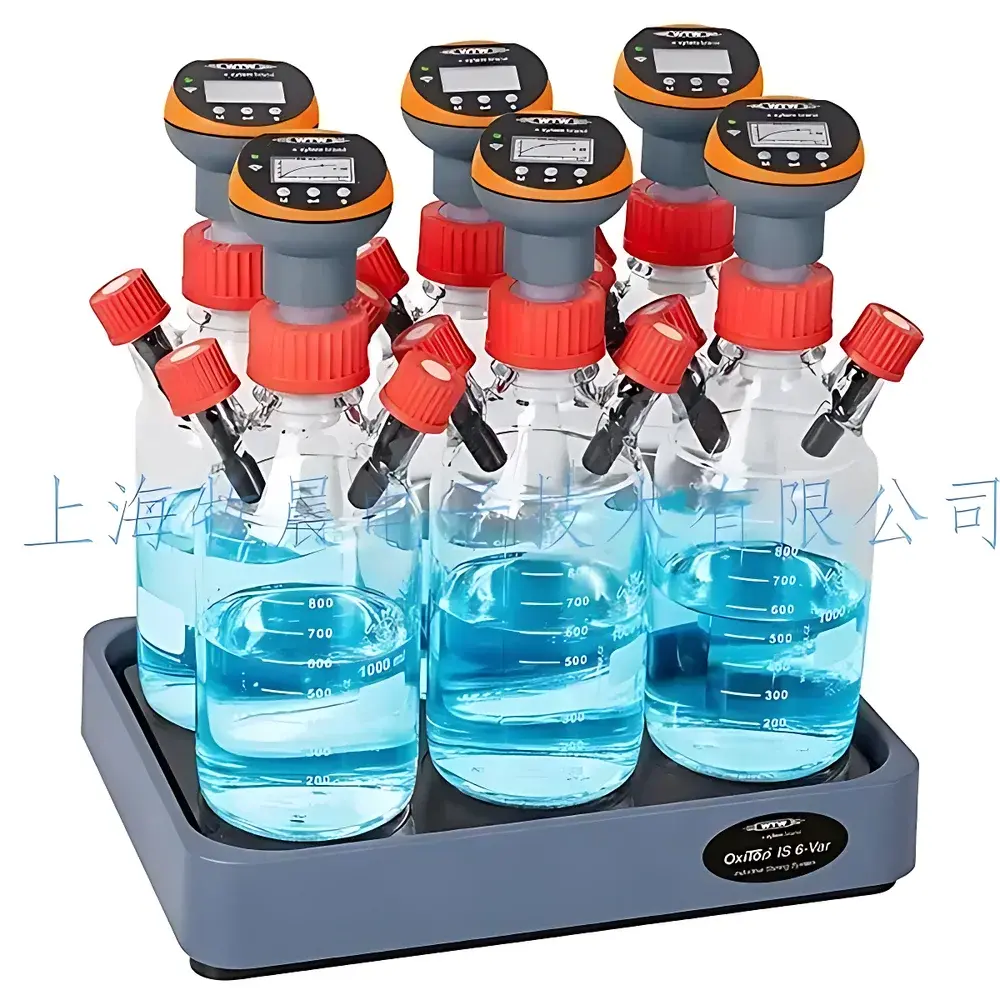
WTW OxiTop Control AN6/AN12 Anaerobic Biogas Measurement System
| Brand | WTW |
|---|---|
| Origin | Germany |
| Model | OxiTop Control AN6/AN12 |
| Instrument Type | Laboratory BOD Analyzer |
| Measurement Principle | Differential Pressure Method |
| Pressure Range | 0–1500 hPa |
| Compliance | Designed for ISO 11734, ISO 10634, OECD 311, ASTM D5210, and EU Regulation (EC) No. 1069/2009 Annex VI biodegradability testing protocols |
Overview
The WTW OxiTop Control AN6/AN12 is a dedicated, pressure-based anaerobic biogas measurement system engineered for standardized assessment of organic substrate fermentability under strictly anoxic conditions. It operates on the differential pressure principle: during anaerobic digestion, microorganisms metabolize organic matter to produce CO₂ and CH₄. CO₂ is chemically absorbed by sodium hydroxide or barium hydroxide pellets placed inside the sealed reaction vessel, while CH₄ accumulates and exerts measurable pressure. The net pressure increase—corrected for temperature and headspace volume—is directly proportional to methane yield. This method eliminates the need for gas chromatography or infrared detection, offering traceable, gravimetrically referenced quantification aligned with internationally recognized biodegradability test standards.
Key Features
- Two-configurable platforms: AN6 (optimized for high-gas-yield substrates such as food waste and manure) and AN12 (designed for low-activity matrices including lignocellulosic biomass and recalcitrant polymers)
- OxiTop®-IDS/B pressure sensor heads with H₂S-resistant ceramic diaphragm and integrated temperature compensation (±0.1 °C), enabling long-term stability in corrosive biogas environments
- Sealed 510 mL amber glass bottles with dual-side inert gas purge ports (N₂ or Ar) to ensure complete O₂ removal prior to incubation—critical for strict anaerobic process fidelity
- Programmable pressure monitoring intervals from 15 minutes to 24 hours; data logged internally with timestamped resolution up to 0.1 hPa
- Integrated overpressure alarm at 1500 hPa with automatic logging suspension and visual indicator—prevents membrane rupture and ensures data integrity
- Modular compatibility with WTW Multi 3620/3630 IDS controllers for multi-parameter synchronization (e.g., pH, redox, conductivity) during parallel fermentation assays
Sample Compatibility & Compliance
The system supports solid, semi-solid, and liquid substrates—including sewage sludge, agricultural residues, industrial organic effluents, and synthetic polymer test materials—as defined in ISO 11734 (anaerobic biodegradability of organic compounds in aqueous medium) and OECD Test Guideline 311. Vessel configurations include fixed-volume 510 mL brown glass bottles (AN6/AN12), plus optional 500 mL / 1 L / 2.5 L vessels with AD/SK adapters for scalability. All kits include certified CO₂ absorbent (Ba(OH)₂ or NaOH), nitrification inhibitor (allylthiourea), and magnetic stir bars compatible with IS 6-Var/IS 12 variable-speed stir bases. Data output meets GLP requirements, with full audit trail capability when paired with WTW LabX software and FDA 21 CFR Part 11-compliant user access controls.
Software & Data Management
OxiTop Control systems interface seamlessly with WTW’s LabX software suite for automated data import, calculation of cumulative CH₄ production (mL CH₄/g VS), biodegradation percentage, and lag-phase determination. Raw pressure-time datasets are exportable in CSV and Excel formats; trend visualization includes first-derivative plots for peak activity identification. When used with Multi 3630 IDS controllers, synchronized multi-channel environmental parameter logging (temperature, redox potential, pH) enables kinetic modeling of microbial consortia behavior. Internal memory retains up to 180 days of data at 30-minute intervals per vessel—sufficient for extended 90-day OECD 311 tests without external intervention.
Applications
- Quantitative evaluation of anaerobic digestibility for feedstock selection in biogas plant commissioning
- Regulatory compliance testing for organic waste acceptance criteria under EU Landfill Directive 1999/31/EC and German Technical Rules for Biowaste (TR Boden)
- Research into methanogenic pathway inhibition, co-digestion synergy, and impact of trace elements or antibiotics on archaeal activity
- Standardized biodegradability screening of novel bioplastics (e.g., PHA, PLA blends) per EN 13432 Annex E and ISO 14855-2
- Soil microbiome studies assessing anaerobic respiration capacity in flooded paddy soils or contaminated sediments
FAQ
What distinguishes the AN6 and AN12 configurations?
The AN6 uses a higher-sensitivity pressure transducer optimized for rapid, high-yield gas generation (e.g., sugar-rich substrates), while the AN12 employs a broader dynamic range sensor suited for slow, low-amplitude methane evolution typical of lignin-rich or inhibited systems.
Can the system measure CO₂ separately from CH₄?
No—CO₂ is intentionally removed via chemical absorption to isolate CH₄ partial pressure. Total biogas composition requires complementary GC-TCD analysis.
Is calibration required before each test series?
Zero-pressure calibration is performed automatically at startup; span verification against a certified reference pressure source is recommended every 6 months per ISO/IEC 17025 quality management guidelines.
How is oxygen exclusion validated?
Oxygen concentration is verified using a calibrated optical dissolved oxygen probe inserted through the purge port prior to sealing; residual O₂ must be <0.1 mg/L to satisfy ISO 11734 pre-incubation criteria.
Are replacement CO₂ absorbents supplied with traceability documentation?
Yes—each batch of Ba(OH)₂ absorbent is accompanied by CoA (Certificate of Analysis) specifying purity (>99.5%), moisture content (<1.0%), and shelf-life under desiccated storage.
Related Products







