
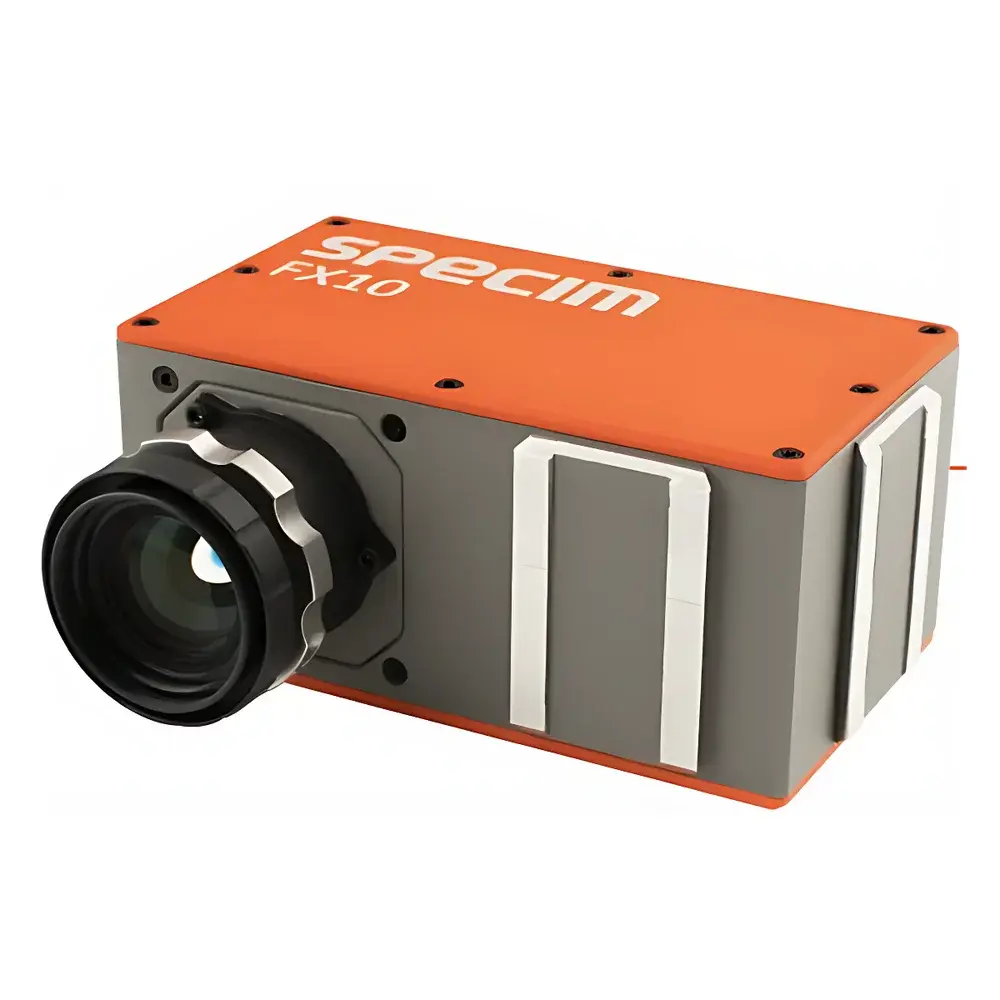
Specim FX10+ VNIR Hyperspectral Line-Scan Camera
| Brand | SPECIM |
|---|---|
| Origin | Finland |
| Model | FX10+ |
| Spectral Range | 400–1000 nm |
| Spatial Resolution | 1024 pixels |
| Pixel Size | 19.9 × 9.97 µm |
| Max Frame Rate | 705 fps (with spectral binning = 2) |
| Spectral Bands | Up to 200 selectable bands (binning = 2) |
| Interface | GigE Vision compliant |
| Certifications | CE, RoHS |
Overview
The Specim FX10+ is a high-performance, industrial-grade VNIR (Visible–Near Infrared) hyperspectral line-scan camera engineered for real-time, quantitative material characterization in automated inspection and process monitoring environments. Operating on the principle of push-broom imaging, the FX10+ captures spatially resolved spectral data across 1024 pixels per line and up to 200 discrete wavelength channels within the 400–1000 nm range—enabling full spectral fingerprinting of materials at production-line speeds. Its optical design integrates a high-throughput transmission grating and optimized fore-optics to deliver high photon efficiency and low stray light, ensuring robust signal-to-noise ratio (SNR) even under variable illumination conditions. Unlike RGB or multispectral systems, the FX10+ provides continuous spectral sampling, supporting chemometric modeling, spectral unmixing, and classification algorithms compliant with ISO 13655 (graphic technology – spectral measurement and colorimetric computation) and ASTM E1767 (standard practice for hyperspectral imaging).
Key Features
- True VNIR spectral coverage from 400 to 1000 nm with <1.5 nm spectral sampling interval (native resolution), enabling discrimination of subtle absorption features in organic compounds, pigments, and plant pigments (e.g., chlorophyll, anthocyanins, carotenoids).
- 1024-pixel linear CMOS sensor with pixel pitch of 19.9 × 9.97 µm, optimized for high spatial fidelity and minimal geometric distortion across field-of-view.
- Real-time acquisition at up to 705 lines per second when using 2× spectral binning—maintaining sufficient spectral resolution while maximizing throughput for conveyor-based sorting and inline quality control.
- Onboard radiometric calibration and factory-applied spectral response correction ensure consistent data output across units, critical for multi-camera deployments and long-term trend analysis in GLP/GMP-regulated facilities.
- GigE Vision-compliant interface enables seamless integration with common machine vision platforms (e.g., HALCON, OpenCV, MATLAB Image Acquisition Toolbox) and supports GenICam XML configuration for standardized parameter control.
- Ruggedized aluminum housing (IP52 rated), passive thermal management, and shock-resistant lens mount facilitate reliable operation in industrial settings without active cooling or external stabilization.
Sample Compatibility & Compliance
The FX10+ is compatible with standard C-mount lenses and supports working distances from 100 mm to infinity, accommodating reflective, transmissive, and fluorescence-mode configurations. It meets electromagnetic compatibility requirements per EN 61326-1 and safety standards per EN 61000-6-2/6-4. All firmware and calibration data are traceable to NIST-traceable reference sources. The camera’s spectral stability (<0.1 nm drift over 8 h at 25°C ambient) satisfies requirements for ASTM E2750 (standard guide for hyperspectral sensor performance verification) and supports audit-ready documentation for FDA 21 CFR Part 11–compliant workflows when paired with validated software environments.
Software & Data Management
Specim’s proprietary SpectralCube software provides real-time preview, spectral library creation, ROI definition, and basic PLS/PCA analysis. Raw data is saved in industry-standard formats (ENVI .hdr/.bil, TIFF, HDF5) with embedded metadata including exposure time, integration time, temperature, and calibration timestamps. SDKs for C++, Python, and LabVIEW enable custom pipeline development—including integration with MES/SCADA systems via OPC UA or MQTT. All calibration files (dark frame, white reference, spectral response) are stored onboard and applied automatically during acquisition, eliminating manual preprocessing steps and reducing operator dependency.
Applications
- Food sorting and defect detection—differentiating bruised fruit, foreign material, or compositional anomalies based on spectral reflectance signatures.
- Pharmaceutical tablet coating uniformity assessment via NIR absorbance mapping (compliant with USP <1119>).
- Print quality assurance—measuring ink density, metamerism, and substrate interaction across CMYK and spot-color inks (aligned with ISO 12647-2).
- Agricultural phenotyping—quantifying NDVI, PRI, and other vegetation indices from UAV- or gantry-mounted platforms.
- Recycling stream analysis—identifying polymer types (PET, HDPE, PP) and contaminants using characteristic C–H and O–H overtone bands.
- Display manufacturing—evaluating OLED/LCD panel uniformity, Mura defects, and color gamut accuracy via hyperspectral emissivity profiling.
FAQ
What is the native spectral resolution of the FX10+?
The FX10+ delivers approximately 2.7 nm full-width-at-half-maximum (FWHM) spectral resolution at 600 nm, with sub-nanometer sampling intervals across its 400–1000 nm range.
Does the FX10+ support external triggering and synchronization?
Yes—it features TTL-compatible input/output trigger ports for precise line-scan synchronization with encoders, PLCs, or lighting strobes, essential for motion-compensated imaging on moving belts.
Can spectral binning be adjusted dynamically during acquisition?
Spectral binning is configured prior to acquisition via GenICam features; however, multiple pre-defined binning modes (1×, 2×, 4×) can be switched on-the-fly through software API calls without interrupting streaming.
Is radiometric calibration traceable to national standards?
Calibration is performed using NIST-traceable tungsten-halogen and deuterium lamps, with uncertainty budgets documented per ISO/IEC 17025 requirements.
How is inter-unit spectral consistency ensured?
Each unit undergoes individual spectral response characterization and receives a unique correction matrix; cross-unit variability is maintained within ±1.5% relative spectral radiance error across the full bandpass.




