
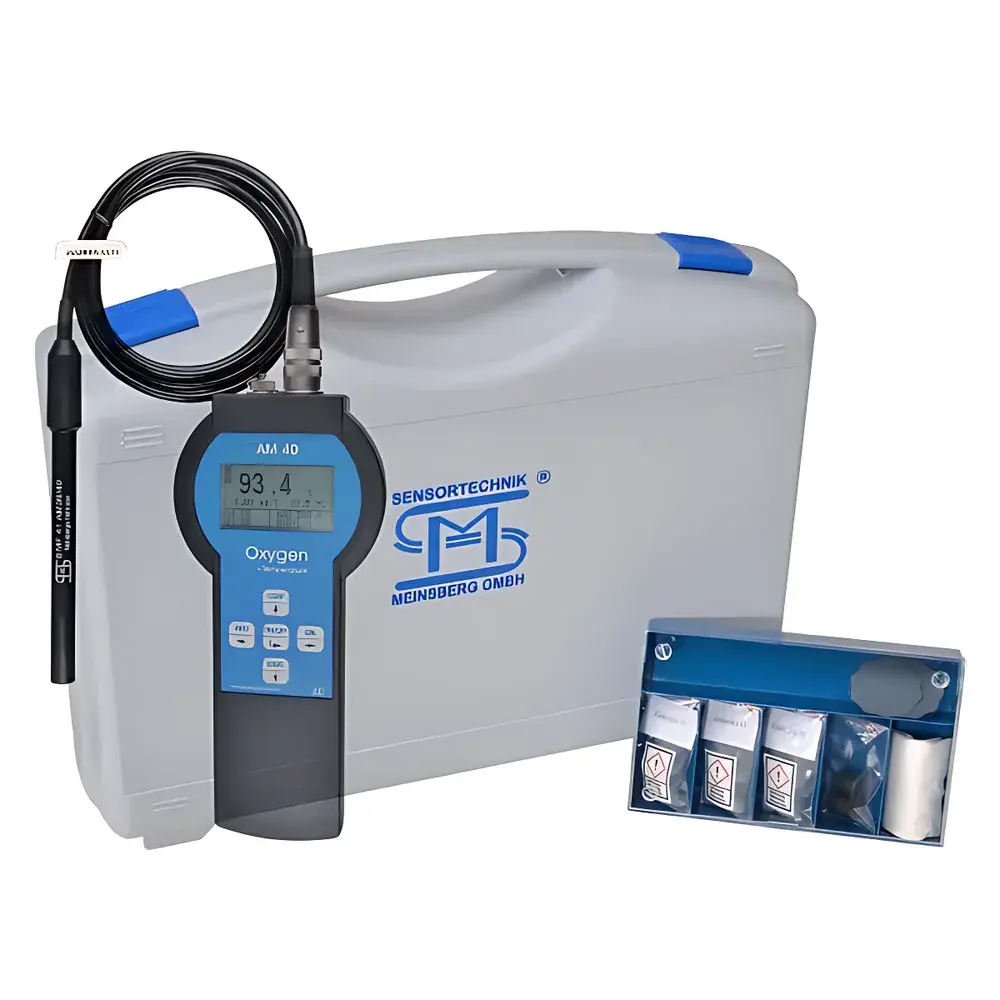
WTW AM40 Portable Dissolved Oxygen Meter
| Brand | WTW |
|---|---|
| Origin | Germany |
| Model | AM40 |
| Instrument Type | Portable |
| Parameter Type | Single-parameter (Dissolved Oxygen & Temperature) |
| Sensor Principle | Polarographic (Clark-type) with Pt cathode and Ag/AgCl anode |
| Polarization Voltage | 700 mV |
| Measurement Outputs | mg/L O₂ and % saturation |
| Display | Backlit LCD |
| Calibration | Automatic air-saturation calibration |
| Data Storage | 4,000 measurement sets with min/max tracking |
| Compliance | GLP-compliant data logging |
| Protection Rating | IP65 |
| Interface | USB for PC connectivity and software-assisted data export |
| Application Scope | Surface water, wastewater, sewage treatment, composting, irrigation monitoring |
| Regulatory Alignment | Designed to support ISO 5814, ASTM D888, and EN 25814 methodologies |
Overview
The WTW AM40 Portable Dissolved Oxygen Meter is a field-deployable electrochemical analyzer engineered for reliable, on-site quantification of dissolved oxygen (DO) concentration and temperature in aqueous environmental matrices. It operates on the polarographic (Clark-type) principle: the MF41N sensor integrates a platinum cathode and silver/silver chloride (Ag/AgCl) anode immersed in a potassium chloride electrolyte. A fixed polarization voltage of 700 mV is applied across the electrodes, driving the electrochemical reduction of molecular oxygen at the Pt surface to hydroxide ions (O₂ + 2H₂O + 4e⁻ → 4OH⁻). Concurrently, oxidation of silver at the anode yields Ag⁺ ions, which precipitate as AgCl in the presence of Cl⁻. The resulting diffusion-limited current is linearly proportional to the partial pressure of dissolved oxygen—enabling direct conversion to concentration units (mg/L) and percent saturation (% sat), referenced to local barometric pressure and temperature. Its compact, rugged design supports continuous operation in uncontrolled outdoor environments without compromise to measurement stability or electrode longevity.
Key Features
- Integrated dual-parameter measurement: simultaneous acquisition of dissolved oxygen (mg/L and % saturation) and temperature (°C)
- Polarographic MF41N sensor with Pt cathode and Ag/AgCl reference—anode system optimized for low-drift, high-reproducibility field use
- Backlit LCD display with intuitive icon-driven interface for rapid parameter verification under variable lighting conditions
- Automatic air-saturation calibration routine with built-in atmospheric pressure compensation (no manual barometric input required)
- GLP-compliant internal data logger storing up to 4,000 timestamped records—including user-defined sample IDs, min/max values per measurement session, and calibration history
- IP65-rated housing ensuring dust-tightness and protection against low-pressure water jets—suitable for prolonged deployment in rain, humid soil zones, or splash-prone treatment facilities
- USB interface enabling bidirectional communication with WTW LabX® Light software for configuration, firmware updates, and traceable data export in CSV or PDF report formats
Sample Compatibility & Compliance
The AM40 is validated for use across heterogeneous aqueous media including natural surface waters (rivers, lakes, reservoirs), municipal and industrial wastewater streams, activated sludge reactors, leachate from landfills or compost piles, and irrigation return flows. It meets functional requirements specified in ISO 5814:2012 (Water quality — Determination of dissolved oxygen — Electrochemical probe method), ASTM D888-22 (Standard Test Methods for Dissolved Oxygen in Water), and EN 25814 (Water quality — Determination of dissolved oxygen — Electrochemical method). All logged data include mandatory GLP metadata: operator ID, instrument serial number, calibration timestamps, sensor status flags, and environmental parameters (temperature, atmospheric pressure). Audit trails are retained within the device memory and preserved during USB transfer—supporting regulatory readiness for ISO/IEC 17025-accredited laboratories and wastewater discharge compliance reporting.
Software & Data Management
The AM40 interfaces exclusively with WTW LabX® Light software—a lightweight, Windows-based application designed for field instrument management. LabX Light enables remote configuration of logging intervals (1 s to 24 h), auto-calibration schedules, alarm thresholds (e.g., DO < 2 mg/L in aerobic bioreactors), and custom unit preferences. Exported datasets retain full metadata integrity and can be imported into LIMS platforms or statistical analysis tools (e.g., R, Python pandas) without loss of temporal or contextual fidelity. All data files carry embedded digital signatures verifying origin, modification history, and user authentication—fulfilling foundational elements of FDA 21 CFR Part 11 for electronic records in regulated environmental monitoring programs.
Applications
- Environmental monitoring: Real-time profiling of DO gradients in rivers, wetlands, and coastal zones to assess eutrophication risk and ecological health
- Wastewater treatment: Optimization of aeration basin control strategies by tracking DO dynamics across influent, mixed liquor, and effluent points
- Composting process control: Monitoring aerobic stability in windrows or in-vessel systems via periodic DO sampling at varying depths
- Irrigation water quality assessment: Screening for hypoxic conditions in reclaimed water sources prior to agricultural reuse
- Field validation of online DO sensors: Providing traceable reference measurements for sensor drift verification and performance auditing
FAQ
What electrochemical principle does the AM40 employ?
It uses polarographic amperometry with a Clark-type sensor (Pt cathode, Ag/AgCl anode, KCl electrolyte) and a fixed 700 mV polarization voltage.
Does the AM40 require membrane replacement or electrolyte refilling?
Yes—the MF41N sensor includes a replaceable oxygen-permeable membrane and requires periodic replenishment of the internal electrolyte solution per WTW maintenance guidelines.
Can the AM40 compensate for salinity effects on DO readings?
No—salinity correction must be applied manually using standard conversion tables (e.g., APHA Standard Methods 4500-O G) or external calculation tools; the instrument reports raw sensor output referenced to freshwater saturation.
Is the data logger compliant with ISO/IEC 17025 documentation requirements?
Yes—each stored record contains immutable timestamps, operator identifiers, calibration verification flags, and sensor diagnostic codes, satisfying clause 7.5.2 on result reporting integrity.
How often should the sensor be calibrated in routine field use?
Daily air-saturation calibration is recommended before first use each day; additional zero-point calibration is advised when measuring in anaerobic or sulfide-rich samples to verify baseline stability.





