
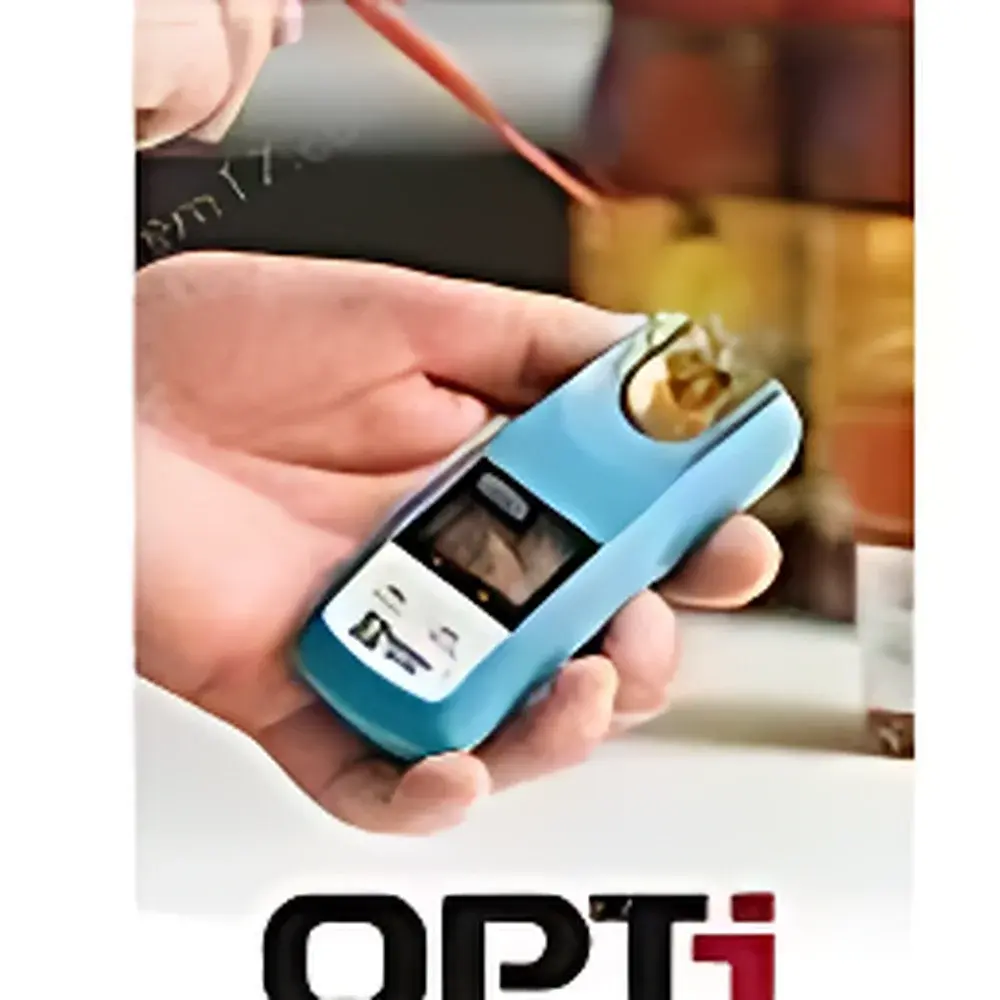
Bellingham + Stanley OPTi Industrial Digital Handheld Refractometer
| Brand | Bellingham + Stanley |
|---|---|
| Origin | United Kingdom |
| Manufacturer Status | Authorized Distributor |
| Origin Category | Imported |
| Model | OPTi Industrial Digital |
| Type | Handheld Refractometer |
| Temperature Control | Yes (ATC) |
| Digital Display | Yes |
| IP Rating | IP65 |
| Construction | Stainless-steel prism housing, ultrasonically welded waterproof enclosure |
| Calibration | Pure water zero-point calibration |
| Prism Design | Shallow-depth prism plate for rapid cleaning |
| Ergonomics | Optimized handheld form factor |
| Compliance | Designed for GLP-compliant field and lab use in regulated industrial environments |
Overview
The Bellingham + Stanley OPTi Industrial Digital Handheld Refractometer is a precision optical instrument engineered for rapid, on-site measurement of refractive index (RI) and concentration-derived units—including % w/w, % v/v, °Brix, and freeze point depression—in aggressive chemical and process environments. Based on the fundamental principle of Snell’s Law, the device measures the critical angle of total internal reflection at the prism-sample interface, converting it into a digital RI value with automatic temperature compensation (ATC) across a wide operational range (typically 0–50 °C). Unlike traditional analog refractometers, the OPTi integrates a high-stability LED light source, a thermally stabilized sapphire-coated prism assembly, and a calibrated CMOS photodetector array to deliver repeatable measurements with minimal operator dependency. Its design prioritizes robustness in industrial settings where exposure to solvents, glycols, urea solutions, aviation fluids, and corrosive coolants is routine.
Key Features
- Stainless-steel monolithic prism housing—machined from a single billet to eliminate crevices and ensure full cleanability between samples
- Ultrasonically welded IP65-rated enclosure—provides dust-tight integrity and resistance to low-pressure water jets, meeting IEC 60529 requirements for field-deployed instrumentation
- Automatic Temperature Compensation (ATC)—real-time correction using an integrated Pt1000 sensor referenced to ISO 21748 and ASTM D115 for accuracy across 0–50 °C without external thermostating
- Shallow-depth prism geometry—reduces sample retention volume (< 0.1 mL) and accelerates solvent rinsing, minimizing cross-contamination in multi-analyte workflows
- Dual-scale and single-scale configurations—pre-programmed with industry-specific calibration curves traceable to NIST-certified reference standards (e.g., EG/PG mixtures, DEF, DiEGME, aviation-grade ethylene glycol)
- Ergonomic, one-handed operation—textured grip and intuitive button layout support glove-compatible use in production or maintenance zones
Sample Compatibility & Compliance
The OPTi is validated for direct measurement of aqueous and organic liquid phases encountered in chemical manufacturing, automotive fluid QC, aerospace ground support, and thermal management system maintenance. Compatible matrices include ethylene glycol (EG), propylene glycol (PG), diethylene glycol monoethyl ether (DiEGME), urea aqueous solutions (DEF), glycerol-based heat transfer fluids, and aviation de-icing formulations. All factory calibrations are performed per ISO 5725 (accuracy and precision) and documented with uncertainty budgets traceable to UKAS-accredited reference materials. The instrument supports audit-ready operation under GLP and GMP frameworks through optional firmware logging (timestamped readings, user ID, calibration history), aligning with FDA 21 CFR Part 11 data integrity expectations when paired with compliant software export protocols.
Software & Data Management
While the OPTi operates as a standalone field instrument, its RS-232 serial interface enables bidirectional communication with host systems for automated data capture and traceability. Optional PC software (OPTiLink™) provides configurable report generation, statistical process control (SPC) charting, and batch-level trend analysis. All stored calibration coefficients and user-defined scale parameters reside in non-volatile memory with write-protection, ensuring configuration integrity during power cycling or battery replacement. Firmware updates are delivered via signed binary packages to maintain cryptographic integrity and regulatory compliance.
Applications
- Chemical manufacturing: Real-time verification of glycol purity, solvent blends, and reaction mixture concentrations
- Automotive service: On-vehicle assessment of coolant freeze point, DEF concentration, and brake fluid moisture ingress
- Aerospace maintenance: Rapid screening of aircraft de-icing fluid potency and dilution ratios prior to application
- Thermal systems: Monitoring of heat transfer fluid degradation in HVAC, chiller, and solar thermal installations
- Industrial lubrication: Detection of water contamination in turbine oils and hydraulic fluids via RI deviation
- Pharmaceutical excipient QC: Verification of polyol (e.g., propylene glycol) concentration in non-sterile formulations
FAQ
Does the OPTi require periodic recalibration by an accredited lab?
No—field recalibration using certified reference standards (e.g., distilled water for zero-point, NIST-traceable sucrose solutions) is sufficient per ISO 8655-6. Full metrological recalibration is recommended every 12 months or after mechanical shock.
Can the OPTi measure viscous or particulate-laden samples?
It is optimized for clear, low-viscosity liquids (< 500 mPa·s). Suspended solids or high-viscosity media require filtration or dilution to avoid prism fouling and optical scatter errors.
Is ATC active across the full -10 °C to +60 °C ambient range?
ATC functionality is specified for sample temperatures between 0 °C and 50 °C. Ambient operating range is -10 °C to +50 °C; measurement accuracy outside the ATC range requires manual correction per published temperature coefficient tables.
How is compliance with ISO 21748 verified during installation qualification?
Each unit ships with a Certificate of Conformance listing ATC validation data points (at 10 °C, 20 °C, 30 °C, 40 °C) against reference RI standards, satisfying IQ/OQ documentation requirements for regulated users.





