
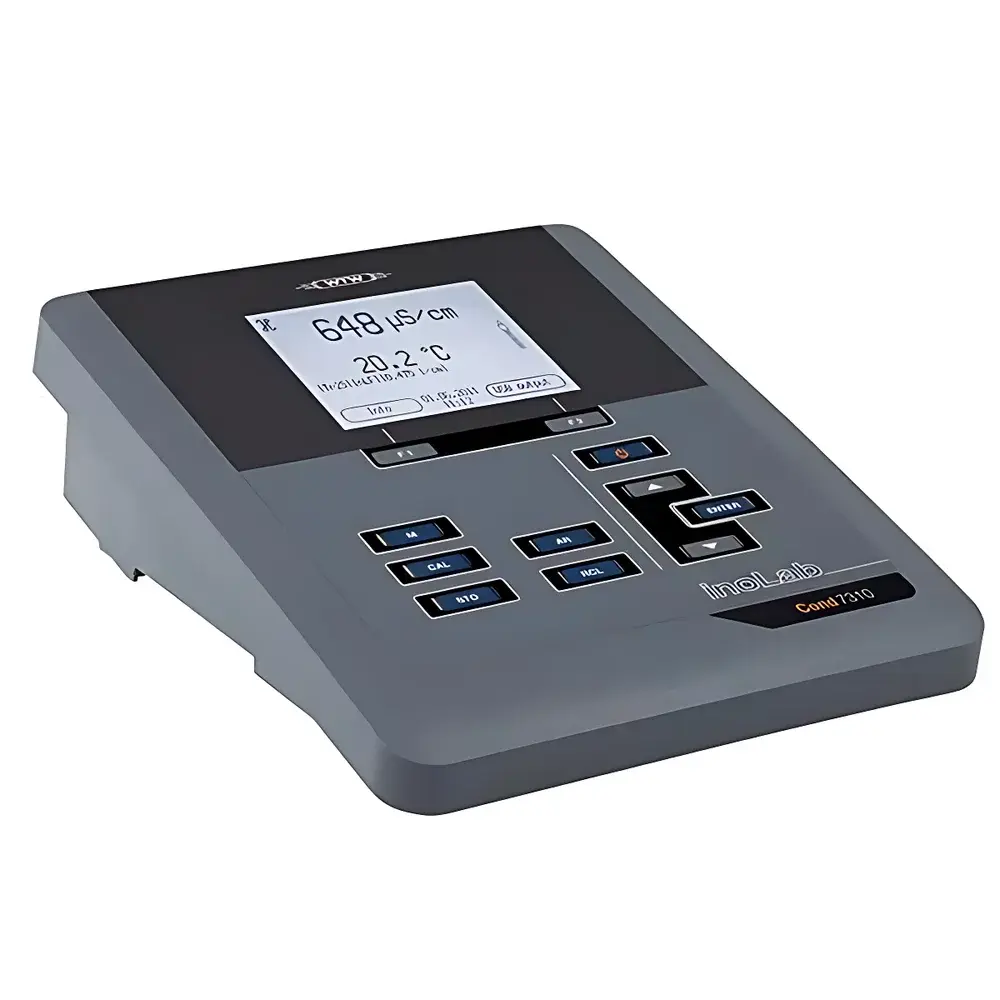
WTW inoLab Cond 7310 Benchtop Conductivity Meter
| Brand | WTW |
|---|---|
| Origin | Germany |
| Model | Cond 7310 |
| Measurement Parameters | Conductivity, Resistivity, Salinity, TDS, Temperature |
| Conductivity Range | 0.000 µS/cm to 1000 mS/cm |
| Accuracy | ±0.5% of reading ±1 digit |
| Electrode Constant Adjustment Range | 0.01 to 62.5 cm⁻¹ |
| Temperature Compensation | Linear, Non-Linear (nLF), or None |
| Calibration | Up to 10 stored calibration records |
| Data Storage | 500 manual + 5000 auto-stored readings |
| Interface | USB (with CSV export) |
| Optional | Integrated thermal printer (58 mm width) |
| Power | 4×AA batteries or universal AC adapter |
| Display | Backlit LCD with 7-segment numeric and status icons |
Overview
The WTW inoLab Cond 7310 is a high-precision benchtop conductivity meter engineered for traceable, reproducible measurements in regulated laboratory environments. Based on the four-electrode (tetrapolar) measurement principle, it eliminates polarization effects and electrode fouling errors—critical for long-term stability in demanding applications such as ultrapure water monitoring, pharmaceutical process validation, and environmental effluent analysis. Unlike two-electrode systems, the Cond 7310’s dual current/voltage electrode configuration ensures accurate low-conductivity measurements down to 0.000 µS/cm and maintains linearity across its full dynamic range (0.000 µS/cm to 1000 mS/cm). Its temperature-compensated algorithms support compliance with ISO 7888 (water conductivity), ASTM D1125 (electrical conductivity of water), and USP (water for pharmaceutical use), making it suitable for GLP- and GMP-aligned workflows.
Key Features
- Four-electrode (tetrapolar) conductivity measurement architecture for minimized polarization error and enhanced long-term stability
- AutoRead function: automatically detects signal stabilization and locks measurement upon reaching user-defined drift threshold (±0.02 µS/cm/min), ensuring repeatability
- Configurable temperature compensation: linear (0.000–10.00 %/°C), non-linear (nLF per DIN 38404-1), or reference-based (20 °C/25 °C)
- Electrode constant programmability from 0.01 cm⁻¹ to 62.5 cm⁻¹, supporting a wide range of sensor geometries including TetraCon 325 (K = 0.475 cm⁻¹), LR 325/01 (K = 0.01 cm⁻¹), and KLE 325 (K = 0.1 cm⁻¹)
- Integrated real-time clock and audit trail logging: all calibrations, measurements, and parameter changes are time-stamped and stored with operator ID field (when used with optional software)
- USB interface compliant with CDC class protocol—no driver installation required on Windows/macOS/Linux; supports direct CSV export for LIMS integration
- Optional built-in thermal printer (58 mm width) for immediate hardcopy output meeting FDA 21 CFR Part 11 requirements when paired with electronic signature-capable software
Sample Compatibility & Compliance
The Cond 7310 accommodates aqueous samples across diverse matrices—from deionized water (0.055 µS/cm at 25 °C) to concentrated brines (>800 mS/cm). It supports standardized electrode configurations for specific applications: TetraCon 325 for general lab use (0.01–200 mS/cm), LR 325/01 with flow cell D 01/T for continuous ultrapure water monitoring (0.001–20 µS/cm), and KLE 325 for high-ionic-strength industrial effluents. All measurements comply with IEC 60746-3 (electrochemical analyzers), EN 27888 (water quality), and pharmacopeial standards including EP 2.2.38 and JP 2.07. The instrument’s firmware implements data integrity safeguards: write-protected memory, automatic checksum validation, and tamper-evident calibration record hashing.
Software & Data Management
The included LabX Lite software enables secure configuration, remote calibration, and batch export of measurement logs in CSV format—with column headers aligned to ISO/IEC 17025 reporting requirements (e.g., “Date”, “Time”, “Conductivity [mS/cm]”, “Temp [°C]”, “Electrode ID”, “Calibration ID”). Data files include embedded metadata: instrument serial number, firmware version, sensor calibration date, and user-defined sample IDs. For regulated environments, optional LabX Professional adds 21 CFR Part 11 compliance modules: role-based access control, electronic signatures, and immutable audit trails with hash-verified archive integrity. All exported CSVs retain timestamp precision to 1 second and support direct import into ELN platforms (e.g., LabArchives, Benchling) or statistical analysis tools (JMP, Minitab).
Applications
- Pharmaceutical QC: USP water conductivity verification (Purified Water, Water for Injection), cleaning validation rinse water testing
- Environmental labs: ASTM D5907 (TDS in wastewater), ISO 10523 (pH and conductivity in surface waters), EPA Method 120.1
- Power generation: boiler feedwater and condensate purity monitoring per ASTM D4582
- Food & beverage: conductivity-based concentration control in syrup dilution, dairy processing, and CIP solution verification
- Academic research: electrolyte characterization, membrane conductivity studies, and electrochemical cell optimization
FAQ
Does the Cond 7310 support automatic temperature compensation for non-aqueous solvents?
No—it is calibrated and validated exclusively for aqueous solutions per IEC 60746-3. Non-aqueous media require manual correction factors and are outside the scope of factory certification.
Can calibration data be exported separately from measurement records?
Yes—LabX Lite allows selective export of calibration logs (including slope, offset, cell constant, and standard used) as standalone CSV files with full traceability.
Is the thermal printer module validated for 21 CFR Part 11 compliance?
The printer itself is not independently validated; however, when operated through LabX Professional with enabled audit trail and electronic signature workflows, printed reports inherit the system’s Part 11 compliance attributes.
What is the maximum allowable cable length between the meter and a TetraCon 325 electrode?
Up to 5 meters using shielded, twisted-pair cable (WTW part no. 200010); longer runs risk noise-induced drift and require active signal conditioning.
How does the nLF (non-linear function) temperature compensation differ from linear compensation?
nLF applies a polynomial algorithm per DIN 38404-1 to model the non-linear relationship between conductivity and temperature in natural waters—particularly critical for environmental samples where ion composition varies significantly.






