
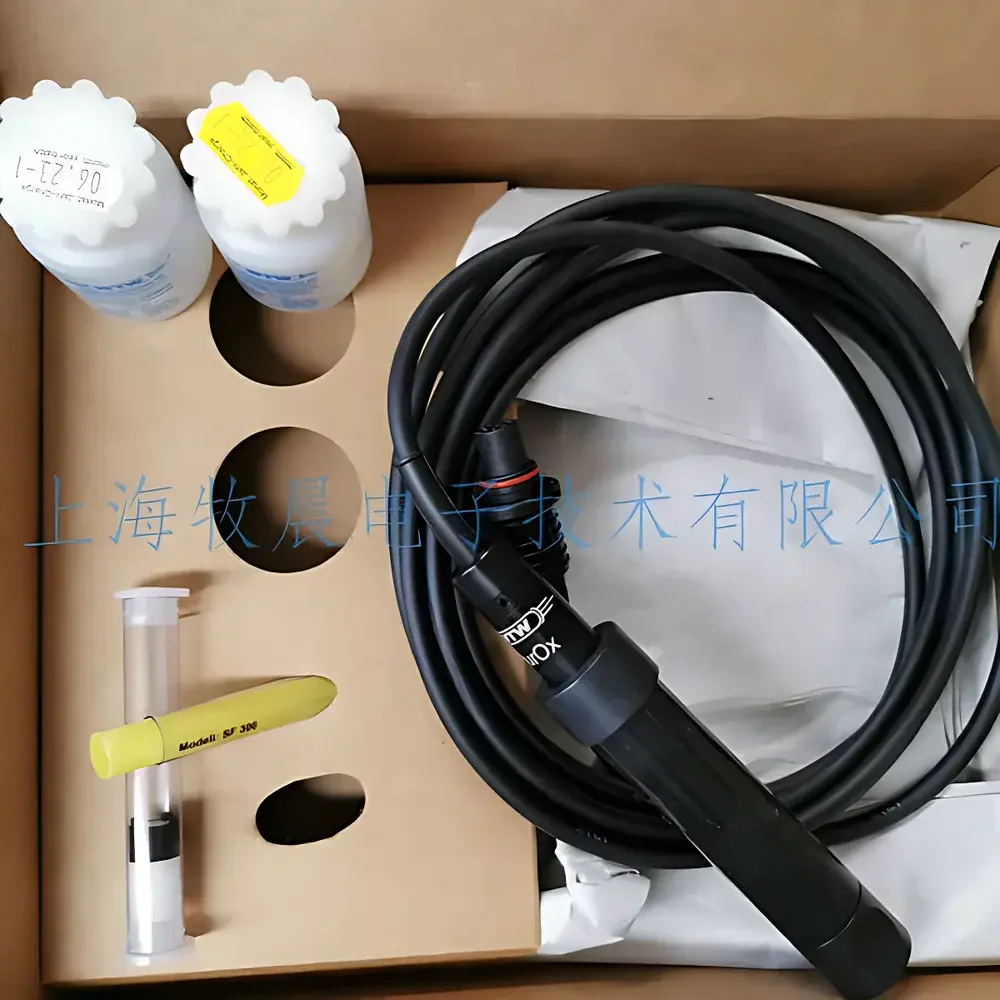
WTW DurOx325-3 Dissolved Oxygen Electrode for Aquaculture Applications
| Brand | WTW |
|---|---|
| Origin | Germany |
| Model | DurOx325-3 |
| Measurement Principle | Electrochemical (Polarographic) |
| IP Rating | IP68 (2 bar) |
| Cable Length | 3 m |
| Temperature Compensation | Integrated Dual-Temperature IMT Sensor |
| Zero Drift | None |
| Electrolyte Service Life | Up to 6 months |
| Storage/Calibration Kit | OxiCal®-D included |
| Protective Cap | SK-D standard |
| Application Class | Laboratory & Field-Portable Instruments |
| Compliance | Designed for ASTM D888, ISO 5814, EN 25814, and EPA Method 360.1 |
Overview
The WTW DurOx325-3 is a high-reliability polarographic dissolved oxygen (DO) electrode engineered specifically for demanding aquaculture, wastewater monitoring, and environmental field applications where robustness, stability, and minimal maintenance are critical. Based on the Clark-type electrochemical principle, it employs a gold cathode and silver/silver chloride anode within a gas-permeable membrane, enabling selective oxygen reduction at a fixed polarization voltage (−0.8 V). Unlike amperometric sensors requiring extended stabilization, the DurOx325-3 delivers immediate, stable readings upon immersion—eliminating polarization delay and associated procedural variability. Its design integrates dual temperature sensing via integrated membrane temperature (IMT) compensation, ensuring accurate DO concentration correction across dynamic thermal gradients common in ponds, raceways, and effluent streams. The electrode operates independently of flow velocity—a key advantage in low-circulation aquaculture tanks—while maintaining ±0.1 mg/L resolution and long-term baseline stability without zero-point drift.
Key Features
- Polarization-free operation: Delivers valid measurements immediately after immersion—no warm-up or stabilization time required.
- Zero-drift architecture: Eliminates need for routine zero calibration; verified per ISO 5814 Annex B for long-term signal integrity.
- IP68-rated housing (2 bar submersion): Fully sealed against dust and continuous immersion up to 2 meters depth—suitable for submerged deployment in ponds, sumps, and open-channel monitoring.
- Dual-sensor IMT temperature compensation: Two independent Pt1000 thermistors embedded in the membrane cap ensure real-time, localized temperature measurement at the sensing interface—not ambient probe temperature—minimizing thermal lag errors.
- Extended service life: Electrolyte fill lasts up to six months under typical aquaculture use conditions (20–30 °C, moderate biofouling), reducing operational downtime and consumables cost.
- Low oxygen consumption rate: <0.008 µg h⁻¹ (mg/L)⁻¹—critical for minimizing localized oxygen depletion during static or low-flow measurements in sensitive biological systems.
- Standard 3 m waterproof cable with IP67 connector: Compatible with WTW handheld meters (e.g., Multi 3630 IDS, Oxi 340i) and benchtop analyzers (e.g., IQ Sensor Net nodes).
- Included accessories: Factory-supplied OxiCal®-D storage/calibration kit and SK-D protective cap for safe transport and dry-storage between measurements.
Sample Compatibility & Compliance
The DurOx325-3 is validated for use in turbid, organic-rich, and moderately saline waters typical of aquaculture operations—including freshwater recirculating aquaculture systems (RAS), brackish shrimp ponds, and municipal wastewater pre-aeration basins. It meets performance criteria specified in ISO 5814:2012 (water quality — determination of dissolved oxygen — electrochemical probe method), ASTM D888-22 (standard test methods for dissolved oxygen in water), and EN 25814:1993. When used with WTW IDS-compatible instruments, data acquisition supports GLP-compliant audit trails, including timestamped calibration logs, sensor diagnostics, and user authentication—fully traceable under FDA 21 CFR Part 11 when deployed in regulated QA/QC workflows.
Software & Data Management
When connected to WTW’s IDS-enabled platforms (e.g., Multi 3630 IDS, pH/DO/Ion modular systems), the DurOx325-3 transmits raw current signals and IMT temperature data digitally via RS485/Modbus RTU. Firmware-level linearization applies Nernst-based oxygen solubility corrections using salinity, atmospheric pressure, and temperature inputs—configurable via WTW LabX® software or direct meter interface. Calibration history, membrane status alerts, and electrolyte expiry tracking are stored onboard and exportable as CSV or PDF reports. For networked deployments, integration with IQ Sensor Net gateways enables remote DO trending, threshold-based SMS/email alerts, and historical comparison against DO saturation models (e.g., APHA Standard Methods Eq. 4500-O G).
Applications
- Aquaculture process control: Real-time DO monitoring in hatcheries, grow-out tanks, and RAS biofilters to maintain optimal oxygen partial pressure (>60% saturation) for species-specific metabolic demand.
- Wastewater treatment: DO profiling in activated sludge basins, oxidation ditches, and aerated lagoons—supporting aeration energy optimization and nitrification/denitrification balance.
- Environmental compliance reporting: Field-deployable verification of discharge permit limits per NPDES or EU Urban Wastewater Treatment Directive Annex I.
- Research & education: Stable reference-grade DO measurement in mesocosm studies, sediment-water interface flux experiments, and BOD incubation validation (when paired with StirrOx-G variants).
- Regulatory QA/QC: Verified performance in GLP-certified laboratories conducting method validation per USP and EP 2.2.43 for pharmaceutical water systems.
FAQ
Does the DurOx325-3 require zero calibration?
No. Its polarographic design and stable Ag/AgCl reference system eliminate zero-point drift; only span calibration with air-saturated water or certified standard solutions is required.
Can it be used with non-WTW meters?
Only with instruments supporting WTW’s analog 0–200 mV or digital IDS protocol; third-party compatibility is not guaranteed due to proprietary signal conditioning and IMT data encoding.
What maintenance intervals are recommended for aquaculture use?
Membrane replacement every 3–4 months in high-fouling environments; electrolyte refill every 6 months; full diagnostic check (current output, membrane integrity, cap seal) prior to seasonal deployment.
Is the electrode suitable for seawater applications?
Yes—validated for salinities up to 35 g/kg. Use of OxiCal®-D with NaCl-saturated solution ensures proper ionic strength matching during calibration.
How is film damage detected?
While DurOx325-3 lacks built-in film-puncture detection (a feature of StirrOx-G), visual inspection of the Teflon membrane for cloudiness, scratches, or micro-tears—combined with abrupt signal instability—is the primary failure indicator.
Related Products







