
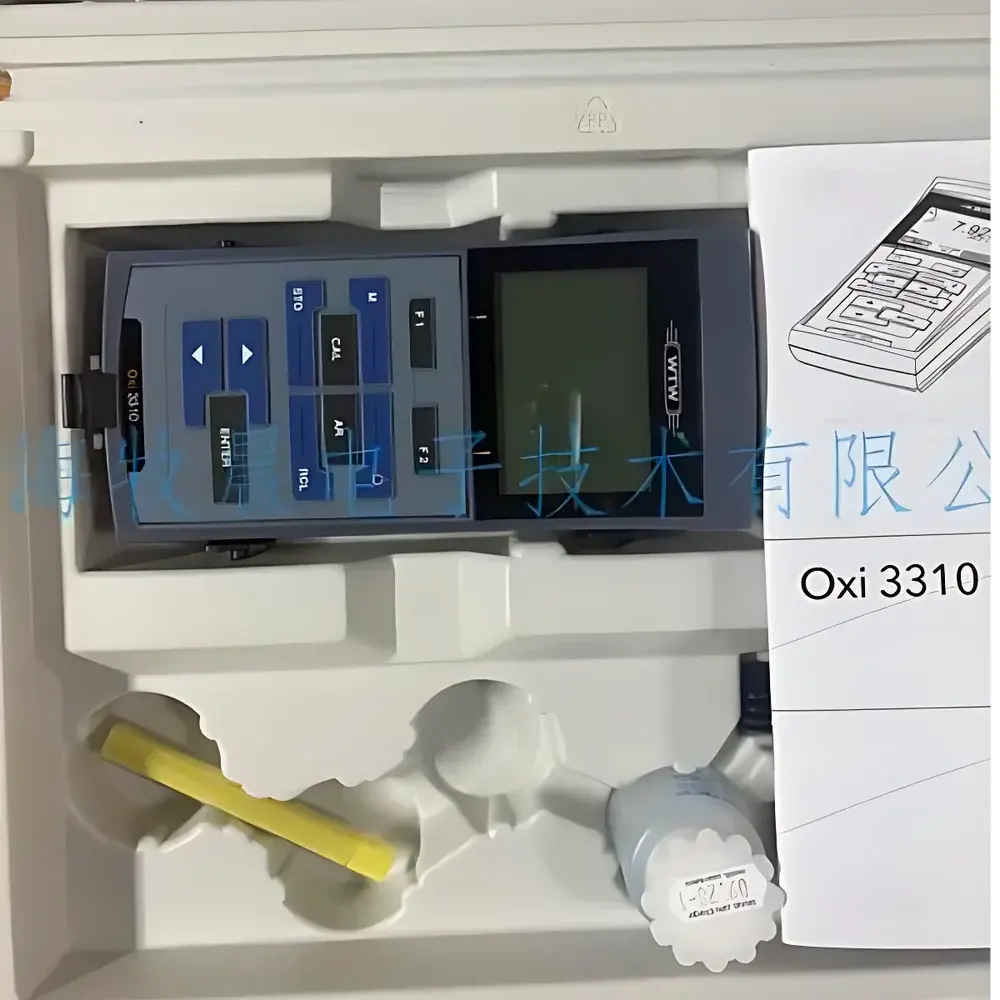
WTW Oxi 3310 Portable Dissolved Oxygen Meter (Model 2BA301)
| Brand | WTW |
|---|---|
| Origin | Germany |
| Model | Oxi 3310 |
| Measurement Principle | Electrochemical Clark-type Polarographic Sensor |
| DO Range | 0.00–19.99 mg/L (±0.5% of reading), up to 90 mg/L |
| Saturation Range | 0.0–199.9% (±0.5%), up to 600% |
| Partial Pressure Range | 0–199.9 hPa / 0–1250 hPa (±0.5%) |
| Temperature Range | −5.0–105.0 °C (±0.1 °C) |
| Data Storage | 5000 automatic + 200 manual entries |
| IP Rating | IP66/IP67 |
| Battery Life | Up to 1000 h (150 h with backlight) |
| Interface | Waterproof USB |
| Calibration | Automatic OxiCal dry-air or saturated air method with electrode status feedback |
| Temperature Compensation | ATC (Automatic Temperature Compensation) |
| Compliance | Designed for GLP-compliant field and lab use |
Overview
The WTW Oxi 3310 Portable Dissolved Oxygen Meter (Model 2BA301) is a rugged, field-deployable electrochemical analyzer engineered for high-accuracy, trace-level dissolved oxygen (DO) quantification in aqueous matrices. Based on the Clark-type polarographic principle, it employs a membrane-covered, gold-cathode sensor (CellOx 325-3, 3 m cable) that selectively reduces molecular oxygen at a fixed polarization voltage (−0.8 V), generating a diffusion-limited current linearly proportional to DO concentration. This fundamental electrochemical architecture ensures stable baseline response, minimal drift, and immunity to common interferents such as chloride, nitrate, and low-molecular-weight organics—critical for long-term monitoring in wastewater, aquaculture, and groundwater systems. The instrument simultaneously reports DO (mg/L), saturation (%), and partial pressure (hPa), all referenced to user-defined atmospheric pressure (500–1100 mbar auto-compensated), enabling precise normalization across elevation gradients and barometric fluctuations.
Key Features
- Triple-parameter measurement: Dissolved oxygen (0.00–19.99 mg/L, extended to 90 mg/L), saturation (0.0–199.9%, extended to 600%), and temperature (−5.0–105.0 °C) with ±0.1 °C accuracy and full ATC integration.
- High-capacity data logging: Stores up to 5,000 time-stamped automatic records (interval programmable from 1 s to 60 min) plus 200 manual entries—including measured values, temperature, date/time stamp, sample ID, calibration status, and pressure compensation flag.
- IP66/IP67-rated enclosure: Fully sealed housing with silicone keypad and 100% waterproof USB port, certified for continuous outdoor operation under rain, dust, and temporary submersion.
- Intelligent calibration management: Integrated OxiCal system supports one-point saturated air or zero-oxygen (sodium sulfite) calibration; post-calibration screen displays real-time electrode status (e.g., membrane integrity, electrolyte level, cathode activity).
- Continuous Measurement Control (CMC): Real-time validation logic compares each reading against calibrated range boundaries—green indicator for in-spec values, audible/visual alert for out-of-range conditions, ensuring measurement traceability.
- Extended battery endurance: 1000-hour operation on four AA alkaline cells (150 h with backlight enabled); no memory loss during battery replacement.
- GLP-aligned interface: USB connection enables direct, encrypted transfer of raw datasets (CSV/Excel-compatible) to PCs or LIMS, preserving timestamps, operator IDs, and calibration metadata for regulatory review.
Sample Compatibility & Compliance
The Oxi 3310 is validated for direct immersion in heterogeneous liquid samples including raw sewage, surface runoff, anaerobic digesters, aquaculture ponds, pharmaceutical process water, ultrapure rinse water (semiconductor grade), and potable distribution networks. Its CellOx 325-3 probe features a PTFE hydrophobic membrane optimized for fouling resistance in suspended solids-rich environments and rapid thermal equilibration (<60 s at ΔT = 20 K). The system conforms to key international standards governing environmental analysis: EPA Method 4500-O G (electrochemical DO), ISO 5814:2012 (electrochemical determination of oxygen), and ASTM D888-12 (dissolved oxygen in water). All calibration events, sensor diagnostics, and measurement logs are timestamped and non-erasable—supporting compliance with ISO/IEC 17025 accreditation requirements and internal GLP/GMP documentation protocols.
Software & Data Management
Data retrieval and reporting are facilitated via WTW’s proprietary LabX® Light software (included on CD-ROM), which imports native .wtw files and exports structured CSV or PDF reports compliant with laboratory information management systems (LIMS). Each dataset retains embedded metadata: instrument serial number, probe ID, calibration history (date, method, reference value), ambient pressure, and user-defined site tags. The USB interface implements hardware-level write protection to prevent accidental overwrites, and all stored records include cryptographic checksums to verify data integrity during FDA 21 CFR Part 11–aligned audits. Optional LabX® Connect enables remote firmware updates and centralized fleet configuration across multi-site deployments.
Applications
- Municipal and industrial wastewater treatment: Aeration basin optimization, nitrification/denitrification control, effluent compliance verification.
- Environmental field surveys: Stream health assessment, hypolimnetic oxygen profiling, sediment–water interface flux studies.
- Aquaculture and hatchery management: Real-time DO monitoring in recirculating aquaculture systems (RAS), feed-triggered aeration control.
- Pharmaceutical water systems: Monitoring of purified water (PW) and water for injection (WFI) storage loops per USP .
- Food & beverage processing: Fermentation tank DO tracking, carbonation line validation, clean-in-place (CIP) rinse verification.
- Research laboratories: Bioreactor parameter correlation, microbial respiration assays, ecotoxicity testing (OECD 209, 210).
FAQ
What calibration methods does the Oxi 3310 support?
It supports one-point calibration using either saturated air (at ambient pressure and temperature) or zero-oxygen solution (e.g., sodium sulfite), with automatic recognition and electrode health diagnostics post-calibration.
Is the probe suitable for use in high-solids or viscous media?
Yes—the CellOx 325-3 probe includes a reinforced PTFE membrane and optional cleaning kit (grinding foil, cleaning solution) to maintain response stability in sludge, algae-laden water, or glycerol-based process streams.
How is temperature compensation implemented?
Automatic Temperature Compensation (ATC) uses an integrated Pt1000 sensor in the probe body; compensation follows the standardized Winkler-derived algorithm per ISO 5814, eliminating manual correction tables.
Can measurement data be exported in a format compatible with LIMS?
Yes—raw data exports as timestamped CSV files with column headers aligned to ASTM E1469-15 (Standard Practice for Electronic Data Interchange), supporting direct ingestion into most LIMS platforms without transformation.
Does the instrument meet FDA 21 CFR Part 11 requirements?
While the Oxi 3310 itself is not individually 21 CFR Part 11 certified, its LabX® Light software provides electronic signature capability, audit trails, and role-based access control—enabling compliant deployment within FDA-regulated quality systems when configured per organizational SOPs.
Related Products







