
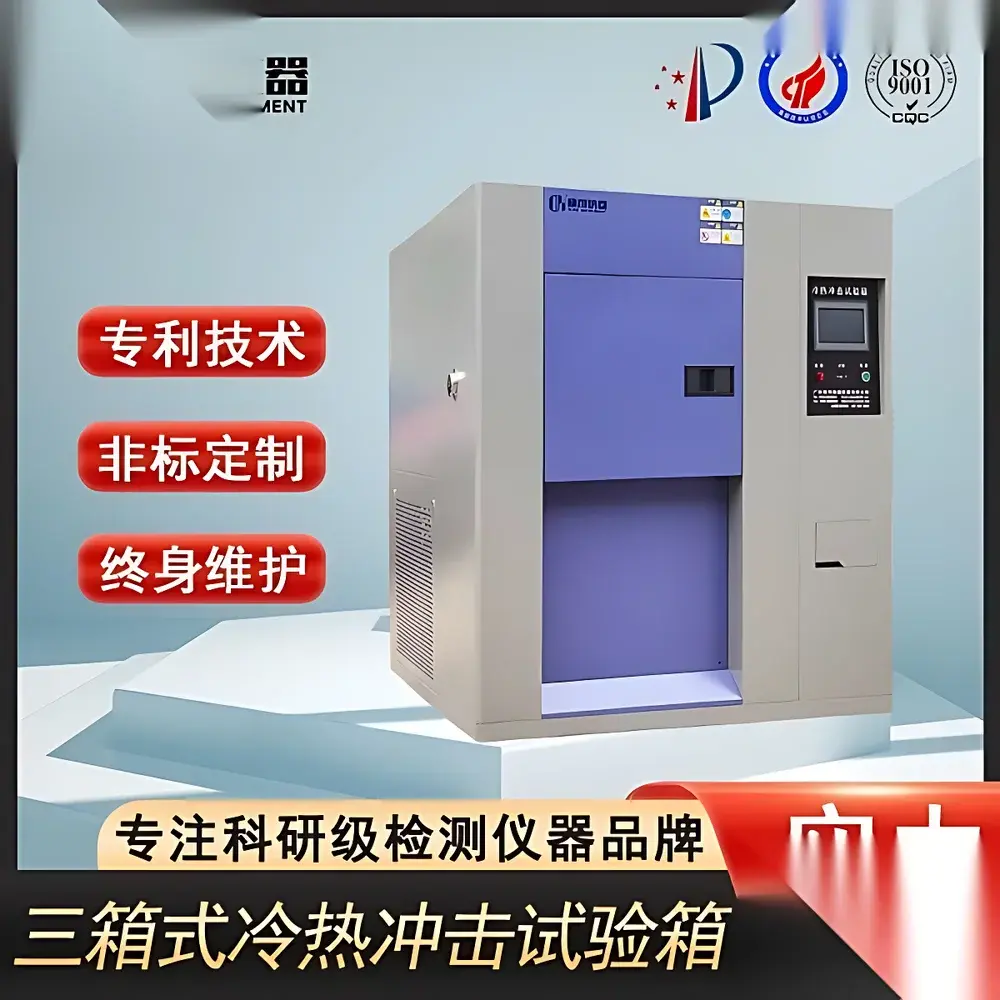
Thermal Shock Test Chamber – Industrial-Grade Environmental Test System
| Brand | OEM / Custom Brand |
|---|---|
| Origin | Imported |
| Manufacturer Type | Authorized Distributor |
| Price | USD 11,200 (FOB) |
| Temperature Range | −70°C to +180°C |
| Thermal Transition Time | ≤15 s (50 K transfer between chambers) |
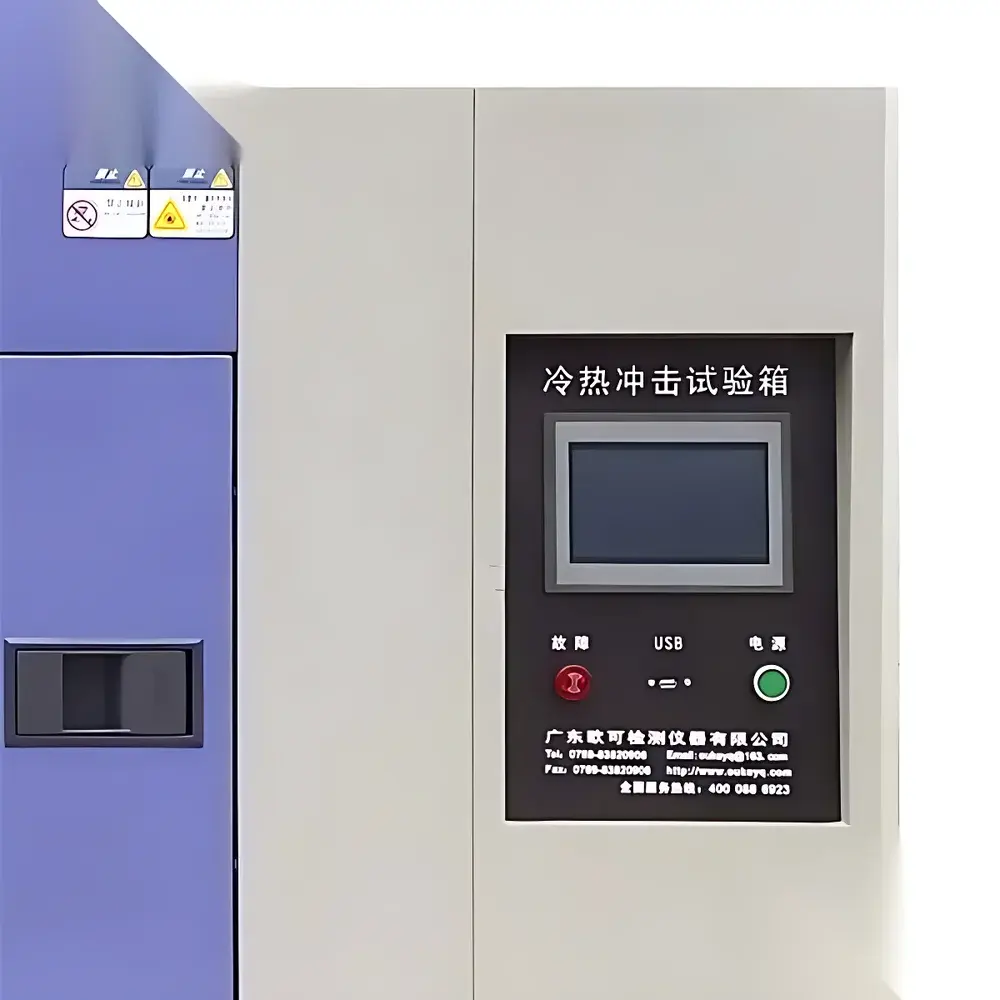
| Control System | TEMI880 Color Touchscreen PLC Controller (EN/CN Switchable) |
| Compliance | IEC 60068-2-14, MIL-STD-810H, JIS Z 8701 |
| Refrigeration | Twin-Circuit Cascade System with Original Tecumseh/Tecumseh-derived Hermetic Compressor |
| Insulation | 120 mm Polyurethane Rigid Foam + 80 mm Ultra-Fine Glass Fiber |
| Airflow | Wide-Band Forced Convection (Top-Out/Bottom-In), ≥3.5 m/s Uniform Velocity |
| Humidity Control | Surface Evaporation Type (Optional), RH 10–98% (at 25–85°C) |
| Power Supply | 380 VAC ±10%, 3-Phase, 50/60 Hz |
Overview
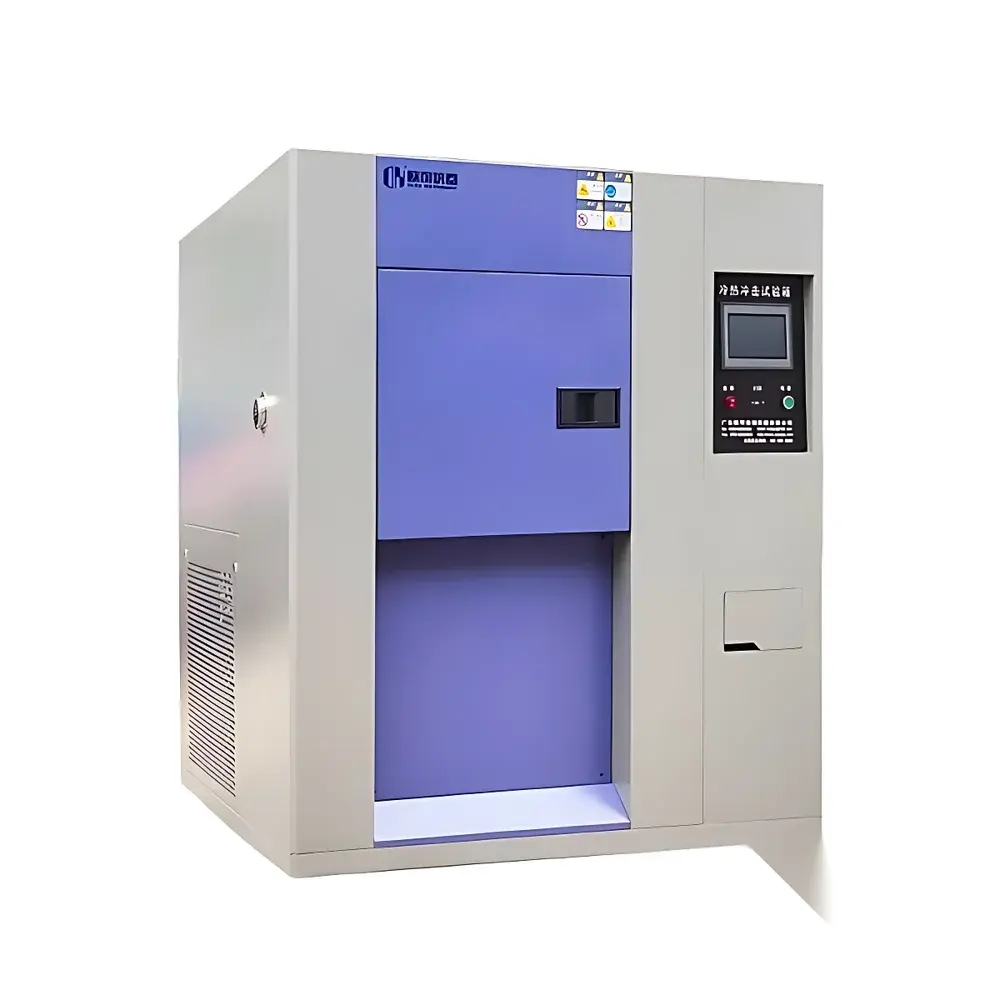
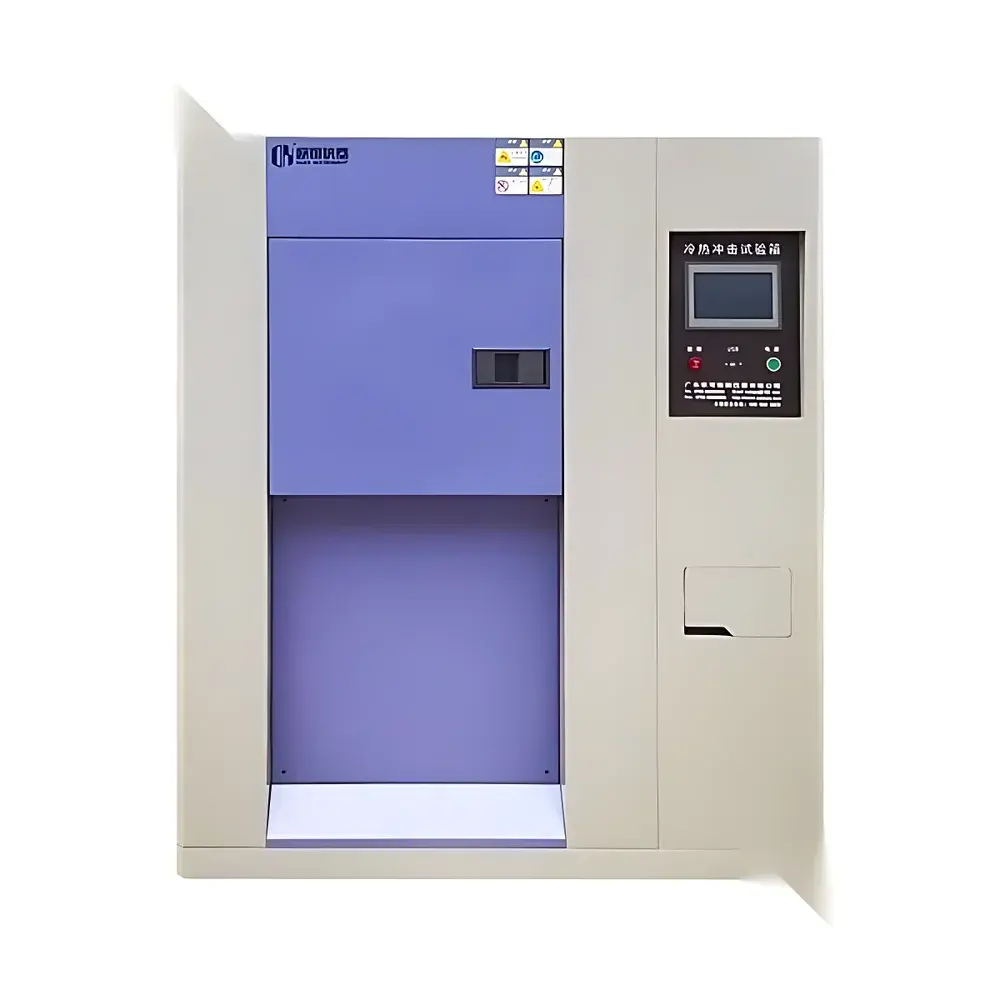
The Thermal Shock Test Chamber is an industrial-grade environmental test system engineered for rapid, repeatable evaluation of material and component reliability under extreme thermal transients. Based on the principle of dual-chamber or single-chamber forced-air thermal shock testing, it subjects specimens to abrupt transitions between high- and low-temperature extremes—typically −70°C to +180°C—with transition times ≤15 seconds (measured per IEC 60068-2-14 Annex A). This capability enables accelerated stress screening (ESS) of electronic assemblies, automotive ECUs, aerospace composites, PCB laminates, and polymer-based enclosures. The chamber’s architecture integrates a cascade refrigeration loop, high-efficiency centrifugal air circulation, and BTSC (Balanced Temperature & Humidity Control) logic to maintain spatial uniformity (±1.5°C at 100 L load) and temporal stability (±0.5°C over 24 h) during sustained cycling. Designed for continuous operation in ISO 17025-accredited labs and production QA environments, it meets core requirements for HALT/HASS preparation and qualification per MIL-STD-810H Method 503.5.
Key Features
- Dual independent temperature zones (hot/cold) with programmable dwell time, transfer speed, and cycle count — configurable via TEMI880 color touchscreen PLC controller (English/Chinese UI toggle)
- Backup TEMI300 membrane-key controller for redundancy and simplified operation in GMP-critical settings
- Cascade refrigeration system using hermetically sealed compressors (Tecumseh-derived design), eliminating oil migration and extending service intervals beyond 15,000 operational hours
- Forced convection airflow with multi-wing centrifugal blower; optimized top-out/bottom-in ducting ensures <±1.0°C spatial deviation across full working volume (per ASTM E2297 calibration protocol)
- Double-layer tempered safety glass observation window with anti-fog coating and integrated LED lighting for real-time visual monitoring without thermal leakage
- Comprehensive protection suite: compressor overheat/overcurrent/overpressure cut-off; dry-run prevention for heaters and humidifiers; low-water alarm; chamber over-temperature lockout; door interlock safety circuit
- Structural integrity: SUS304 stainless steel interior; electrostatically coated cold-rolled steel exterior; dual-stage silicone rubber gasketing rated for −70°C to +200°C continuous exposure
Sample Compatibility & Compliance
The chamber accommodates standard test specimens up to 500 mm × 500 mm × 500 mm (W×D×H) with adjustable stainless steel sample racks (two sets included). A 50 mm diameter pass-through port (left-side mounted, sealed with silicone plug) supports sensor cabling or external power feeds. All internal surfaces are non-outgassing and compliant with NASA-SP-R-102 and ECSS-Q-ST-70-02C cleanliness standards for space-grade hardware validation. Regulatory alignment includes full traceability to IEC 60068-2-14 (thermal shock), ISO 16750-4 (road vehicles), and JIS Z 8701-2017 (environmental testing methods). Optional validation packages include IQ/OQ documentation, NIST-traceable temperature mapping reports (16-point grid), and 21 CFR Part 11-compliant audit trails when paired with certified software.
Software & Data Management
The included PC-based control software enables remote scheduling, real-time parameter logging (temperature, humidity, cycle status), and automated report generation in PDF/CSV formats. Data acquisition operates at 1 Hz resolution with timestamped entries stored locally and exportable via USB or Ethernet. For regulated environments, optional firmware upgrade supports ALCOA+ data integrity principles: attributable, legible, contemporaneous, original, accurate — with electronic signatures, role-based access control, and immutable audit logs meeting FDA 21 CFR Part 11 and EU Annex 11 requirements. Historical data retention exceeds 12 months at default sampling rates; compressed archival mode extends storage to >5 years.
Applications
- Accelerated life testing of solder joints, conformal coatings, and encapsulated MEMS devices
- Qualification of battery modules (Li-ion, solid-state) under thermal cycling stress per UN 38.3 Section 38.3.4
- Validation of optical lens adhesives and AR-coated substrates for aerospace avionics
- Material embrittlement assessment of thermoplastics and elastomers used in medical device housings
- Pre-screening of automotive infotainment systems prior to climatic chamber durability testing (ISO 16750-4)
- Process development support for reflow profile optimization and underfill cure validation
FAQ
What is the minimum thermal transition time achievable between −65°C and +150°C?
Standard configuration achieves ≤15 seconds for 50 K transfer; optional high-speed actuator package reduces this to ≤10 seconds (subject to chamber volume and load mass).
Is the system compatible with GLP/GMP audit requirements?
Yes — with optional 21 CFR Part 11 firmware and validated software, it supports electronic records, user authentication, and tamper-proof audit trails required for pharmaceutical and medical device testing.
Can humidity control be added post-purchase?
Surface-evaporation humidification is factory-integrated as an option; retrofitting after commissioning is not supported due to structural and control architecture constraints.
What calibration standards are used for temperature verification?
NIST-traceable PT100 sensors calibrated per ISO/IEC 17025; optional third-party certification available from accredited metrology labs (e.g., TÜV SÜD, UL Solutions).
Does the chamber support custom test profiles beyond standard IEC cycles?
Yes — the TEMI880 controller allows creation of multi-segment profiles with variable ramp rates, dwell durations, and conditional branching logic (e.g., “if T > 120°C for >30 min, initiate cooling sequence”).



