
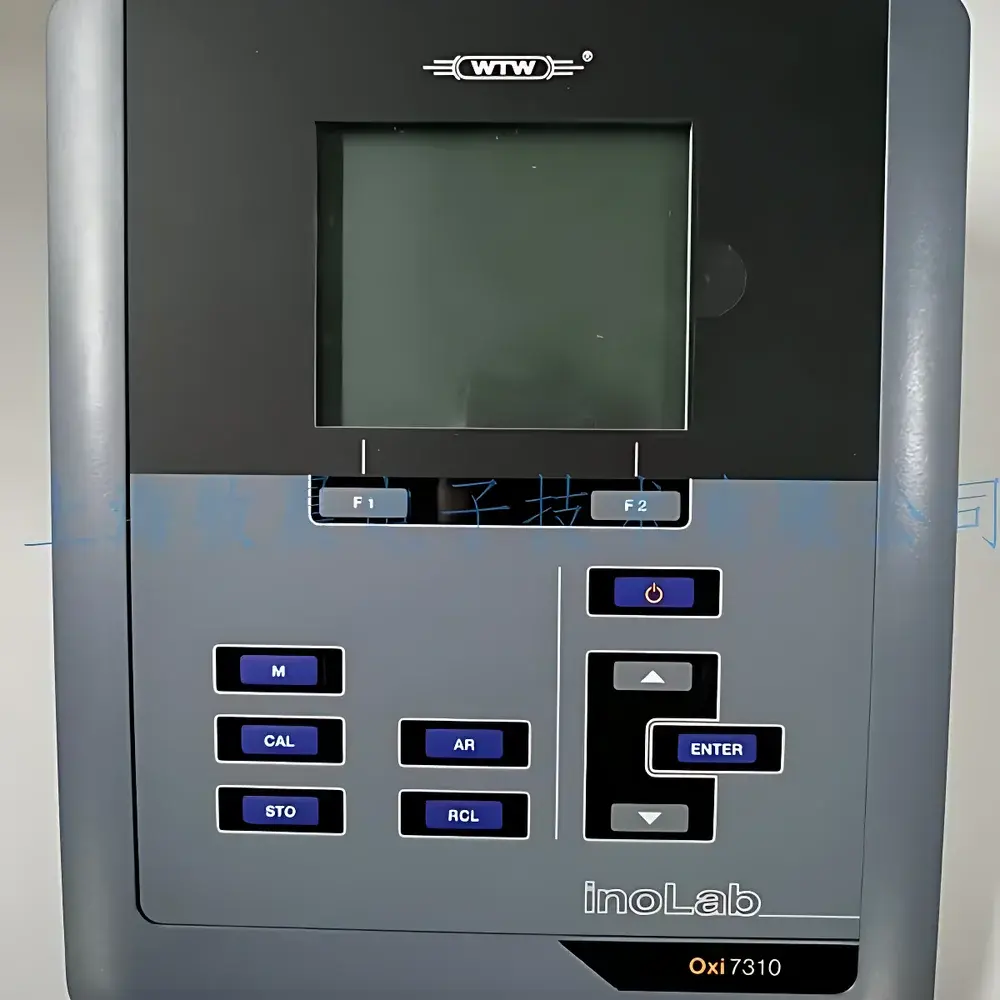
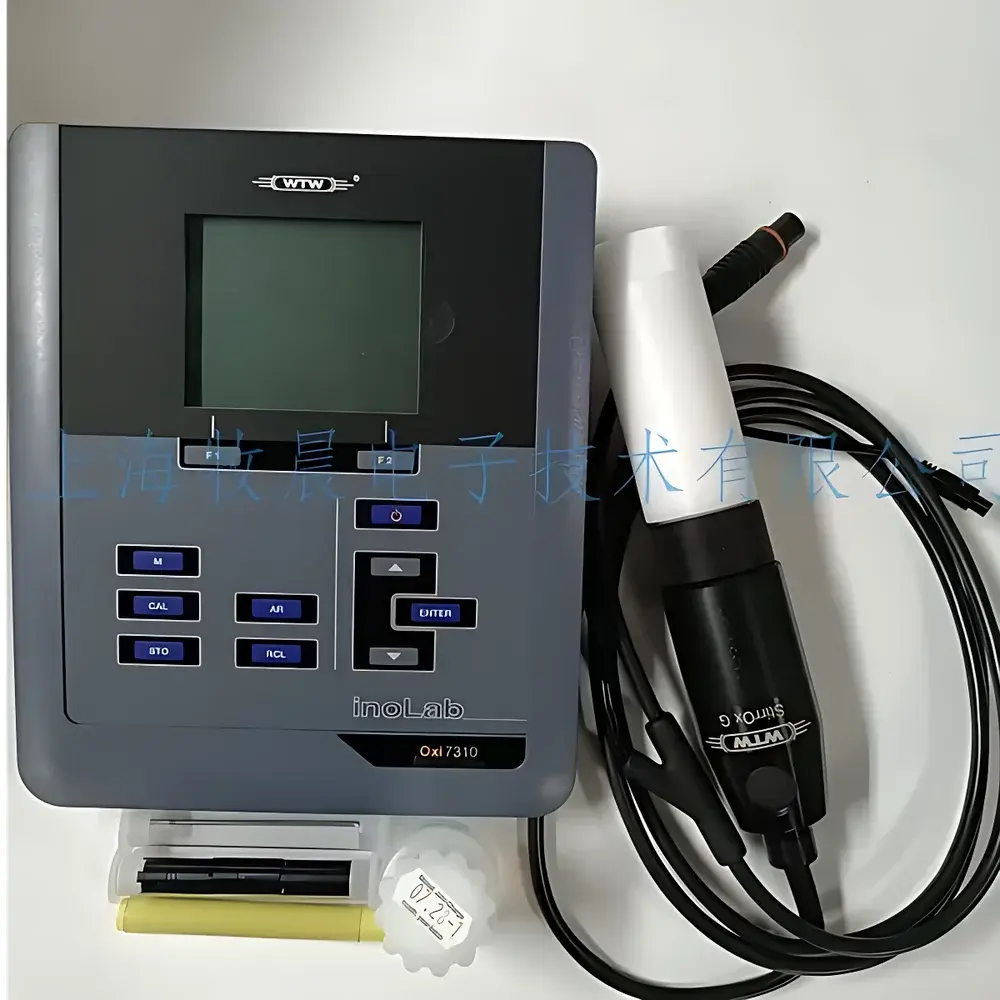
WTW inoLab Oxi 7310 Portable Dissolved Oxygen Meter
| Brand | WTW |
|---|---|
| Origin | Germany |
| Model | inoLab Oxi 7310 |
| Instrument Type | Portable |
| Measurement Principle | Electrochemical (Polarographic) |
| Dissolved Oxygen Range | 0.00–19.99 mg/L |
| Accuracy | ±0.5% of reading |
| Data Storage Capacity | 5,000 automatic / 500 manual entries |
| Pressure Compensation | Automatic (500–1100 mbar) |
| Salinity Compensation | Manual (0–70.0 g/kg) |
| Temperature Range | 0.0–50.0 °C |
| Temperature Accuracy | ±0.1 °C |
| Interface | Mini-USB |
| Display | Backlit LCD with graphical capability |
| Power Supply | 4 × 1.5 V alkaline batteries, USB bus power, or universal AC adapter |
| Battery Life | Up to 800 h (no backlight), 100 h (continuous backlight) |
| Compliance | GLP/AQA-compliant data logging |
Overview
The WTW inoLab Oxi 7310 is a high-precision, portable dissolved oxygen (DO) meter engineered for field and laboratory applications requiring traceable, reproducible measurements in compliance with Good Laboratory Practice (GLP) and Analytical Quality Assurance (AQA) frameworks. It operates on the polarographic electrochemical principle—utilizing a Clark-type sensor with a gold cathode and silver/silver chloride anode immersed in an electrolyte-filled membrane cap. Oxygen diffuses through a selective gas-permeable membrane, undergoes reduction at the cathode, and generates a current linearly proportional to the partial pressure of dissolved molecular oxygen. This signal is converted into concentration units (mg/L), saturation (%), or partial pressure (mbar), with real-time temperature and atmospheric pressure compensation applied to eliminate environmental drift. Designed for rigorous environmental monitoring—including wastewater treatment, surface water assessment, aquaculture, and BOD5 incubation protocols—the instrument delivers metrological integrity across diverse matrices without requiring external calibration gases or complex setup procedures.
Key Features
- Polarographic DO sensor interface supporting WTW’s StirrOx-G self-stirring probe—eliminating need for external magnetic stirrers during BOD5 testing and ensuring consistent hydrodynamic conditions per ISO 5815-1:2016
- Integrated barometric pressure sensor (500–1100 mbar) enabling fully automatic altitude- and weather-adjusted compensation
- Manual salinity input (0–70.0 g/kg) for accurate seawater, estuarine, and brackish water correction per ASTM D888-20
- Large-capacity memory storing up to 5,000 automatically timestamped readings with full metadata (date, time, temperature, pressure, salinity, electrode ID)
- Backlit graphical LCD display supporting real-time trend visualization, multi-parameter overlays, and intuitive navigation
- Mini-USB interface compliant with standard CDC/ACM serial emulation—enabling direct data export to Windows/macOS/Linux systems in CSV format without proprietary software
- Optional integrated thermal printer for on-site report generation meeting chain-of-custody documentation requirements
- Robust housing rated IP67 for immersion resistance; battery operation supports >800 hours of intermittent use in remote sampling locations
Sample Compatibility & Compliance
The inoLab Oxi 7310 is validated for aqueous samples across freshwater, marine, wastewater, and process streams. When paired with the StirrOx-G probe, it meets the mechanical stirring criteria defined in ISO 5815-1 (BOD determination) and US EPA Method 4500-O G. The self-stirring mechanism maintains a constant flow velocity (>1.5 cm/s) over the membrane surface—critical for minimizing boundary layer effects and achieving t90 response times <10 s. All stored data include audit-trail fields (operator ID, calibration history, sensor serial number) satisfying GLP documentation mandates. Firmware implements secure timestamping and read-only archival mode to prevent post-acquisition modification—aligning with FDA 21 CFR Part 11 electronic record controls where enabled via IT infrastructure integration.
Software & Data Management
Data transfer occurs via native CDC-mode USB connection—requiring no driver installation on modern operating systems. Exported CSV files contain column headers compatible with LIMS, Excel, and statistical analysis platforms (e.g., R, Python pandas). Each entry includes ISO 8601 timestamps, measurement uncertainty flags, and sensor health indicators (e.g., membrane integrity status, electrolyte level warning). Internal memory retains calibration logs (zero point, span point, date/time, operator) for full traceability. Optional PC software (WTW LabX® Light) provides advanced reporting templates aligned with ISO/IEC 17025 accreditation requirements—but standalone operation requires no software dependency.
Applications
- BOD5 incubation monitoring using standardized 300-mL BOD bottles with StirrOx-G insertion—ensuring uniform mixing and minimal oxygen consumption by the probe itself (intrinsic O2 demand: ≤0.008 µg·h−1 per mg/L)
- Routine effluent discharge compliance testing per EU Urban Wastewater Treatment Directive (91/271/EEC) and US Clean Water Act NPDES permits
- Ecological field surveys assessing hypolimnetic oxygen depletion in stratified lakes and reservoirs
- Aquaculture system optimization—tracking diurnal DO fluctuations and feed-induced respiration spikes
- Pharmaceutical water system validation (PW, WFI) under USP and EU Annex 1 guidelines
- Research-grade oxygen profiling in sediment-water interface studies using depth-compensated probe configurations
FAQ
Does the inoLab Oxi 7310 require daily calibration?
No—calibration frequency depends on application stringency and regulatory context. For routine environmental monitoring, single-point air-saturation calibration before each sampling session is sufficient per ISO 5814:2012. For GLP audits, two-point calibration (zero and air-saturation) is recommended at start/end of analytical batches.
Can the StirrOx-G probe be used in viscous or particulate-laden samples?
Yes—the IP67-rated probe head and integrated stirring motor tolerate suspended solids up to 500 mg/L and kinematic viscosities ≤10 mm²/s. However, frequent membrane cleaning with soft tissue and periodic electrolyte replacement (every 6 months max) are required to maintain accuracy.
Is firmware update supported in the field?
Yes—updates are distributed as signed .hex files via WTW’s official support portal and installed via USB using the built-in bootloader. Version history and release notes comply with IEC 62304 Class B software safety requirements.
How is measurement uncertainty calculated and reported?
Total uncertainty incorporates sensor accuracy (±0.5%), temperature compensation error (<±0.2%), pressure sensor tolerance (±1.5 mbar), and salinity input deviation (±0.5 g/kg)—aggregated using root-sum-square methodology per GUM (JCGM 100:2018). Uncertainty values appear in exported CSV metadata columns.
What happens if the internal pressure sensor fails?
The instrument defaults to user-entered barometric pressure and displays a diagnostic flag. All historical data retain original compensation values; no retroactive recalculations occur to preserve data integrity per ALCOA+ principles.







