Global Water SPX Series Inline Low-Flow Turbine Flowmeter
| Brand | Global Water |
|---|---|
| Origin | Germany |
| Manufacturer Status | Authorized Distributor |
| Origin Category | Imported |
| Model | SPX Series |
| Price Range | USD 2,800 – 14,000 |
| Body Material | Polypropylene |
| Cover Material | Acrylic |
| Rotor Material | PVDF |
| Shaft Material | Nickel-Based Tungsten Carbide |
| Bearing Material | Sapphire |
| Max Pressure | 150 psi (10 bar) |
| Temp. Range | Up to 70°C |
| Power Supply | 6–24 VDC, min. 2 mA |
| Output Signal | Sinking Pulse (6–24 VDC) |
| Cable | 5 m, AWG 22, 3-conductor |
| Max Cable Length | 650 m |
| Dimensions | 10.5 × 5.5 × 5 cm (L×W×H) |
| Weight | 1.13 kg |
| Accuracy | ±1% FS |
| Flow Ranges | 3/8″: 0.07–5 GPM |
| 1/2″ | 0.1–10 GPM |
| 3/4″ | 0.2–20 GPM |
| 1″ | 0.5–40 GPM |
Overview
The Global Water SPX Series Inline Low-Flow Turbine Flowmeter is a precision-engineered mechanical flow sensing device designed for accurate, repeatable measurement of low-flow-rate liquid streams in small-diameter piping systems (3/8″ to 1″ NPT). Operating on the principle of turbine rotation induced by fluid momentum, the SPX meter converts volumetric flow into proportional electrical pulses via a non-contact, solid-state sensor assembly. Its core architecture integrates sapphire jewel bearings and a nickel-based tungsten carbide shaft—materials selected for exceptional hardness, dimensional stability, and resistance to abrasive wear—enabling reliable operation down to 0.07 GPM (0.27 L/min) with ±1% full-scale accuracy. Unlike ultrasonic or electromagnetic alternatives, the SPX leverages direct mechanical coupling between flow and rotor motion, delivering high signal-to-noise ratio and minimal zero drift under steady-state and transient conditions. It is specifically engineered for integration into process control loops, environmental monitoring stations, laboratory dosing systems, and pilot-scale chemical delivery infrastructure where long-term calibration stability and chemical compatibility outweigh the need for bidirectional or high-turbulence flow capability.
Key Features
- Robust mechanical design featuring sapphire bearings and nickel-based tungsten carbide shaft for extended service life and minimal rotational hysteresis
- Chemically resistant wetted materials: polypropylene body, acrylic transparent cover, and PVDF rotor—validated against mild acids, glycols, alcohols, and aqueous saline solutions per ASTM D543 and ISO 175
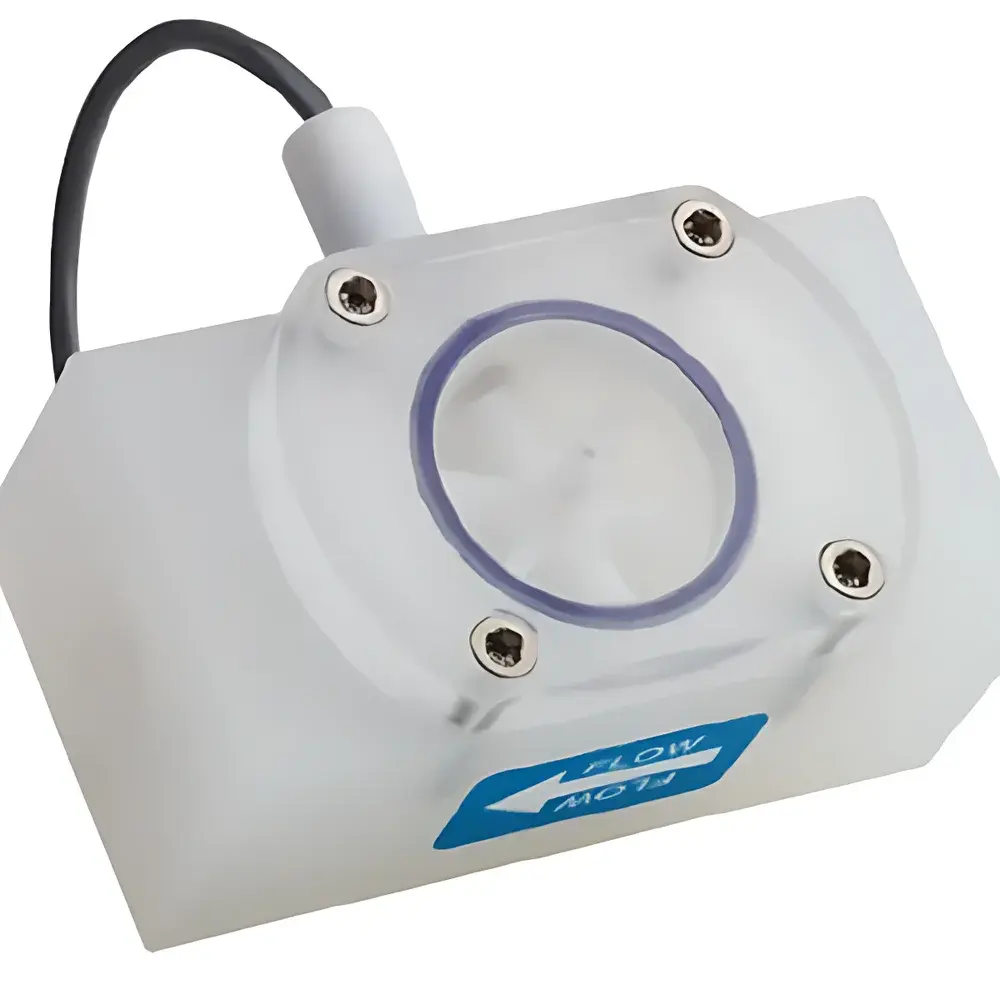
- Optically transparent acrylic cover enables real-time visual verification of rotor movement and flow presence without system shutdown
- Non-wetted, replaceable solid-state sensor eliminates contact corrosion risk and supports field maintenance without recalibration
- Wide operating voltage range (6–24 VDC) and sinking pulse output ensure seamless interoperability with PLCs, SCADA I/O modules, rate meters, and industrial counters compliant with IEC 61131-2 Type 3 (sinking) specifications
- Compact form factor (10.5 × 5.5 × 5 cm) and lightweight construction (1.13 kg) facilitate installation in space-constrained enclosures or mobile analytical platforms
Sample Compatibility & Compliance
The SPX Series is suitable for clean, low-viscosity liquids with suspended solids content below 50 ppm and particle size under 50 µm to prevent rotor impingement. It complies with pressure equipment directives for low-pressure instrumentation (PED 2014/68/EU Category I), carries CE marking for EMC (2014/30/EU) and RoHS 2011/65/EU conformity, and meets IP65 ingress protection when installed with proper conduit sealing. While not certified for hazardous area use (ATEX/IECEx), its non-sparking materials and low-power operation make it appropriate for general-purpose Zone 2 environments. For regulated applications—including water quality monitoring per EPA Method 160.1 and pharmaceutical utility water flow verification—the SPX supports audit-ready documentation packages aligned with GLP and 21 CFR Part 11 data integrity requirements when paired with compliant data loggers.
Software & Data Management
The SPX operates as a stand-alone pulse generator and does not require embedded firmware or proprietary software. Pulse output frequency (typically 10–100 Hz per GPM, scalable via K-factor configuration) is directly interpretable by any programmable logic controller or data acquisition system supporting TTL/CMOS-compatible sinking inputs. Integration with SCADA platforms (e.g., Ignition, Siemens WinCC, or Rockwell FactoryTalk) is achieved using standard Modbus RTU gateways or pulse-to-analog converters. Optional third-party pulse-counting modules provide timestamped event logging, totalization, alarm thresholds, and CSV export—fully traceable with user-defined metadata tags and electronic signature support for QA/QC workflows.
Applications
- Continuous monitoring of reagent dosing lines in wastewater treatment and potable water disinfection systems
- Low-flow verification in laboratory ultra-pure water recirculation loops (Type I–III per ISO 3696)
- Feedstock flow assurance in small-batch chemical synthesis reactors and catalyst injection manifolds
- Leak detection and consumption tracking in HVAC glycol circuits and chilled beam networks
- Calibration reference for larger flowmeters during low-flow validation per ISO 7145 and ASTM D3558
- Environmental sensor networks measuring seepage rates in lysimeters and soil column studies
FAQ
Can the SPX be installed in vertical pipelines?
Yes—orientation-independent mounting is supported; however, for optimal bearing lubrication and rotor centering, horizontal installation is preferred. Vertical mounting requires upstream flow conditioning per ISO 4006 guidelines.
Is the SPX suitable for seawater or brine applications?
Polypropylene and PVDF exhibit good resistance to chloride ions at ambient temperatures; however, prolonged exposure to >3.5% NaCl above 40°C may accelerate creep deformation. Use with caution in marine environments without periodic inspection.
What is the minimum straight-run requirement for accurate measurement?
A minimum of 5 pipe diameters upstream and 2 diameters downstream is recommended per ISO 5167 Annex B; 10D upstream is advised for turbulent or disturbed flow profiles.
Does the SPX require periodic recalibration?
No scheduled recalibration is mandated under normal operating conditions. Verification via master meter comparison per ISO/IEC 17025 is recommended annually for metrologically critical applications.
Can the pulse output drive a 24 VAC PLC input?
No—the SPX provides only DC sinking output (6–24 VDC). AC-coupled inputs require an external DC-powered interface relay or opto-isolator module.