
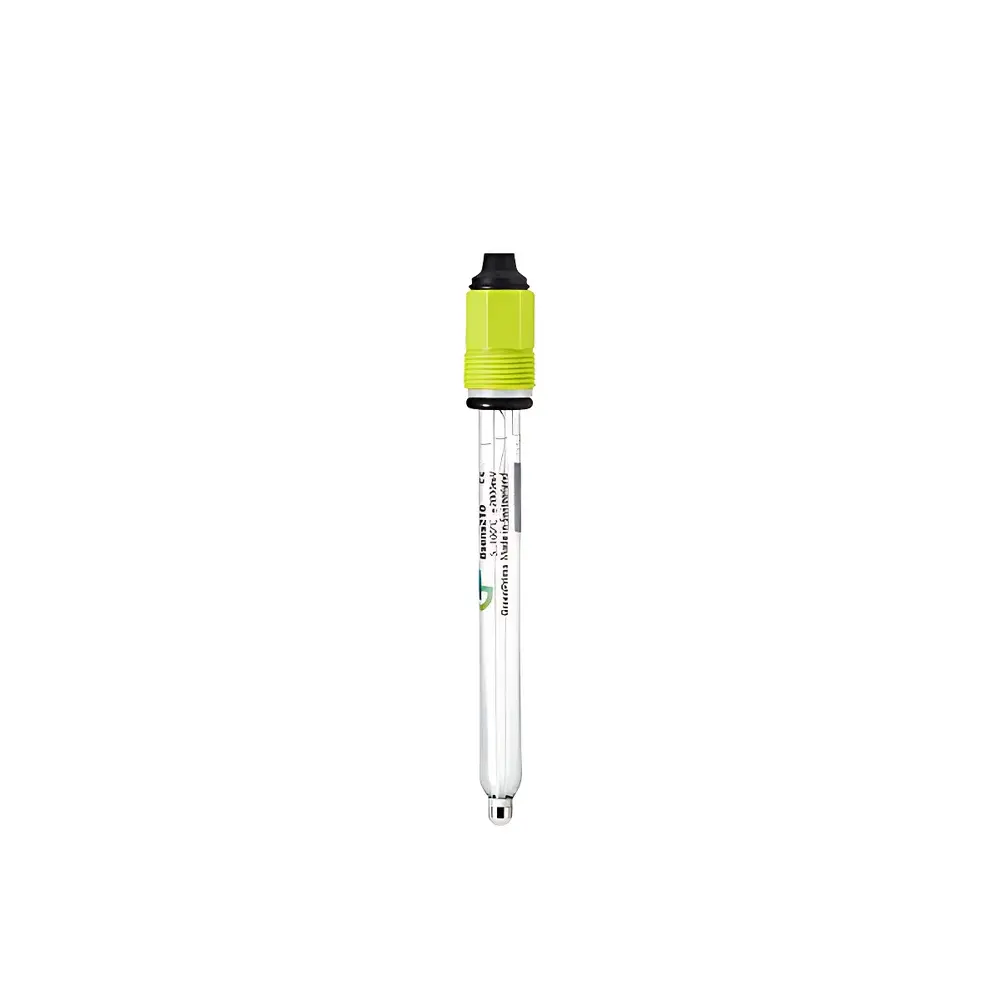
GreenPrima BSens 210 Industrial Wastewater ORP Electrode
| Brand | GreenPrima |
|---|---|
| Origin | Switzerland |
| Manufacturer Type | Original Equipment Manufacturer (OEM) |
| Origin Category | Imported |
| Model | BSens 210 |
| Measurement Range | −1500 to +1500 mV |
| Operating Temperature | −5 to 70 °C |
| Resolution | 1 mV |
| Accuracy | ±1 mV |
| Maximum Pressure Rating | 3.5 bar |
| Electrode Body Material | Borosilicate Glass / Platinum Sensing Element |
| Reference System | Gel-Filled Ag/AgCl |
| Junction Type | Ceramic Frit |
| Electrolyte | Polymer-Gel Electrolyte |
| Connection | Fixed PG13.5 Threaded Cable Port |
| Cable Length | 3 m |
| Electrode Tip Geometry | AH Glass Ball (Asymmetric Hydrophilic Bulb) |
Overview
The GreenPrima BSens 210 Industrial Wastewater ORP Electrode is a robust, field-deployable redox potential sensor engineered for continuous and reliable measurement in demanding aqueous environments—including municipal wastewater treatment plants, industrial effluent streams, chemical process water loops, and bioreactor monitoring systems. Based on the fundamental principle of potentiometric measurement, the BSens 210 operates as a composite electrode integrating both measuring and reference functions within a single, sealed probe body. Its sensing element utilizes a platinum (Pt) redox-active surface paired with a stable, polymer-gel–filled silver/silver chloride (Ag/AgCl) reference system, eliminating liquid electrolyte leakage and minimizing junction clogging—a critical advantage in high-solids, high-organic-load, or sulfide-rich wastewaters. The asymmetric hydrophilic (AH) glass ball tip ensures rapid hydration, consistent interfacial potential development, and reduced response hysteresis during dynamic redox transitions.
Key Features
- Composite design with integrated Pt measuring element and gel-filled Ag/AgCl reference—no external reference required.
- Asymmetric hydrophilic (AH) glass bulb geometry optimized for fast equilibration and stable potential output in viscous or particulate-laden media.
- Polymer-gel electrolyte provides long-term stability, zero maintenance between calibrations, and resistance to electrolyte depletion or contamination.
- Borosilicate glass body with platinum sensing surface offers chemical inertness against oxidizing agents, heavy metals, and common industrial solvents.
- Rated for continuous operation at pressures up to 3.5 bar—suitable for submersible mounting in pressurized pipelines, aeration tanks, and clarifier effluent channels.
- PG13.5 fixed-thread cable port ensures IP68-rated mechanical integrity and eliminates connector corrosion risks in humid or splash-prone installations.
- Temperature compensation-ready interface compatible with standard industrial pH/ORP transmitters supporting PT100 or NTC inputs.
Sample Compatibility & Compliance
The BSens 210 is validated for use across heterogeneous aqueous matrices, including activated sludge effluents, landfill leachate, electroplating rinse waters, pulp and paper mill process streams, and anaerobic digester supernatants. Its gel-junction architecture and AH glass surface resist fouling by oils, biofilms, and precipitated metal hydroxides—common failure modes observed with conventional liquid-junction electrodes. While not certified to intrinsic safety standards (e.g., ATEX or IECEx), the electrode complies with IEC 60746-3 for electrochemical performance specifications and meets material compatibility requirements outlined in ISO 5667-12 (water sampling — Part 12: Sampling of waste water). It supports GLP-aligned data acquisition when paired with transmitters featuring audit-trail logging and user-access controls per FDA 21 CFR Part 11.
Software & Data Management
The BSens 210 functions as an analog sensor (mV output) and interfaces seamlessly with third-party industrial controllers, SCADA systems, and dedicated ORP/pH analyzers (e.g., Endress+Hauser Liquiline, Emerson Rosemount 5081, or Hach SC1000 platforms). No proprietary software is required; however, GreenPrima provides calibration protocols and verification checklists aligned with ASTM D1129 and ISO 11221 for traceable redox validation. When integrated into automated monitoring networks, raw mV signals can be logged with timestamped metadata—including temperature, flow status, and calibration history—to support regulatory reporting under EPA 40 CFR Part 136 or EU Water Framework Directive Annex V compliance frameworks.
Applications
- Real-time redox monitoring in denitrification and sulfur-oxidizing bioreactors.
- Process control of chlorine dioxide or ozone dosing in tertiary disinfection stages.
- Early detection of septic conditions in sewer force mains via negative ORP excursion trends.
- Redox profiling across multi-stage anaerobic digestion tanks to optimize volatile fatty acid (VFA) accumulation.
- Quality assurance in pharmaceutical clean-in-place (CIP) rinse cycles where residual oxidant presence must be verified.
- Environmental compliance monitoring for discharge permits requiring redox-based limits (e.g., cyanide stabilization, chromium(VI) reduction).
FAQ
What is the recommended calibration frequency for the BSens 210 in continuous wastewater applications?
Calibration is advised before initial deployment and at intervals not exceeding 7 days in high-fouling environments; monthly verification suffices in stabilized, low-turbidity effluents. Use certified quinhydrone or Zobell’s solution standards traceable to NIST SRM 1900.
Can the BSens 210 be cleaned in situ without removal from the process?
Yes—gentle mechanical brushing (non-metallic bristles) and periodic low-concentration citric acid (1% w/w, pH ~2.5) soak cycles are approved for junction and bulb cleaning. Avoid abrasive pads or strong oxidizers such as sodium hypochlorite.
Is temperature compensation mandatory for accurate ORP readings?
While ORP is intrinsically temperature-dependent, the BSens 210 does not incorporate a built-in temperature sensor. External PT100 or NTC input to the transmitter is required for compensated mV-to-redox conversion per the Nernst equation.
Does the electrode require refilling or electrolyte replacement?
No—the polymer-gel electrolyte is sealed for the lifetime of the sensor (typically ≥24 months in continuous service) and contains no free liquid to deplete or contaminate.
What is the minimum immersion depth for stable signal acquisition?
A minimum of 50 mm of active electrode length must remain submerged; the AH glass bulb must be fully covered to ensure reproducible hydration and junction potential stability.







