
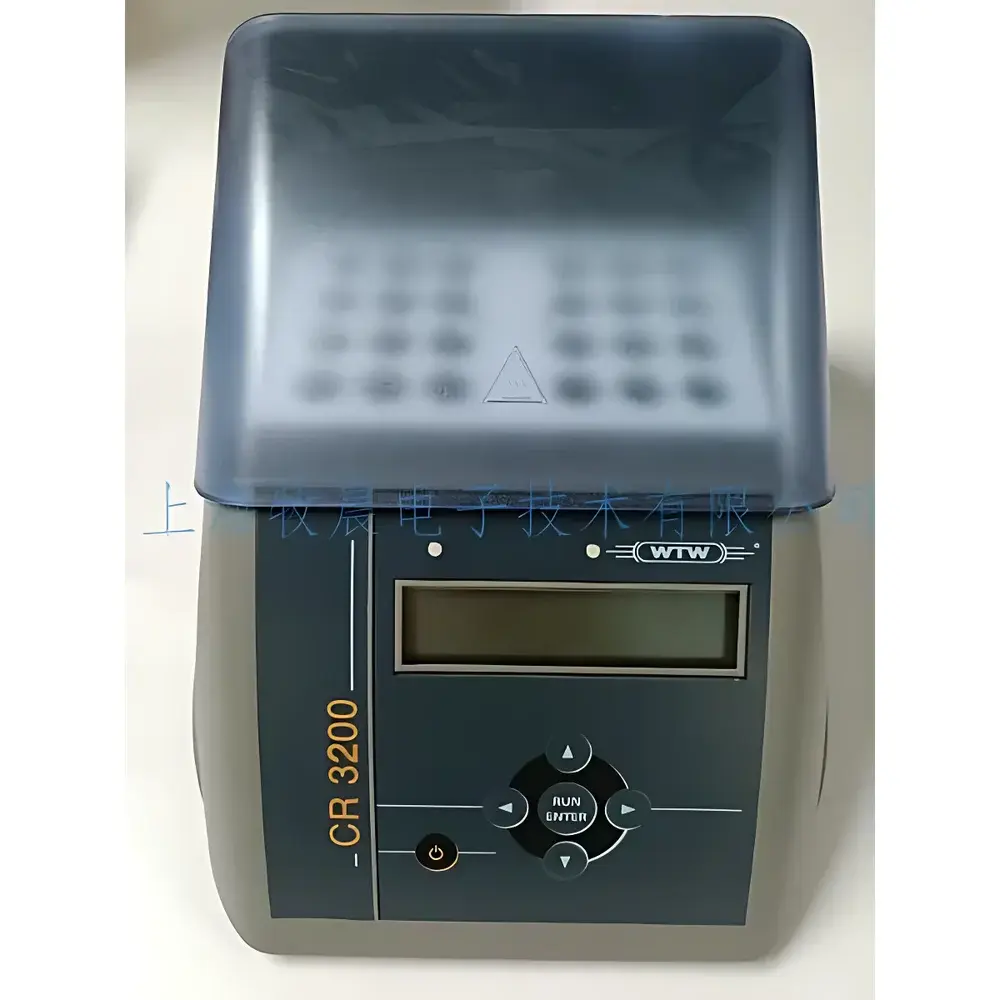
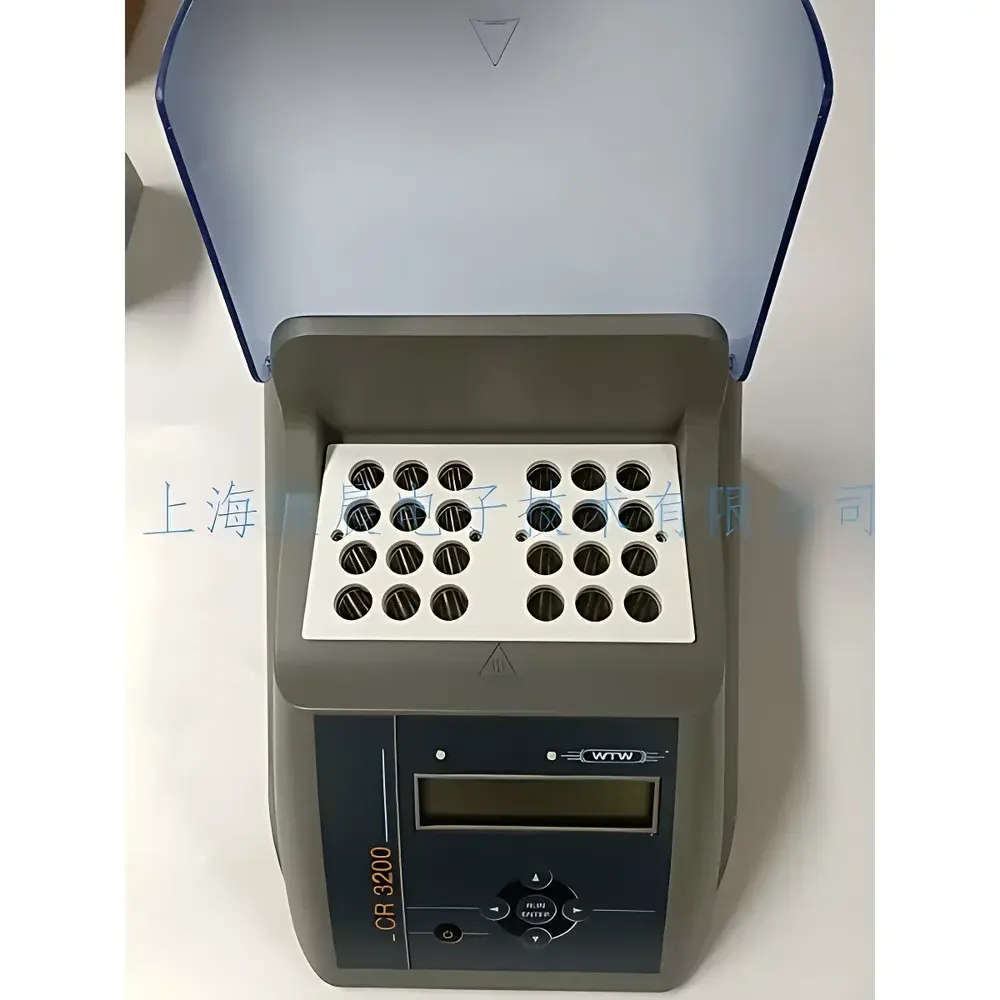
WTW CR 3200 1P22-1 COD Digestion System
| Brand | WTW |
|---|---|
| Origin | Germany |
| Model | CR 3200 1P22-1 |
| Digestion Method | Rapid Digestion |
| Heating Modules | Dual Block Heater |
| Batch Capacity | 24 × 16 mm tubes |
| Temperature Range | 25–170 °C |
| Time Range | 0–180 min |
| Power Supply | 230 VAC 50 Hz ±15% / 115 VAC 60 Hz ±15% |
| Power Consumption | 560 W |
| Safety Class | I (DIN VDE 0700 Part 1:11/90) |
| Certifications | CE, cETLus, GS |
| Dimensions (W×H×D) | 256 × 185 × 315 mm |
| Weight | 3.6 kg |
| Interface | RS232 (unidirectional), 2 banana sockets (for TFK CR, AK CR/P or CR/PC sensors) |
Overview
The WTW CR 3200 1P22-1 is a precision-engineered, dual-block COD digestion system designed for standardized chemical oxygen demand (COD) analysis in environmental and wastewater laboratories. Based on the widely accepted closed-reflux colorimetric method (e.g., ISO 6060, APHA 5220 D, ASTM D1252), the instrument provides thermally stable, reproducible heating conditions required for complete oxidation of organic matter in aqueous samples using potassium dichromate under acidic conditions. Its robust architecture integrates two independent 12-position heating blocks—each accommodating standard 16 mm outer-diameter digestion tubes—enabling simultaneous processing of up to 24 samples per run. The system operates across a precisely controlled temperature range of 25–170 °C (adjustable in 1 °C increments) with ramp times validated per DIN EN 61000-4-30: <12 min to 170 °C. Thermal uniformity across the block surface is maintained within ±1.5 °C at setpoint, ensuring compliance with QA/QC requirements for inter-laboratory comparability.
Key Features
- Dual independent heating blocks (2 × 12 positions) for high-throughput batch digestion of 24 × 16 mm reaction tubes
- Precise digital temperature control (25–170 °C, 1 °C resolution) with real-time LED display and status indicators
- Pre-programmed digestion protocols aligned with international standards: 148 °C/120 min (ISO 6060), 120 °C/30–120 min (US EPA 410.4), 100 °C/60 min (low-temperature alternative)
- Eight user-definable programs supporting custom temperature–time profiles (25–170 °C, 0–180 min)
- Automated start/stop functionality with programmable delay timers and thermal cut-off at 190 °C (hardware-based overtemperature protection)
- Integrated safety shielding and Class I electrical insulation (DIN VDE 0700 Part 1:11/90) for operator protection
- RS232 serial interface for external logging or integration into LIMS; dual banana socket ports compatible with WTW TFK CR temperature probes (Order No. 250100) and AK CR/P reference sensors
Sample Compatibility & Compliance
The CR 3200 1P22-1 is optimized for use with standard borosilicate glass digestion tubes (16 mm OD, 100–150 mm length) compliant with ISO 8466-1 and DIN 38405-45. It supports all common COD reagent kits—including mercury-free alternatives—and is validated for matrices ranging from municipal wastewater and industrial effluents to surface water and digested sludge filtrates. The unit meets essential regulatory requirements for environmental testing laboratories: CE marking per EU Directive 2014/30/EU (EMC) and 2014/35/EU (LVD); cETLus certification to UL 61010-1 and CSA C22.2 No. 61010-1; GS mark per German Product Safety Act (ProdSG). Its operational consistency supports adherence to ISO/IEC 17025:2017 clause 6.4.3 (equipment verification) and GLP principles for traceable, auditable digestion workflows.
Software & Data Management
While the CR 3200 operates as a standalone benchtop instrument, its unidirectional RS232 output enables passive data capture of runtime parameters—including actual block temperature, elapsed time, and program ID—via third-party terminal software or laboratory information management systems (LIMS). When paired with optional WTW TFK CR immersion probes (250100), real-time sample-adjacent temperature monitoring is achievable, enhancing method validation documentation. All heating cycles include automatic timestamping and thermal event logging (start, peak, hold, end), satisfying FDA 21 CFR Part 11 audit trail expectations when integrated into validated digital workflows. No proprietary software is required; ASCII-formatted serial output ensures compatibility with common data acquisition platforms.
Applications
- Routine COD determination in municipal and industrial wastewater treatment plants
- Regulatory compliance monitoring per EU Urban Waste Water Treatment Directive (91/271/EEC) and US Clean Water Act discharge permits
- Method development and validation studies requiring precise thermal profiling (e.g., comparing dichromate vs. permanganate oxidation efficiency)
- Research applications in environmental chemistry, including biodegradability assessment and organic load characterization
- Quality control of pretreatment reagents and calibration standards in certified environmental labs
- Education and training in analytical environmental science curricula
FAQ
What safety certifications does the CR 3200 1P22-1 hold?
It carries CE, cETLus (UL 61010-1 / CSA C22.2 No. 61010-1), and GS marks—fully compliant with European and North American electrical safety and electromagnetic compatibility directives.
Can the CR 3200 be used for TOC or TN digestion?
No—it is specifically engineered for COD analysis per closed-reflux dichromate oxidation. TOC and total nitrogen require different furnace configurations, catalysts, and temperature profiles.
Is external temperature monitoring mandatory for ISO 6060 compliance?
Not mandatory, but highly recommended. While block temperature control satisfies basic requirements, insertion of a calibrated TFK CR probe into a representative tube provides direct sample-zone verification—critical for accreditation audits.
Does the unit support remote start via digital input?
No. Start/stop is initiated exclusively via front-panel keypad or timer-based scheduling. RS232 is output-only and does not accept command signals.
What is the expected service life of the heating elements under routine use?
With proper maintenance (cleaning residue after each batch, avoiding thermal shock), the dual NiCr heating blocks are rated for ≥5,000 operational hours or 10+ years of typical lab usage (2–3 batches/day).
Related Products







