
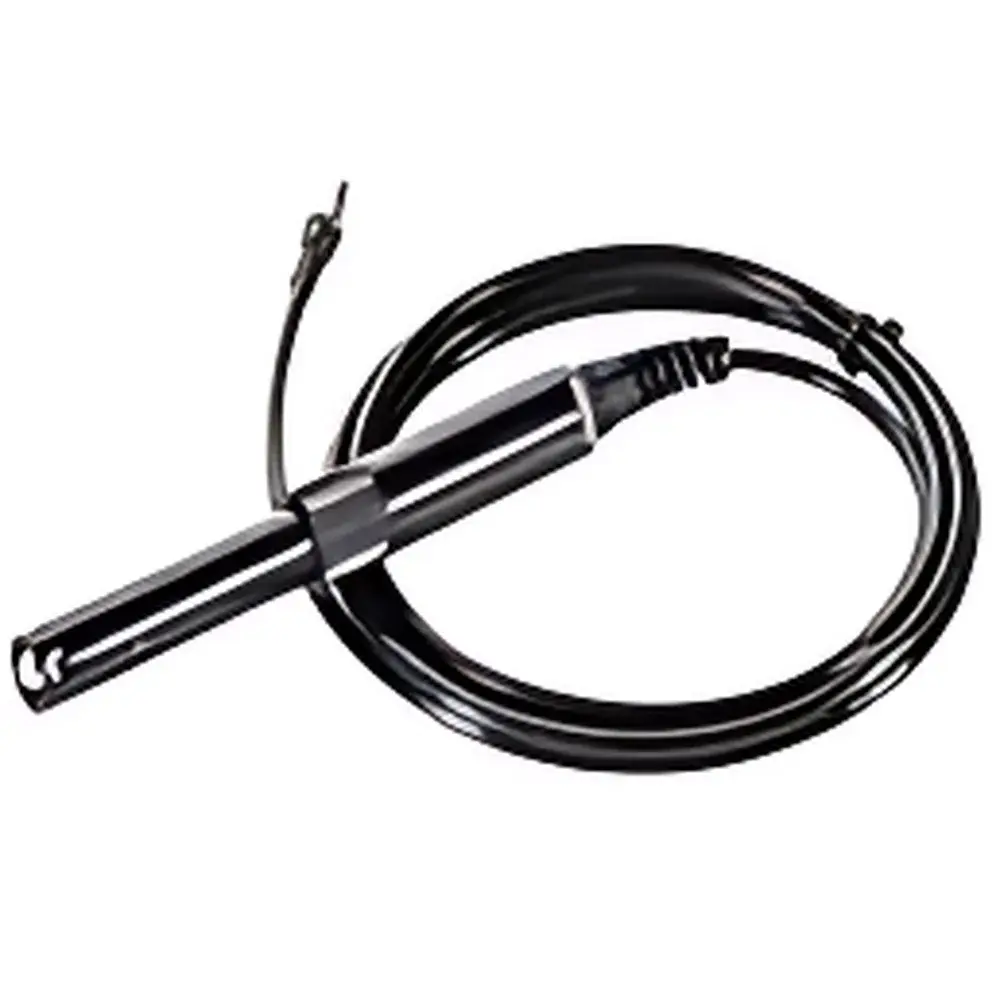
PONSEL PHEHT Digital pH/ORP/Temperature Sensor
| Brand | PONSEL (France) |
|---|---|
| Origin | France |
| Model | PHEHT |
| Measurement Principle | Composite Glass Electrode (pH), Platinum Redox Electrode (ORP), NTC Thermistor (Temperature) |
| pH Range | 0–14 |
| pH Resolution | 0.01 |
| pH Accuracy | ±0.1 |
| ORP Range | −1000 to +1000 mV |
| ORP Resolution | 0.1 mV |
| ORP Accuracy | ±2 mV |
| Temperature Range | 0.00–50.00 °C |
| Temperature Resolution | 0.01 °C |
| Temperature Accuracy | ±0.5 °C |
| Response Time | <5 s |
| IP Rating | IP68 |
| Output Interface | Modbus RTU over RS-485 (standard), SDI-12 (optional) |
| Supply Voltage | 5–12 V DC |
| Standby Current | 25 µA |
| Active Current (1 Hz, RS-485) | 3.9 mA |
| Active Current (1 Hz, SDI-12) | 6.8 mA |
| Pulse Current | 500 mA |
| Dimensions (Ø × L) | 27/21 mm × 207 mm |
| Weight (sensor + 3 m cable) | 350 g |
| Housing Materials | PVC, Delrin®, specialty pH glass, platinum, polyamide |
| Max Pressure Rating | 5 bar |
| Cable | Armored coaxial polyurethane cable, bare leads or Fischer connector |
Overview
The PONSEL PHEHT Digital pH/ORP/Temperature Sensor is an industrial-grade, tri-parameter electrochemical transducer engineered for high-reliability operation in demanding aqueous environments—from low-conductivity natural waters (≥20 µS/cm) to seawater (≈50 mS/cm) and high-salinity or high-TDS wastewaters (>200 mS/cm). Unlike analog pH probes requiring continuous signal conditioning and frequent recalibration, the PHEHT integrates a microcontroller-based digital architecture with embedded calibration memory and standardized Modbus RTU communication. Its measurement principle relies on a dual-composite electrode design: a temperature-compensated glass membrane electrode for pH (with Ag/AgCl reference system and colloidal KCl electrolyte), a platinum sensing element for redox potential (ORP), and a precision NTC thermistor for simultaneous temperature acquisition. This co-located, three-in-one sensor architecture eliminates inter-channel drift and ensures synchronized, time-aligned data capture—critical for regulatory-compliant process monitoring and environmental compliance reporting.
Key Features
- Digital intelligence: Onboard non-volatile memory stores factory calibration coefficients, user-defined calibration points, and timestamped historical calibration logs—enabling true plug-and-play deployment without host-side calibration routines.
- Robust electrochemical design: Plastogel® electrolyte technology (a proprietary thixotropic gel formulation) minimizes liquid junction potential drift and extends service life of replaceable electrode cartridges—reducing total cost of ownership in continuous immersion applications.
- Low-power, high-integrity interface: Compliant with Modbus RTU over RS-485 (EN 50170), the sensor supports multi-drop networks (up to 32 nodes) with galvanic isolation-ready wiring. Optional SDI-12 compatibility enables integration into legacy environmental datalogger ecosystems.
- Environmental resilience: IP68-rated housing (tested to 5 bar static pressure), armored polyurethane cable, and chemically inert materials—including Delrin® body, platinum sensing tip, and borosilicate pH glass—ensure long-term stability in abrasive, biofouling, or UV-exposed installations.
- Fast, flow-insensitive response: Achieves <5 s t90 across full pH and ORP ranges with minimal dependence on sample velocity—validated per ASTM D1293 and ISO 10523 protocols for field-deployable water quality sensors.
Sample Compatibility & Compliance
The PHEHT is validated for direct immersion in potable water, surface water (lakes, rivers), estuarine and marine systems, wastewater effluents, cooling tower circuits, and industrial process streams with conductivity ≥20 µS/cm. It meets material compatibility requirements per US EPA Method 150.1 (pH), ASTM D3370 (field sampling), and ISO 5667-3 (water quality sampling). Its digital architecture supports audit-trail-capable data acquisition when integrated with GLP/GMP-compliant SCADA or LIMS platforms. While not intrinsically safe, its low-voltage operation (5–12 V DC) and absence of internal batteries make it suitable for Class I, Division 2 hazardous locations when deployed with appropriate barrier systems.
Software & Data Management
Calibration metadata—including date, buffer values, slope, offset, and electrode impedance—are stored in EEPROM and retrievable via Modbus function codes (e.g., Read Holding Registers 40001–40064). Host systems can log these parameters automatically to satisfy FDA 21 CFR Part 11 requirements for electronic records and signatures, provided the supervisory software implements user authentication, audit trails, and electronic signature workflows. No proprietary drivers or configuration utilities are required; standard Modbus master software (e.g., ModScan, Ignition, or custom Python/Node-RED implementations) fully supports read/write access to all operational registers.
Applications
- Real-time monitoring of drinking water treatment plant influent/effluent streams
- Regulatory compliance tracking in municipal wastewater discharge points (e.g., NPDES permits)
- Process control in electroplating, chemical synthesis, and pharmaceutical water-for-injection (WFI) loops
- Long-term ecological monitoring in remote lake and river networks using solar-powered telemetry nodes
- Integration into automated nutrient dosing systems where pH and ORP serve as feedback variables for redox-coupled reactions
FAQ
Does the PHEHT require periodic recalibration?
Yes—though less frequently than analog probes. Calibration interval depends on application severity; PONSEL recommends verification every 7–30 days in continuous use, with full two-point pH and single-point ORP calibration performed when drift exceeds ±0.2 pH or ±5 mV.
Can the electrode cartridge be replaced in-field?
Yes—the PHEHT uses a modular, screw-threaded replaceable cartridge assembly. Replacement requires no tools and preserves the calibrated digital identity of the sensor body.
Is temperature compensation automatic?
Yes—NTC-based temperature measurement is acquired simultaneously with pH and ORP, and all calculations (including Nernst equation correction) are executed internally prior to digital output.
What is the maximum cable length for RS-485 operation?
Up to 1,200 meters at 9.6 kbps (per EIA/TIA-485 standard), assuming proper twisted-pair shielding and termination. For longer runs or electrically noisy environments, fiber-optic media converters or isolated repeaters are recommended.
Does the sensor support Modbus TCP?
No—the PHEHT implements only Modbus RTU over physical RS-485. Integration into Ethernet-based systems requires a protocol gateway (e.g., Modbus RTU-to-TCP bridge) configured as a slave device.






