
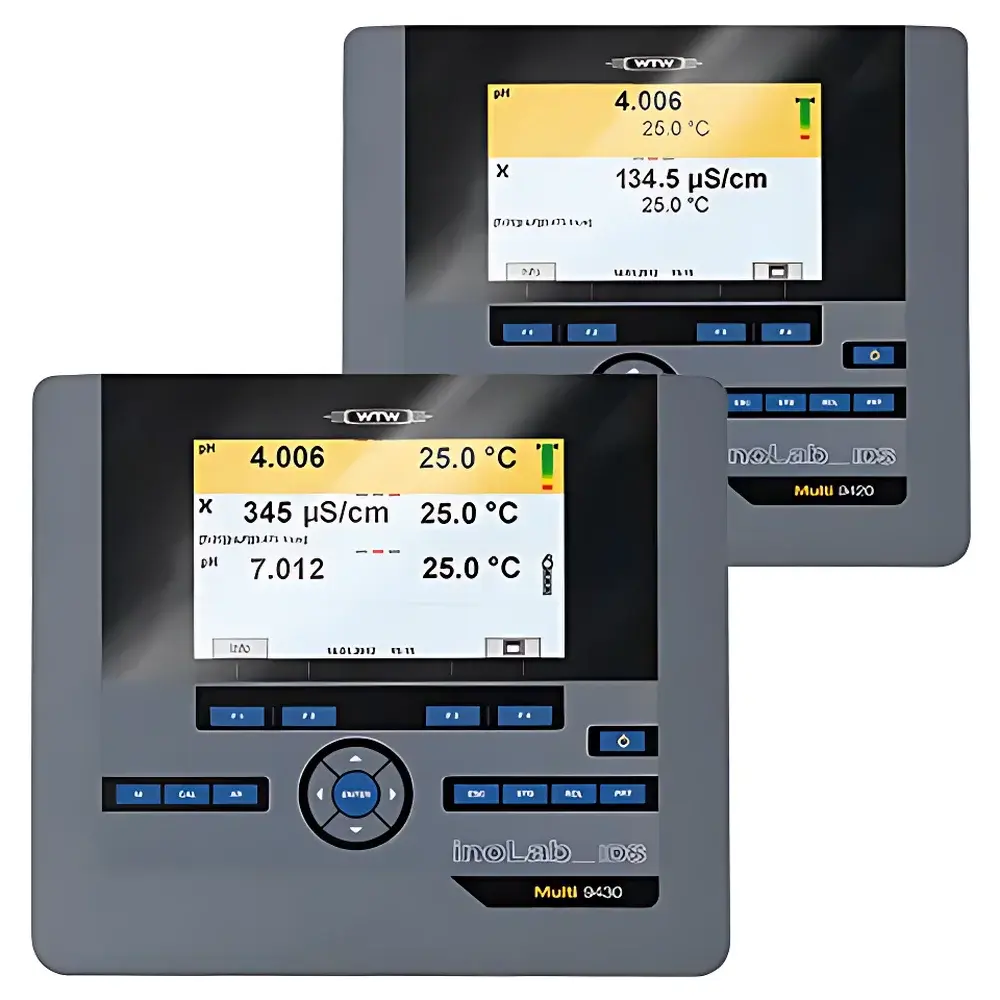
WTW inoLab® Multi 9430 IDS Multiparameter Laboratory Analyzer
| Brand | WTW |
|---|---|
| Origin | Germany |
| Model | Multi 9430 |
| Instrument Type | Laboratory Water Quality Analyzer |
| Measurement Principle | Electrochemical (pH, ORP, Conductivity, Optical Dissolved Oxygen) |
| Measured Parameters | pH, ORP, Conductivity, Dissolved Oxygen (optical), Temperature |
| Sensor Interface | Digital IDS (Intelligent Digital Sensors) |
| Channels | 3 independent digital sensor inputs |
| Data Storage | 10,000 measurement sets |
| Compliance | GLP/AQA-ready, FDA 21 CFR Part 11–compatible data handling |
| Connectivity | USB-A (host), Mini-USB-B (device), optional external printer support |
| Display | Backlit color graphic LCD |
| Keyboard | Antimicrobial-coated membrane keypad |
| Power Supply | Universal AC adapter |
Overview
The WTW inoLab® Multi 9430 IDS is a high-precision, three-channel laboratory multiparameter analyzer engineered for rigorous water quality assessment in accredited environmental, municipal, and industrial laboratories. Built upon WTW’s Intelligent Digital Sensor (IDS) platform, the instrument employs fully digital signal transmission between sensors and the base unit—eliminating analog noise, cable-length limitations, and calibration drift associated with traditional analog electrodes. Each IDS sensor embeds its own calibration history, serial number, type identification, and sensor-specific parameters directly into its memory chip, enabling automatic recognition, plug-and-play operation, and full traceability per GLP and AQA requirements. The system supports simultaneous measurement of pH, redox potential (ORP), conductivity (including TDS, salinity, resistivity, and hardness calculations), optical dissolved oxygen (via fluorescence-based FDO sensors), and temperature—with automatic temperature compensation applied across all electrochemical parameters except ORP. Its robust zinc die-cast electrode holder ensures mechanical stability during extended benchtop use, while the sealed, antimicrobial keyboard mitigates cross-contamination risks in shared lab environments.
Key Features
- Three independent digital IDS sensor channels—supporting mixed-parameter configurations (e.g., pH + DO + conductivity) or triple-redundant measurements of the same parameter for validation
- Automatic sensor identification and calibration data recall via integrated IDS memory chips—ensuring measurement integrity and eliminating manual entry errors
- Backlit color graphic LCD with intuitive channel visualization: real-time CMC (Continuous Measurement Control) range indicators and QSC (Quality Sensor Check) diagnostics display sensor health status, signal stability, and recommended maintenance actions
- GLP-compliant data management: timestamped, user-ID-tagged records with full audit trail; all metadata—including sensor ID, calibration dates, temperature, and operator—embedded within each stored dataset
- Onboard storage capacity for up to 10,000 measurement sets, exportable via USB-A port to PC (as CSV) or USB flash drive (in both ASCII and CSV formats)
- Optional ADA 94 pH/IDS adapter module enables compatibility with legacy analog pH electrodes featuring S7 connectors—preserving existing electrode investments while transitioning to IDS infrastructure
Sample Compatibility & Compliance
The inoLab® Multi 9430 IDS is validated for analysis of freshwater, wastewater, drinking water, surface water, and process water samples across regulatory and research applications. It complies with ISO 5667-3 (water sampling), ISO 7888 (conductivity), ISO 5814 (electrochemical DO), and EN ISO 11733 (wastewater characterization). When used with certified reference materials and WTW-traceable calibration standards (e.g., DIN 19266 pH buffers, ISO 7888 KCl solutions), the system meets the documentation and procedural rigor required for ISO/IEC 17025-accredited testing laboratories. Its embedded user management system supports role-based access control (administrator, technician, reviewer), ensuring accountability under FDA 21 CFR Part 11 for electronic records and signatures. All exported CSV files retain native formatting compatible with LIMS integration and statistical process control (SPC) software.
Software & Data Management
Data acquisition and reporting are supported by WTW’s MultiLab® software (included on CD-ROM and available for download), which provides configuration management, trend analysis, calibration report generation, and automated PDF certificate creation. The software enforces structured data import/export workflows compliant with laboratory information management systems (LIMS) and enterprise QA/QC databases. Audit trails log every calibration event, sensor swap, parameter change, and user login—capturing IP address (when network-enabled), timestamp, and action type. Raw data files include embedded sensor firmware version numbers and hardware IDs, satisfying traceability requirements for internal audits and external accreditation bodies such as UKAS, DAkkS, or ANAB. Optional thermal printer drivers enable direct hardcopy output of calibration certificates and measurement reports without intermediate PC processing.
Applications
- Regulatory compliance monitoring for EPA Method 150.1 (pH), 150.2 (conductivity), and 365.1 (DO) in wastewater treatment plants and drinking water facilities
- Method validation and routine QC in pharmaceutical water systems (PW, WFI) per USP and EU Annex 1 guidelines
- Research-grade aquatic ecotoxicology studies requiring synchronized multi-parameter profiling of exposure media
- Educational laboratory instruction in analytical environmental chemistry, emphasizing sensor metrology, uncertainty propagation, and GLP documentation practices
- Industrial process water monitoring for semiconductor manufacturing, food & beverage production, and power generation cooling circuits
FAQ
Does the Multi 9430 support analog pH electrodes?
Yes—via the optional ADA 94 pH/IDS interface module, which accepts standard S7-pin analog pH electrodes and integrates their signals into the IDS data stream with full calibration traceability.
How is sensor calibration data stored and transferred?
Calibration coefficients, dates, buffer IDs, and operator entries are written directly to the IDS sensor’s onboard memory and automatically uploaded to the instrument during connection—no manual re-entry is required.
Can multiple users be assigned distinct access rights?
Yes—the built-in user management system allows creation of up to 10 user profiles with configurable permissions for calibration, data export, method editing, and system configuration.
Is the instrument suitable for field-deployable use?
No—the Multi 9430 is designed exclusively for laboratory benchtop operation; it lacks battery power, ruggedized housing, or ingress protection ratings required for portable deployment.
What file formats are supported for data export?
Native CSV (comma-separated values) with UTF-8 encoding and tab-delimited ASCII—both fully compatible with Microsoft Excel, MATLAB, R, and LIMS platforms without format conversion.
Related Products







