
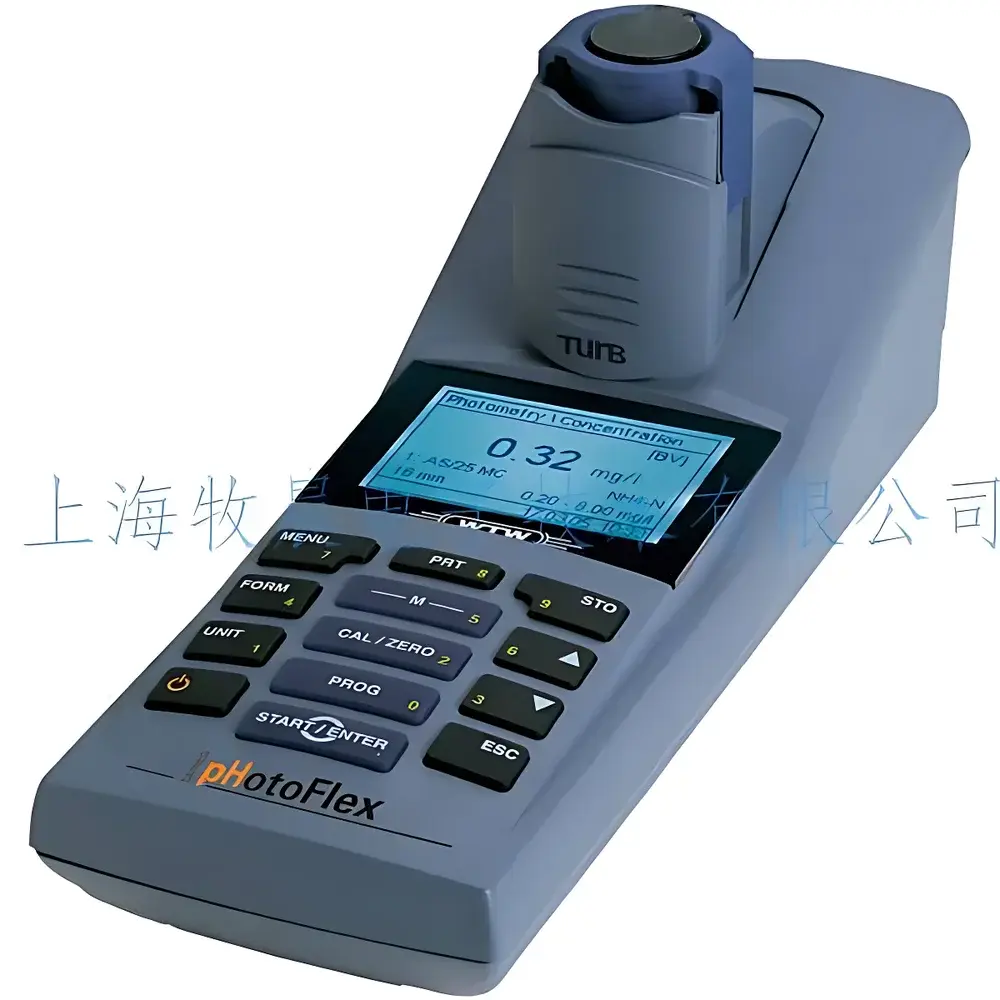
WTW pHotoFlex Turb Portable Spectrophotometer
| Brand | WTW |
|---|---|
| Origin | Germany |
| Model | pHotoFlex Turb |
| Wavelength Range | 436, 517, 557, 594, 610, 690, and 860 nm |
| Wavelength Repeatability | ≤ 0.005 nm |
| Wavelength Accuracy | ±2 nm |
| Photometric Range | −2.000 A to +2.000 A |
| pH Range | −2.00 to +16.00 |
| ORP Range | −1000 to +1000 mV |
| Turbidity Range | 0.01–1100 NTU/FNU |
| Temperature Range | −5 °C to +100 °C |
| Data Storage Capacity | 1000 measurements |
| Protection Rating | IP67 |
| Power Supply | 4 × AA alkaline batteries (≈5000 measurements) |
| Dimensions | 236 × 86 × 117 mm |
| Weight | 0.6 kg (without batteries) |
Overview
The WTW pHotoFlex Turb Portable Spectrophotometer is a field-deployable, multi-parameter analytical instrument engineered for precision photometric, turbidimetric, pH, redox (ORP), and temperature measurements in environmental monitoring, wastewater treatment, drinking water quality control, and industrial process verification. It operates on the principle of fixed-wavelength LED-based absorption photometry—utilizing discrete, thermally stable LEDs at seven precisely defined wavelengths (436, 517, 557, 594, 610, 690, and 860 nm)—to quantify analyte concentrations via Beer–Lambert law-compliant absorbance detection. Unlike scanning spectrophotometers, its LED architecture eliminates moving parts and optical drift, ensuring long-term stability and high reproducibility in variable ambient conditions. The integrated turbidity module complies with ISO 7027 (nephelometric principle at 860 nm), while the pH and ORP channels employ standardized glass electrode and platinum reference technologies with automatic temperature compensation (ATC). Designed for compliance-critical workflows, the instrument supports audit-ready data integrity through timestamped storage, calibration traceability, and GLP-aligned operational protocols.
Key Features
- Seven fixed-wavelength LED light sources—including mandatory 436 nm (for nitrate/nitrite), 517 nm (for copper), 557 nm (for iron), 594 nm (for phosphate), 610 nm (for ammonia), 690 nm (for COD), and 860 nm (for turbidity per ISO 7027)—enabling method-specific selectivity without spectral interference.
- Dual-cuvette compatibility: 16 mm and 28 mm round cells accommodate both standard reagent kits and high-volume field samples, with dedicated blank vials and label tapes included for traceable sample identification.
- Multi-parameter capability: Simultaneous photometric quantification (concentration, absorbance, transmittance), turbidity (NTU/FNU), pH (−2.00 to +16.00), ORP (−1000 to +1000 mV), and temperature (−5 °C to +100 °C) within a single handheld platform.
- 140+ pre-programmed photometric methods covering EPA, APHA, ISO, and DIN-compliant assays—including free/total chlorine, nitrate, phosphate, ammonium, COD, iron, manganese, and hardness—with full support for USP , ASTM D3159, and ISO 8467 validation requirements.
- User-definable calibration: Up to 100 custom calibration curves can be generated using third-party or in-house reagents; curve editing includes linear, quadratic, and polynomial regression options with R² validation reporting.
- Robust field operation: IP67-rated enclosure ensures dust-tightness and immersion resistance up to 1 m for 30 minutes; operating temperature range extends from −10 °C to +50 °C (storage: −20 °C to +60 °C).
Sample Compatibility & Compliance
The pHotoFlex Turb accepts aqueous samples across diverse matrices—including raw surface water, clarified effluent, potable distribution systems, cooling tower fluids, and process streams—with minimal pretreatment. Its turbidity sensor meets ISO 7027:2016 for formazin-equivalent NTU measurement and supports dual-unit output (NTU/FNU) for regulatory alignment with EU Drinking Water Directive (2020/2184) and US EPA Method 180.1. Photometric assays are validated against ISO 15704 (water quality – determination of orthophosphate), ISO 11905-1 (nitrogen compounds), and ASTM D1253 (residual chlorine). All pH and ORP measurements conform to IUPAC pH scale conventions and include automatic electrode diagnostics, slope verification, and offset checks prior to each reading. The device satisfies essential requirements of ISO/IEC 17025:2017 for testing laboratories and supports documentation necessary for FDA 21 CFR Part 11 readiness when paired with optional LSdata software and AK 540 B cable.
Software & Data Management
Data acquisition and management are facilitated via the LSdata PC software suite (included), which enables secure transfer of up to 1000 timestamped measurements—including absorbance spectra, calibration logs, electrode diagnostics, and user annotations—via RS232 or optional USB interface. LSdata provides export functionality in CSV, Excel, and PDF formats, supports batch report generation with customizable headers, and maintains full audit trails compliant with GLP and GMP record-keeping standards. Firmware updates are delivered free-of-charge over HTTPS through WTW’s secure portal, ensuring ongoing method library expansion and regulatory alignment. Optional LabStation portable lab interface (LS Flex/430) allows real-time synchronization with cloud-based LIMS platforms and automated QA/QC flagging based on user-defined tolerance thresholds.
Applications
- Drinking water utilities: Routine verification of disinfectant residuals (free/total chlorine, chloramine), turbidity compliance (<0.3 NTU), and nutrient limits (NO₃⁻, PO₄³⁻) per WHO Guidelines and EU Directive 98/83/EC.
- Wastewater treatment plants: Monitoring influent/effluent COD, BOD surrogate parameters, nitrification/denitrification endpoints, and sludge blanket clarity.
- Environmental field surveys: Rapid assessment of eutrophication indicators (phosphate, nitrate), heavy metals (Cu, Fe, Mn), and suspended solids in rivers, lakes, and estuaries.
- Industrial hygiene: Cooling water system analysis (corrosion inhibitors, biocide efficacy), boiler feedwater quality control, and food/beverage processing rinse validation.
- Educational and research labs: Teaching photometric fundamentals, method development, and inter-laboratory comparison studies under controlled or mobile deployment scenarios.
FAQ
Does the pHotoFlex Turb comply with ISO 7027 for turbidity measurement?
Yes—the 860 nm LED turbidity channel is calibrated and certified to ISO 7027:2016 using NIST-traceable formazin standards (0.02, 10, and 1000 NTU), supporting both NTU and FNU output modes.
Can I use non-WTW reagents with custom curve programming?
Yes—up to 100 user-defined calibration curves may be created using any commercially available or in-house reagents; the instrument accepts absorbance-concentration pairs with manual or auto-regression fitting.
What is the battery life under typical field use?
With four AA alkaline batteries, the device performs approximately 5000 photometric readings or 2000 pH/turbidity cycles; rechargeable NiMH or optional RB Flex/430 battery pack extends operational continuity.
Is firmware update functionality accessible offline?
No—internet connectivity is required to download and verify signed firmware packages from WTW’s secure update server; however, once downloaded, installation proceeds autonomously without live connection.
How does the instrument ensure measurement traceability for audit purposes?
Each stored result includes embedded metadata: date/time stamp, operator ID (if configured), calibration status, cuvette ID (via label tape), method version, and instrument serial number—fully exportable via LSdata for regulatory submission.




