
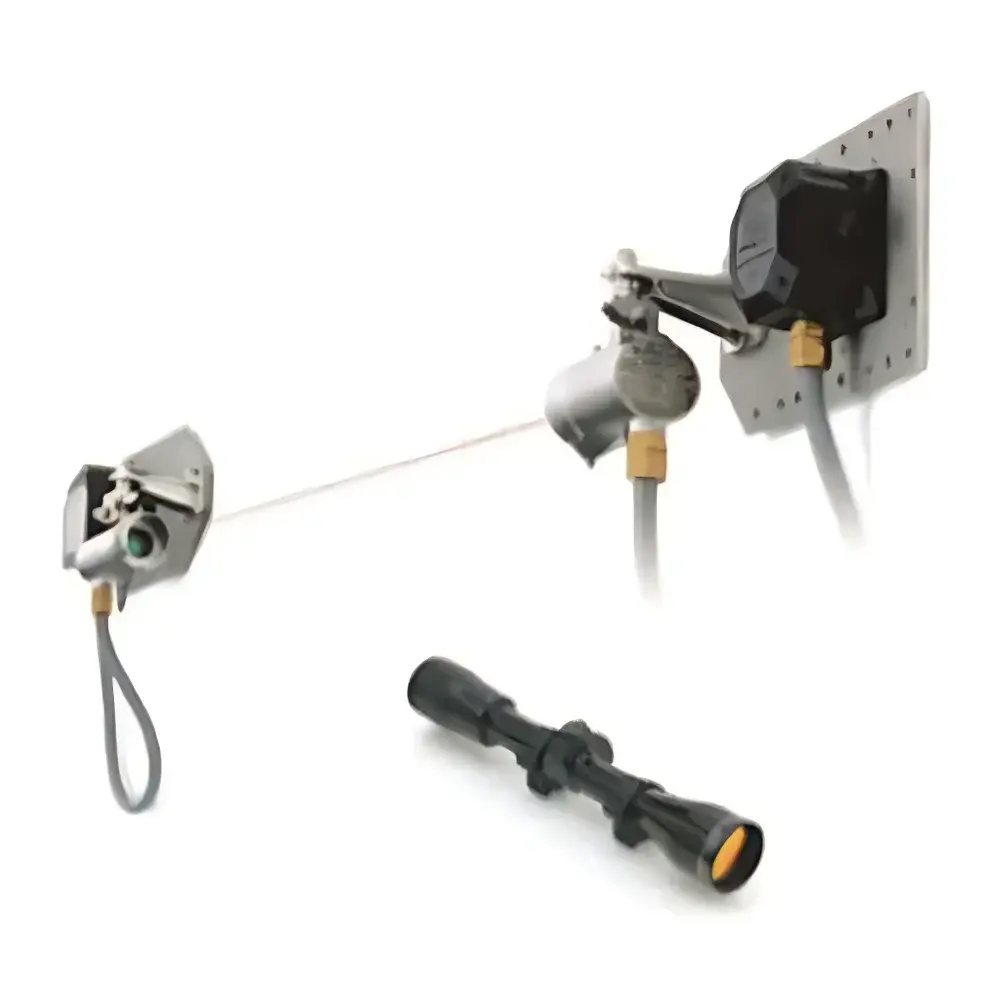
Honeywell Searchline Excel Open-Path Infrared Combustible Gas Detector
| Brand | Honeywell |
|---|---|
| Origin | USA |
| Model | Searchline Excel |
| Certification | ATEX, UL, CSA, IEC 61508 SIL 2 |
| Output | MODBUS RTU (RS-485), 4–20 mA analog |
| Detection Principle | Non-dispersive infrared (NDIR) absorption spectroscopy |
| Operating Range | Up to 120 m path length |
| Environmental Rating | IP66/IP67, -40 °C to +60 °C |
| Compliance | EN 61000-6-2/-6-4, IEC 61326-1, PED 2014/68/EU |
| Sensor Compatibility | Fully compatible with Honeywell XNX universal transmitter platform |
| Mounting | Three-point alignment base with mechanical lock |
Overview
The Honeywell Searchline Excel is an open-path infrared (OPIR) combustible gas detector engineered for continuous, real-time monitoring of hydrocarbon vapors across wide-area industrial perimeters and process zones. Unlike point-sensor gas detectors that sample air at discrete locations, the Searchline Excel employs non-dispersive infrared (NDIR) absorption spectroscopy across an unobstructed optical path—typically spanning 5 to 120 meters—between a dedicated infrared transmitter and receiver unit. This configuration enables volumetric detection of gas clouds along the entire beam path, delivering rapid response to fugitive emissions, pipeline leaks, or vapor releases before concentrations reach lower explosive limit (LEL) thresholds at ground level. Designed for operation in extreme ambient conditions—from Arctic offshore platforms to desert refineries—the system maintains high optical stability under wind loading, temperature cycling, and particulate exposure, supported by its IP66/IP67-rated housing and thermally compensated optics.
Key Features
- Optimized NDIR optical architecture with dual-wavelength reference compensation for enhanced immunity to window fouling, solar interference, and humidity drift
- Precision three-point mechanical alignment base enabling repeatable, tool-free optical setup with sub-milliradian beam stability
- Integrated high-magnification, shock-resistant sighting telescope with real-time signal strength feedback and visual alignment confirmation
- Field-configurable output options including MODBUS RTU (RS-485), 4–20 mA HART-compatible analog, and relay alarm contacts
- Fully interoperable with the Honeywell XNX universal transmitter platform—supporting seamless integration of toxic, oxygen, and combustible sensor modules on a single hardware backbone
- On-site commissioning via intuitive LED interface with backlit alphanumeric display showing real-time %LEL·m reading, status codes, and diagnostic flags
- Compliant with functional safety requirements per IEC 61508 SIL 2 for use in Safety Instrumented Systems (SIS) when deployed per certified architectures
Sample Compatibility & Compliance
The Searchline Excel detects combustible hydrocarbons—including methane, propane, butane, ethylene, and gasoline vapors—based on characteristic C–H bond absorption bands near 3.4 µm. It does not respond to diatomic gases (e.g., N₂, O₂), noble gases, or non-hydrocarbon compounds such as CO₂ or SO₂, ensuring high selectivity in complex process environments. The system meets international regulatory and certification standards required for hazardous area deployment: ATEX II 2G Ex d IIB+H₂ T4 Gb, UL/cUL Class I Division 1 Groups B, C, D; CSA Class I Zone 1 AEx d IIB+H₂ T4; and PED 2014/68/EU for pressure equipment interfacing. Electromagnetic compatibility conforms to EN 61000-6-2 (immunity) and EN 61000-6-4 (emissions), while environmental robustness aligns with IEC 60068-2 test protocols for shock, vibration, and thermal cycling.
Software & Data Management
Configuration, calibration verification, and diagnostics are performed locally using the integrated push-button interface and backlit display—or remotely via MODBUS RTU over standard RS-485 infrastructure. The detector supports Modbus function codes 03 (read holding registers) and 06 (preset single register), enabling integration into DCS, SCADA, and SIS platforms without proprietary gateways. All configuration changes, alarm events, and self-test logs are timestamped and stored internally for traceability. While no embedded data logging is provided, external systems may poll diagnostic registers—including optical path integrity, signal-to-noise ratio, and internal temperature—at user-defined intervals. For audit readiness in regulated industries, the XNX platform (when used as host) optionally supports FDA 21 CFR Part 11-compliant electronic records and signatures when paired with validated software clients.
Applications
The Searchline Excel is deployed where wide-area coverage, rapid leak detection, and operational resilience are critical: offshore floating production storage and offloading (FPSO) vessels; perimeter monitoring of LNG terminals and refinery boundaries; linear surveillance of buried or aboveground hydrocarbon pipelines; flare stack and vent monitoring; and safety zoning around compressor stations and metering skids. Its open-path architecture eliminates blind spots inherent in point-sensor grids, reduces total cost of ownership through fewer required units per square kilometer, and minimizes false alarms caused by localized transient spikes. Typical end users include HSE managers in oil & gas operators, instrumentation engineers in EPC contractors, and maintenance supervisors responsible for SIL verification in process safety management (PSM) programs aligned with OSHA 1910.119 and CCPS guidelines.
FAQ
How does open-path detection differ from point sampling in terms of coverage and response time?
Open-path detection monitors gas concentration integrated over the full optical path (e.g., 50 m), yielding near-instantaneous detection of any cloud intersecting the beam—typically within 1–3 seconds—whereas point sensors require diffusion or aspiration to reach the sensing element, resulting in delays of 10–60 seconds depending on flow rate and distance.
Can the Searchline Excel be used in SIL 2 safety loops?
Yes—when installed, configured, and maintained per Honeywell’s certified safety manual (document number SLX-SIL2-IM), the Searchline Excel achieves IEC 61508 SIL 2 capability for burner management and fire & gas shutdown functions.
Is field alignment dependent on software tools?
No—the mechanical three-point alignment base and integrated high-magnification telescope enable physical alignment to within ±0.1° without requiring external software or laser alignment aids. Final fine-tuning is unnecessary under normal installation conditions.
What maintenance is required to ensure long-term optical accuracy?
Biannual visual inspection of transmitter/receiver windows for contamination, annual verification of alignment stability using the built-in signal strength indicator, and periodic functional testing per IEC 61511 requirements are recommended. No routine optical recalibration is needed.
Does the system support integration with third-party gas detection software platforms?
Yes—standard MODBUS RTU implementation ensures native compatibility with major industrial automation systems including Siemens Desigo, Schneider EcoStruxure, Emerson DeltaV, and Honeywell Experion PKS without custom drivers or middleware.







