
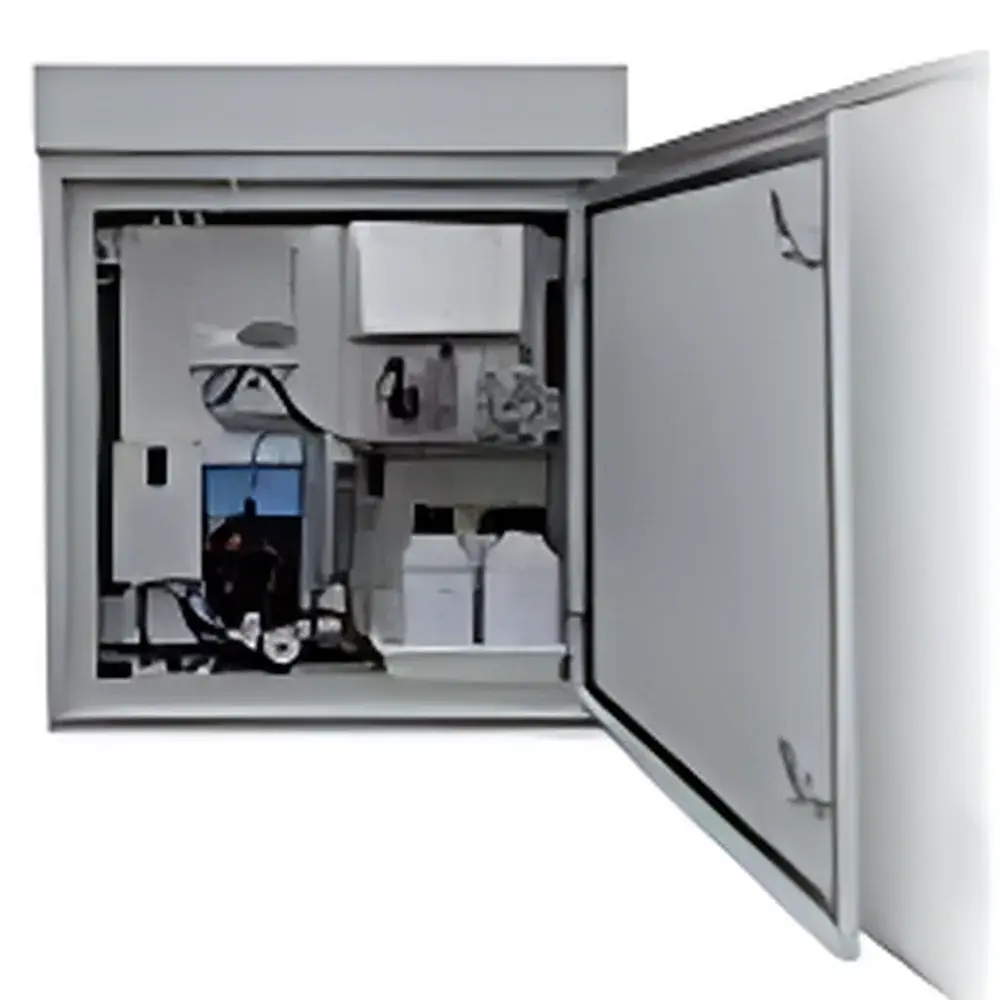
WTW P 700IQ Online Phosphate Analyzer (Vanadomolybdate Photometric Method)
| Brand | WTW |
|---|---|
| Origin | Germany |
| Model | P 700IQ |
| Measurement Principle | Vanadomolybdate Photometric Colorimetry (PO₄–P) |
| Range 1 | 0.05–15.00 mg/L PO₄–P |
| Range 2 | 1–50 mg/L PO₄–P |
| Resolution | 0.05 mg/L (Range 1), 1 mg/L (Range 2) |
| Accuracy | ±2% or ±0.05 mg/L (Range 1), ±2% or ±1 mg/L (Range 2) |
| t₉₀ Response Time | <5 min |
| Minimum Measurement Interval | Adjustable to <5 min |
| Sample Temperature | 4–45 °C |
| pH Range | 5–9 |
| Operating Temperature | –20–40 °C |
| Storage Temperature | –20–50 °C |
| Reagent Consumption | 2500 mL per 8 months (Range 1), 2500 mL per 4 months (Range 2), 1000 mL cleaning solution per 4 months |
| Power Supply | 115/230 V AC |
| Dimensions | 678 × 780 × 395 mm |
| Weight | ~30 kg (excl. reagents) |
| Outputs | Analog (4–20 mA), IQ SENSOR NET 2020XT interface |
| Certifications | CE, cETLus |
| Enclosure Rating | IP65 (integrated cabinet) |
Overview
The WTW P 700IQ Online Phosphate Analyzer is a robust, field-deployable photometric instrument engineered for continuous, unattended measurement of orthophosphate (expressed as PO₄–P) in wastewater treatment processes. It implements the standardized vanadomolybdate colorimetric method—widely recognized in environmental compliance protocols including ISO 6878 and DIN 38405-21—to quantify soluble reactive phosphorus in aqueous matrices. Unlike ion-selective electrode (ISE)-based systems—which are unsuitable for low-concentration phosphate monitoring in complex, particulate-laden wastewater—the P 700IQ delivers high specificity and long-term stability through optical detection of the yellow phosphovanadomolybdate complex at 400 nm. Its integrated cabinet design houses filtration, pumping, reagent dosing, reaction cuvette, and photometer in a single IP65-rated enclosure, enabling deployment in outdoor environments across temperature extremes (–20 to +40 °C). The analyzer operates under ambient pressure, requires no carrier gas or high-pressure fluidics, and is optimized for integration into existing SCADA or IQ SENSOR NET 2020XT-based monitoring networks.
Key Features
- Integrated sample conditioning: Built-in self-cleaning filter pump and automated air bubble removal ensure representative, particle-free sampling without external pre-treatment units.
- Dual-range measurement capability: Switchable ranges (0.05–15.00 mg/L and 1–50 mg/L PO₄–P) support both effluent compliance monitoring and influent/process stream analysis with appropriate resolution and accuracy.
- Low reagent consumption: Optimized fluidic architecture reduces reagent usage to 2500 mL per 8 months (low range) or 4 months (high range), minimizing operational overhead and hazardous waste generation.
- Automated calibration and diagnostics: Scheduled zero/span calibration using certified standards; real-time photometer LED intensity monitoring and cuvette fouling detection via reference channel compensation.
- Intelligent connectivity: Native compatibility with WTW’s IQ SENSOR NET 2020XT platform enables remote configuration, firmware updates, data logging, alarm management, and multi-parameter system expansion (e.g., simultaneous integration with pH, conductivity, or nitrate sensors).
- Regulatory-ready operation: Supports audit-trail-capable data export compliant with EU Water Framework Directive reporting requirements and aligns with QA/QC practices referenced in ISO/IEC 17025-accredited laboratories.
Sample Compatibility & Compliance
The P 700IQ is validated for use with municipal and industrial wastewater streams exhibiting turbidity ≤ 100 NTU, suspended solids ≤ 200 mg/L, and chloride concentrations up to 5000 mg/L. It maintains measurement integrity within pH 5–9 and tolerates intermittent exposure to hydrogen sulfide and organic interferents typical of anaerobic zones—provided sample filtration remains effective. All wetted components contact-resistant fluoropolymer (e.g., PTFE, FEP) and borosilicate glass, ensuring chemical compatibility with acidic molybdate/vanadate reagents and sodium hydroxide conditioning solutions. The analyzer conforms to EN 61326-1 (EMC), EN 61000-6-2/-6-3, and carries CE and cETLus marks for safe operation in North American and European industrial settings. It supports GLP-aligned recordkeeping when paired with IQ SENSOR NET software configured for 21 CFR Part 11-compliant electronic signatures and change control logs.
Software & Data Management
Data acquisition and instrument supervision are managed via WTW’s IQ SENSOR NET software suite (v3.0+), which provides role-based access control, configurable alarm thresholds (e.g., deviation >5% from historical median), and automatic report generation in PDF or CSV format. Raw absorbance values, temperature-compensated concentration outputs, calibration timestamps, and diagnostic flags (e.g., “low LED intensity”, “cuvette contamination warning”) are time-stamped and stored locally on the 2020XT controller with 32 GB internal memory—retaining ≥12 months of 5-minute interval data. Secure remote access is enabled via TLS 1.2-encrypted web interface or OPC UA server integration. Audit trails include operator ID, parameter modification history, and firmware version metadata—supporting regulatory inspections under ISO 14001 or EPA NPDES permit conditions.
Applications
- Real-time monitoring of phosphate removal efficiency across biological (e.g., A²/O, UCT) and chemical (e.g., FeCl₃, Al₂(SO₄)₃ dosing) tertiary treatment stages.
- Feedforward control of coagulant dosing systems based on dynamic orthophosphate load estimation.
- Compliance verification for discharge permits requiring reporting of PO₄–P at ≤0.5 mg/L (EU Urban Wastewater Treatment Directive Annex I) or ≤0.1 mg/L (stringent local ordinances).
- Process optimization in nutrient recovery facilities targeting struvite crystallization, where precise orthophosphate setpoints govern crystal nucleation kinetics.
- Long-term trend analysis of phosphorus loading in combined sewer overflows (CSOs) during wet-weather events.
FAQ
Does the P 700IQ use an ion-selective electrode (ISE) for phosphate detection?
No. The P 700IQ employs photometric vanadomolybdate colorimetry—not ISE technology—as ISEs exhibit poor selectivity, drift, and interference from fluoride, arsenate, and silicate ions in wastewater. This method ensures trace-level accuracy and regulatory acceptance.
Can the analyzer operate without a central IQ SENSOR NET controller?
Yes. It provides isolated 4–20 mA analog output for direct connection to PLCs or DCS systems. However, full diagnostic visibility, remote calibration, and data historization require integration with an IQ SENSOR NET 2020XT node.
What maintenance intervals are recommended for routine operation?
Filter cartridge replacement every 3 months (or per clogging alert), reagent refills per consumption schedule, and annual photometer verification using NIST-traceable absorbance standards.
Is the system suitable for seawater or brackish influent applications?
Not without pretreatment. High chloride (>5000 mg/L) and salinity induce matrix effects in the vanadomolybdate reaction; dilution or desalination is required prior to analysis.
How is temperature compensation applied during measurement?
An integrated Pt100 sensor continuously monitors reaction cuvette temperature; compensation coefficients derived from DIN 38405-21 are applied in real time to correct for thermal effects on color development kinetics and photodiode responsivity.
Related Products







