
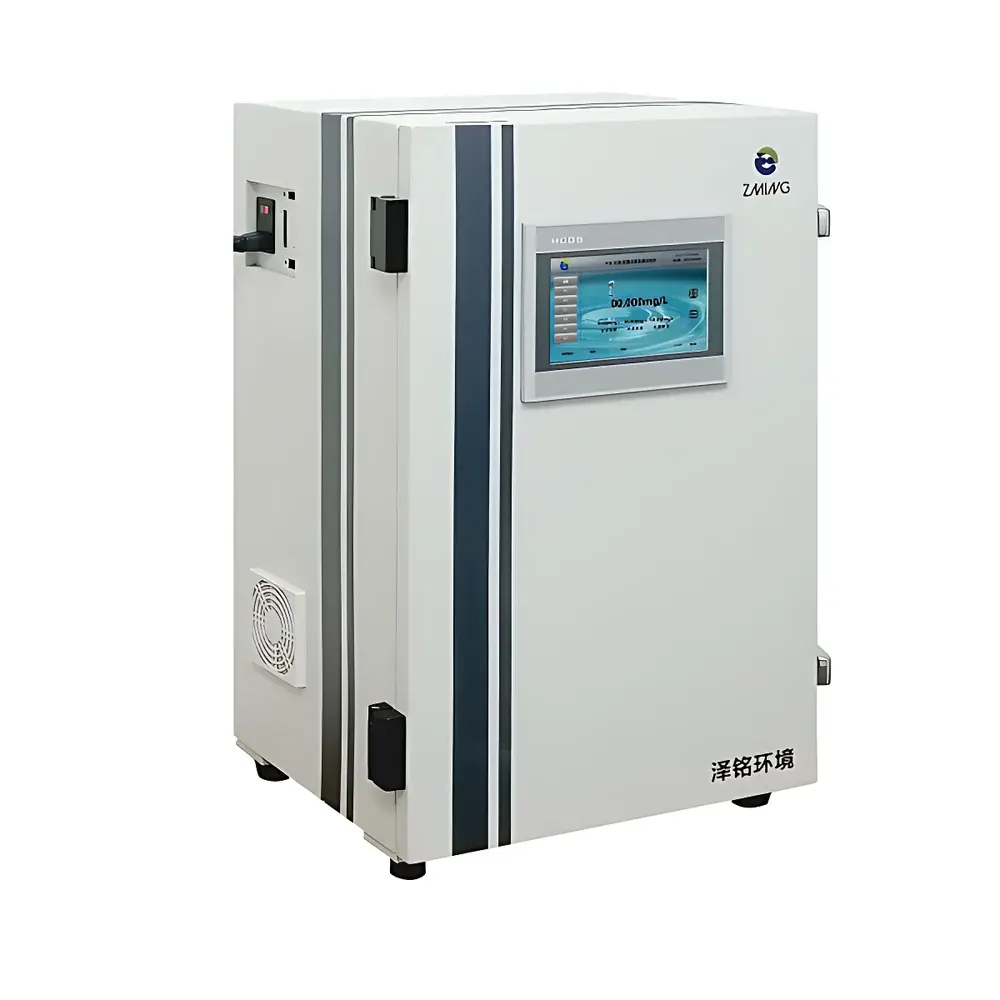
Zming Environmental HQ-3501 Online Permanganate Index (CODMn) Analyzer
| Brand | Zming Environmental Technology Co., Ltd. |
|---|---|
| Origin | Jiangsu, China |
| Manufacturer Type | Authorized Distributor |
| Country of Origin | China |
| Model | HQ-3501 |
| Measurement Principle | Acidic Potassium Permanganate Oxidation with ORP Endpoint Detection |
| Instrument Type | Online Analyzer |
| Range | 0–10 mg/L and 0–20 mg/L (standard), extendable up to 160 mg/L (user-configurable) |
| Resolution | 0.01 mg/L |
Overview
The Zming Environmental HQ-3501 Online Permanganate Index (CODMn) Analyzer is an automated, continuous-monitoring instrument engineered for precise determination of the permanganate index—a critical surrogate parameter for organic pollution load in freshwater systems. It implements the standardized acidic potassium permanganate oxidation method (equivalent to ISO 8467:1993 and GB/T 11892–1989), where sample organic matter is oxidized under controlled acidic conditions at elevated temperature, followed by potentiometric endpoint detection via redox potential (ORP) monitoring. Unlike spectrophotometric or amperometric alternatives, this ORP-based titration approach inherently compensates for optical interferences such as turbidity, color, and suspended solids—making it uniquely robust for real-world surface water matrices including eutrophic lakes, tidal rivers, and intake reservoirs. The system operates unattended for extended periods, supporting regulatory compliance monitoring, early-warning systems, and long-term trend analysis in ambient water quality networks.
Key Features
- ORP-guided titration protocol ensures high specificity and eliminates interference from chromaticity and particulate scattering—critical for non-filtered, field-collected samples.
- Capacitive liquid metering technology delivers sub-microliter precision in reagent and sample dispensing, achieving <±1.5% RSD for repeated measurements across the full dynamic range.
- Digitally regulated heating module maintains reaction bath temperature within ±0.3 °C of setpoint (typically 100 °C), ensuring strict adherence to kinetic requirements defined in national and international standard methods.
- User-configurable measurement range (0–10 mg/L, 0–20 mg/L, or extended up to 160 mg/L) enables adaptability to diverse monitoring scenarios—from oligotrophic source waters to heavily impacted urban effluents.
- Modular design with sealed reagent cartridges and self-cleaning fluidic pathways minimizes maintenance frequency; typical service intervals exceed 30 days under continuous operation.
- Integrated QC routines include blank verification, multi-point calibration validation, spike recovery checks, and drift monitoring—all logged with timestamp and operator ID for audit readiness.
Sample Compatibility & Compliance
The HQ-3501 accepts raw, unfiltered surface water samples with turbidity up to 100 NTU and total suspended solids ≤ 150 mg/L. It complies with Chinese National Standard GB/T 11892–1989 and aligns methodologically with ISO 8467:1993. While not certified to EPA Method 410.2 or ASTM D1253, its analytical principle and performance characteristics are recognized by provincial environmental monitoring centers for routine surveillance of Class I–III surface waters per China’s “Surface Water Environmental Quality Standards” (GB 3838–2002). All measurement records support GLP-compliant data integrity through embedded electronic signatures, immutable audit trails, and configurable retention policies.
Software & Data Management
The embedded Linux-based controller runs Zming’s proprietary AquaLogic™ firmware, providing local touchscreen operation, real-time chromatogram visualization of ORP curves, and automatic endpoint recognition with manual override capability. Data export supports Modbus TCP, RS-485 (RTU/ASCII), and optional 4–20 mA analog output. Remote access is enabled via secure HTTPS interface with role-based authentication (admin/operator/viewer). All raw sensor outputs, calibration logs, QC events, and maintenance alerts are stored in SQLite databases compliant with 21 CFR Part 11 requirements when deployed with optional digital signature modules. Export formats include CSV, PDF reports, and XML for integration into SCADA or national water quality information platforms (e.g., China’s National Surface Water Monitoring System).
Applications
- Unmanned, long-term monitoring of drinking water source reservoirs and intakes
- Regulatory compliance tracking at wastewater discharge points (industrial and municipal)
- Trend analysis in urban river restoration projects and constructed wetlands
- Early detection of organic loading shifts in estuarine mixing zones and river mouths
- Performance evaluation of water diversion corridors (e.g., South-to-North Water Transfer Project monitoring sections)
- Supporting Total Maximum Daily Load (TMDL)-related assessments in watershed management plans
FAQ
What standards does the HQ-3501 comply with?
It conforms to GB/T 11892–1989 and is functionally aligned with ISO 8467:1993. Its methodology satisfies technical requirements for permanganate index determination in China’s surface water quality monitoring programs.
Can the instrument measure samples with high turbidity or color?
Yes—the ORP endpoint detection method is immune to optical interferences, enabling reliable quantification in colored or turbid waters without pre-filtration.
Is remote diagnostics and software update supported?
Yes, firmware updates and diagnostic logs can be retrieved remotely over secure HTTP(S); configuration changes require authenticated access.
How often does the system require calibration or maintenance?
Initial calibration is performed during commissioning; subsequent verification is recommended every 7 days. Reagent cartridge replacement occurs every 30 days under typical usage (1 measurement/hour), and no routine mechanical servicing is required within the first 12 months.
Does the analyzer support integration with existing SCADA or LIMS platforms?
Yes—via Modbus TCP, RS-485, or optional OPC UA gateway; structured data export enables direct ingestion into laboratory information management systems and central environmental data hubs.
Related Products







