
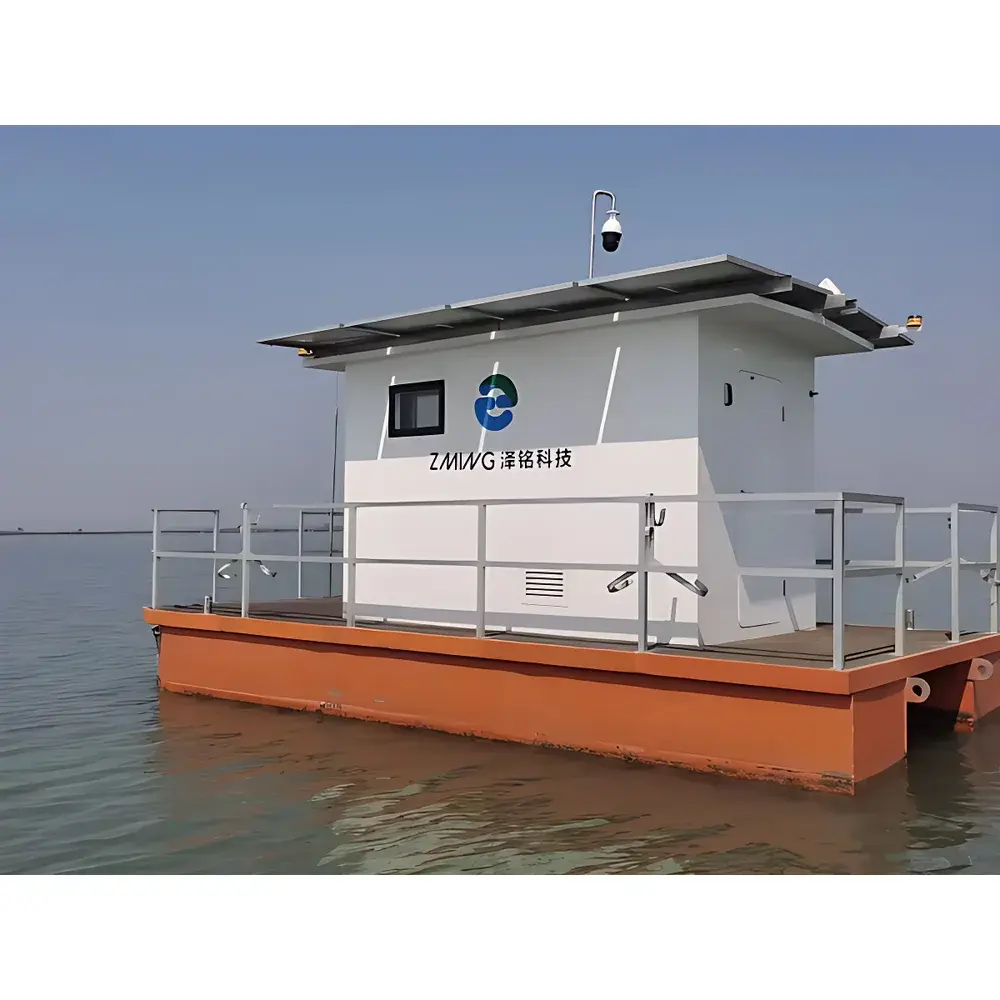
Zming Environmental HQ-FC 600 Floating Platform-Based Online Water Quality Monitoring System
| Brand | Zming Environmental Technology Co., Ltd. |
|---|---|
| Origin | Jiangsu, China |
| Manufacturer Type | Authorized Distributor |
| Country of Origin | China |
| Model | HQ-FC 600 |
| Pricing | Available Upon Request |
Overview
The Zming Environmental HQ-FC 600 is a fully integrated, floating-platform-based online water quality monitoring system engineered for long-term, unattended deployment in open-water environments—including drinking water source reservoirs, lakes, rivers, and irrigation canals. Unlike fixed-station or buoy-mounted alternatives, the HQ-FC 600 utilizes a stabilized pontoon platform with dynamic ballast control to maintain sensor immersion depth and measurement consistency under variable wind, wave, and tidal conditions. Its core architecture combines multi-parameter electrochemical, optical, and spectrophotometric sensors with an embedded industrial-grade data acquisition unit (DAU) compliant with IEC 61131-3 logic standards. All measurements adhere to internationally recognized analytical principles: pH and conductivity via glass electrode and four-electrode conductivity cells; dissolved oxygen via Clark-type membrane electrodes; turbidity via 90° scattered light detection at 860 nm; chlorophyll-a and phycocyanin via dual-wavelength excitation fluorescence (470/520 nm and 590/650 nm); and nutrient parameters (ammonia-nitrogen, total nitrogen, total phosphorus, permanganate index) via on-board wet-chemistry analyzers employing ISO 15681-1 (flow injection analysis), ISO 7890-3 (Nesslerization), and ISO 11905-1 (persulfate digestion) methodologies.
Key Features
- Fully autonomous floating platform with corrosion-resistant marine-grade aluminum alloy hull and adjustable draft stabilization—enabling consistent sensor positioning across ±1.5 m water level fluctuations.
- Modular sensor architecture: Standardized DIN-rail mounting supports hot-swappable probe modules for five conventional parameters (temperature, pH, conductivity, DO, turbidity) plus optional high-sensitivity nutrient and algal pigment analyzers.
- Hybrid renewable power system: Integrated 120 W monocrystalline solar panel array and 300 W vertical-axis wind turbine, coupled with dual 100 Ah deep-cycle LiFePO₄ battery banks—designed for >30 days autonomy during consecutive low-light, low-wind conditions.
- Real-time bidirectional telemetry: LTE-M (Cat-M1) + NB-IoT fallback communication with TLS 1.2 encrypted data transmission; supports remote firmware updates, parameter reconfiguration, and scheduled calibration via secure HTTPS API endpoints.
- Onboard QC capability: Automated zero/span verification using certified reference solutions; drift compensation algorithms aligned with ASTM D511, D1253, and ISO 5815-1 traceability requirements.
Sample Compatibility & Compliance
The HQ-FC 600 is validated for continuous operation in freshwater matrices with salinity ≤ 5 ppt, suspended solids < 200 mg/L, and ambient temperatures ranging from 0 °C to 45 °C. Sensor housings meet IP68 ingress protection rating, and all wetted materials comply with US EPA Method 1600-compliant leach testing protocols. The system’s data integrity framework satisfies GLP and GMP-aligned audit trail requirements—including immutable timestamping, user authentication logs, and electronic signature support per FDA 21 CFR Part 11 Annex 11 guidelines. Calibration records, QC results, and raw sensor outputs are stored locally for ≥18 months and synchronized to cloud repositories meeting ISO/IEC 27001-certified infrastructure standards.
Software & Data Management
The HQ-FC 600 operates with Zming’s proprietary AquaLink™ SCADA software suite, deployed as a web-native application accessible via role-based dashboards (administrator, operator, QA auditor). Data ingestion follows OPC UA 1.04 specification, enabling seamless integration into third-party environmental information systems (EIS), SCADA platforms, or GIS-based decision support tools. All time-series datasets are exported in CF-1.7-compliant NetCDF format, with metadata structured according to ISO 19115-2:2019 geospatial standards. Automated anomaly detection employs statistical process control (SPC) charts (X̄-R and CUSUM) with configurable alarm thresholds, while raw spectral and electrochemical waveforms are retained for retrospective method validation.
Applications
- Drinking water source protection: Early-warning detection of eutrophication events, cyanobacterial blooms, and accidental chemical intrusion in reservoirs and intakes.
- River basin management: High-frequency tracking of nutrient loading dynamics, sediment resuspension impacts, and diurnal DO cycling across longitudinal transects.
- Ecological monitoring: Long-term assessment of phytoplankton community shifts using chlorophyll-a/phycocyanin ratio trends correlated with meteorological and hydrological drivers.
- Regulatory compliance reporting: Automated generation of monthly summary reports aligned with China’s HJ/T 91-2019 and EU WFD Annex V reporting templates.
- Research-grade field validation: Reference platform for calibrating satellite-derived water quality products (e.g., Sentinel-3 OLCI L2W) through co-located in situ ground truthing.
FAQ
What is the typical deployment duration without maintenance?
With routine quarterly sensor cleaning and annual electrolyte replacement, the HQ-FC 600 achieves ≥12 months of uninterrupted operation under standard inland water conditions.
Can the system be integrated with existing municipal SCADA networks?
Yes—the DAU provides Modbus TCP, DNP3, and MQTT v3.1.1 protocol stacks with configurable polling intervals and data mapping tables for legacy infrastructure compatibility.
How is sensor fouling mitigated in algae-rich waters?
Each optical and electrochemical probe incorporates ultrasonic anti-fouling transducers operating at 40 kHz, supplemented by programmable wiper mechanisms for turbidity and chlorophyll sensors.
Is remote calibration traceable to national metrology institutes?
All onboard calibrations reference NIST-traceable CRM solutions (e.g., BAM pH 4.01/7.00/10.01, YSI conductivity standards), with certificate-of-analysis metadata embedded in each calibration event log.
What cybersecurity measures are implemented?
The system enforces hardware-enforced secure boot, AES-256 encrypted local storage, certificate-based mutual TLS authentication, and automatic security patch deployment via signed OTA firmware packages.







